CoreWeave’s revenue story looks almost unreal at first glance: $229 million in 2023, $1.915 billion in 2024 and $5.131 billion in 2025. But the same financial statements show why an AI cloud company should not be mistaken for ordinary asset-light software. CoreWeave lost $1.167 billion in 2025.1
CoreWeave reported revenue of $229 million in 2023, $1.915 billion in 2024 and $5.131 billion in 2025. It still recorded a $1.167 billion net loss in 2025, including $1.229 billion of net interest expense. Its business requires large investments in data-center infrastructure, so rapid revenue growth and heavy financing needs can coexist.1, 2
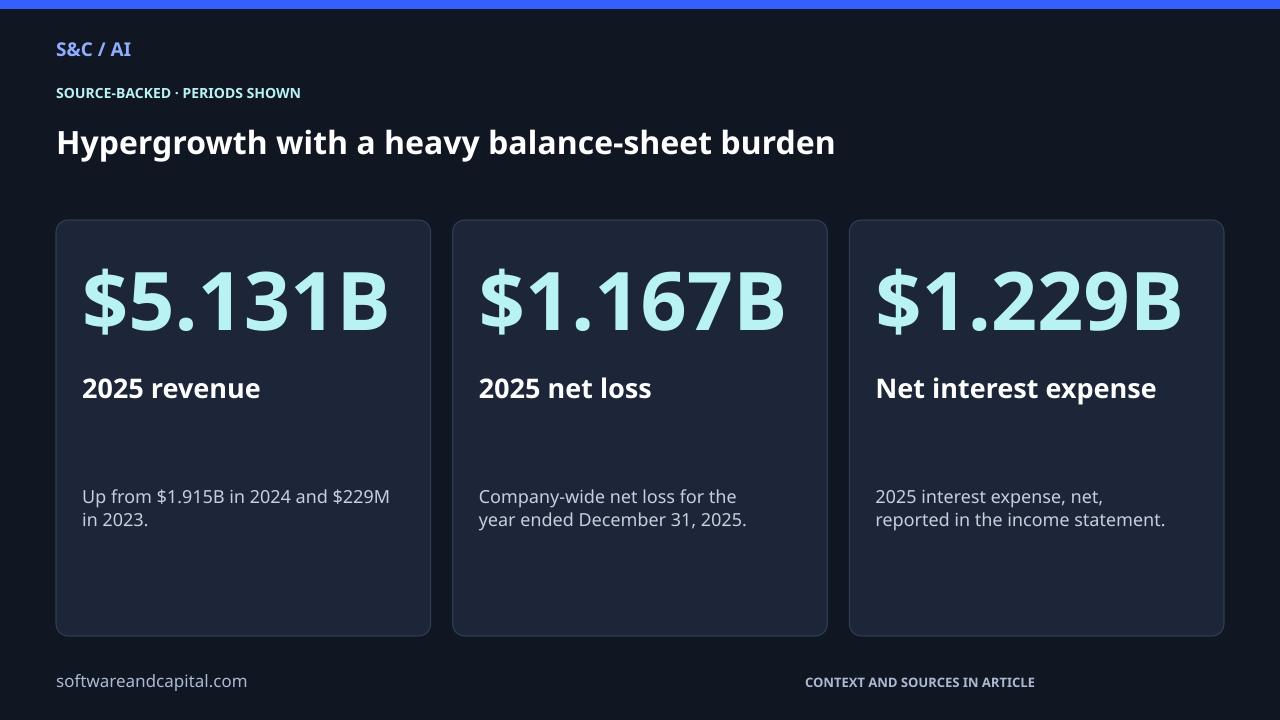
Hypergrowth with a heavy balance-sheet burden
Revenue rose about 168% from 2024 to 2025. That growth is real, but so is the cost of supplying the capacity. CoreWeave rents cloud infrastructure built around accelerated computing, which means growth requires data-center capacity, servers, networking and the financing arrangements used to acquire or lease them.1
The income statement shows two different pressures
| Line | 2025 | Why it matters |
|---|---|---|
| Revenue | $5.131B | Shows the scale of customer demand recognized during the year. |
| Technology and infrastructure | $2.929B | A major operating-cost line tied to supplying the service. |
| Operating loss | $46M | Revenue nearly covered operating expenses before financing and other items. |
| Net interest expense | $1.229B | Shows how financing costs can dominate the path from operations to net income. |
| Net loss | $1.167B | The final annual loss after interest and other items. |
The company was close to break-even at the operating-income line in 2025, with a $46 million operating loss. Then financing costs mattered enormously. Net interest expense of $1.229 billion was far larger than the operating loss. That does not mean interest is the only challenge, but it shows why the capital structure belongs in the story.1
Growth requires infrastructure before customers can use it
CoreWeave describes its platform as purpose-built cloud infrastructure for accelerated computing. It signs leases, purchases equipment and invests in data-center capacity to deliver that service. The 2025 cash-flow statement shows $10.3 billion of net cash used in investing activities, much of it related to property, equipment and other infrastructure investment.1
That $10.3 billion should not be relabeled “GPU spending.” Investing cash flow includes more than one type of asset and transaction. The useful point is broader: the company had to commit very large sums to build capacity while revenue was still scaling.
Backlog makes the future visible—but not guaranteed
CoreWeave’s 2025 earnings release reported $66.8 billion of year-end revenue backlog. Backlog can make future demand more visible, but it is not the same thing as recognized revenue or cash already collected. Contracts can include timing, performance and customer-concentration risks that matter before backlog becomes revenue.2, 1
This is the mirror image of Nvidia’s data-center business. Nvidia sells much of the compute and networking infrastructure. CoreWeave buys, leases and operates infrastructure to sell cloud capacity. One company can benefit from the other’s spending without sharing the same economics.
The AI-cloud question is not only demand
Four things have to work together
- Demand: customers must keep buying large amounts of accelerated compute.
- Capacity: the provider needs data-center space and equipment ready when customers need it.
- Financing: the cost and structure of funding cannot overwhelm the economics of the service.
- Utilization: expensive infrastructure needs enough productive customer use to justify what was spent.
CoreWeave’s trajectory is striking because it contains both sides of the AI infrastructure boom. Customers are spending enough to create multi-billion-dollar revenue growth. Supplying that demand can also require billions of dollars of assets and financing before the economics settle into a mature pattern.
The result is not a contradiction. A company can be growing extremely fast and still lose money because the operating model, financing burden and timing of investment differ from a classic software subscription. CoreWeave makes that distinction unusually visible.
Sources and methodology
Sources checked September 22, 2026. Dates and periods for individual figures are stated beside them.
- CoreWeave: 2025 Form 10-K ↗Accessed 2026-09-22
- CoreWeave: 2025 earnings release, SEC-filed exhibit ↗Accessed 2026-09-22
Scope and assumptions
All financial figures are historical through December 31, 2025 and do not imply future growth or profitability.
Investing cash flow is not treated as GPU-only spending, and backlog is not treated as recognized revenue.