AI clusters are getting large enough that the network between accelerators can become as important as the accelerators themselves. CScale has raised $145 million to build optical scale-up links designed for that problem, including what happens when an optical component fails inside a tightly coupled cluster.1, 2
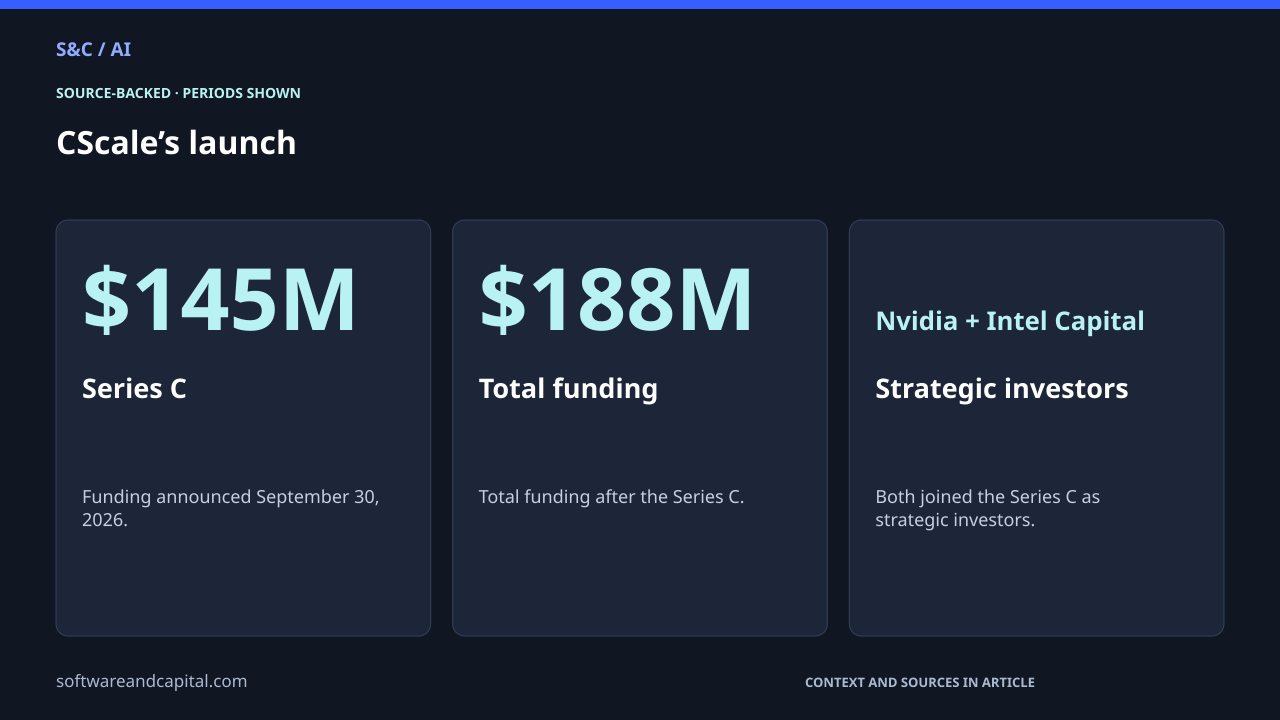
CScale emerged from stealth with a $145 million Series C, bringing total funding to $188 million. The company is developing optical scale-up interconnects intended to connect accelerators across many racks while containing optical failures. The financing is verified, but CScale has disclosed little public performance data, so the article focuses on the system problem rather than claiming product superiority.1, 2
CScale’s launch
Scale-up networking is the fabric inside one large AI machine
Scale-up networking links accelerators so they can work on one tightly coordinated job. CScale says future domains will span thousands of accelerators across dozens of racks, which raises bandwidth, latency and reliability requirements well beyond a single server.1
| Failure point | What happens in a small system | What changes at large scale |
|---|---|---|
| One optical link | A component can be replaced | Failures occur more often somewhere in the fleet |
| Network path | A local slowdown may be tolerable | A tightly coupled training job can stall |
| Repair | Serviceability may be enough | Continuity matters while hardware is being repaired |
CScale is selling fault containment as much as bandwidth
The company says its architecture is designed to contain optical failures without interrupting compute. That is a different promise from simply increasing raw bandwidth. In a very large cluster, reliability becomes part of the economics because idle accelerators are expensive.1
The financing is clearer than the technical benchmark
CScale has not published enough public performance data to compare its interconnect directly with established alternatives. The funding and investor list are concrete. Claims about latency, bandwidth and fault behavior still need product-level evidence.2
What to watch next
- Named customers or production deployments.
- Public bandwidth and latency specifications.
- Failure-recovery behavior under real cluster loads.
- How the product fits with open or proprietary scale-up standards.
The broader lesson is simple: the AI infrastructure race is no longer just about securing more accelerators. Once the cluster becomes one enormous machine, the connections between those accelerators become part of the compute product too.
Sources and methodology
Sources checked October 1, 2026. Dates and periods for individual figures are stated beside them.
- CScale press release via HPCwire ↗Accessed 2026-10-01
- Data Center Dynamics: CScale exits stealth ↗Accessed 2026-10-01
Scope and assumptions
CScale has disclosed little public performance or customer data.
Funding and strategic investors do not establish that its architecture will outperform competing scale-up interconnects.
Continue reading
A $100M Startup Is Betting the Next AI Bottleneck Is the Network →