AI infrastructure has spent years obsessing over the accelerator. Delos Data is betting that the expensive chip increasingly waits on something less glamorous: the network moving data between compute, memory and storage.1
Delos Data says it raised more than $100 million to build networking infrastructure for AI inference across GPUs, CPUs, memory and storage. Its central claim is that data movement becomes a bottleneck as agentic workloads span more hardware. Delos’s 10x performance and efficiency figures are company claims, not independent benchmarks.1, 2
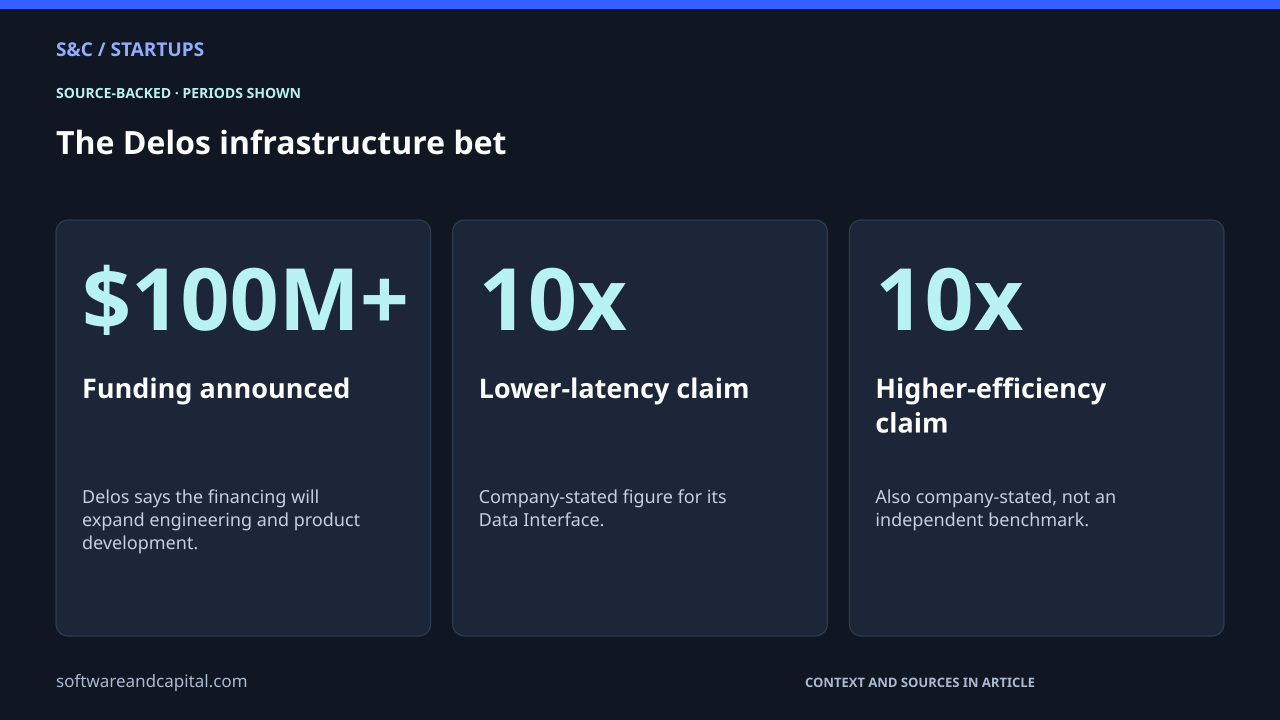
The Delos infrastructure bet
More compute does not help if the compute is waiting
Large inference systems move data across GPUs, other accelerators, CPUs, memory and storage. Delos argues that persistent agentic workloads make those transfers more demanding because the job spans more components and has to continue through failures.1, 2
The general mechanism is straightforward even without accepting every Delos benchmark: a processor can only work on data it can reach. If communication takes too long or a failure stalls the path, expensive compute can sit idle.
Delos wants to own the interface between the pieces
The company’s Nonstop AI portfolio includes a data interface, software, servers, clusters and a reference architecture. It says the interface can be delivered as an I/O chiplet, near-packaged optics or a card, with the goal of connecting different classes of endpoints inside one data-movement domain.2
That is a different layer from buying more GPUs or building another data center. Delos is trying to make the connective tissue itself a product.
The 10x numbers need a large asterisk
Delos says its Data Interface delivers or targets large improvements in latency, efficiency, resiliency and scale. Those figures come from the company. They should not be treated as independent proof that the product outperforms every alternative network or that customers will realize the same gains in production.1, 2
The funding is firmer evidence than the benchmark claims: investors have committed more than $100 million to the thesis. It shows capital moving toward the networking layer, not that Delos has already won it.1
AI infrastructure is becoming a system problem
Our grid-constraint analysis covers one hard limit outside the GPU: electricity. Networking is another. As clusters become larger and more heterogeneous, performance depends on how the system behaves between components as much as on the peak capability of one component.
Four layers to watch in an AI cluster
- Compute: GPUs, CPUs and other accelerators doing the work.
- Memory and storage: where model state, data and intermediate results live.
- Network and interconnect: how quickly and reliably data reaches the component that needs it.
- Power and cooling: whether the physical site can run the system at all.
Delos’s bet is that the third layer is becoming valuable enough to support a new infrastructure company. The important story is not whether “the network is the AI.” It is that AI economics increasingly depend on the whole machine, including the parts between the chips.
Sources and methodology
Sources checked September 24, 2026. Dates and periods for individual figures are stated beside them.
- Delos Data: closes over $100 million ↗Accessed 2026-09-24
- Delos Data: Nonstop AI architecture ↗Accessed 2026-09-24
Scope and assumptions
Delos’s performance and demand projections are company claims rather than independent benchmarks.
The funding round demonstrates investor backing, not commercial adoption or product superiority.