A satellite phone used to look like a satellite phone. Direct-to-cell service changes the picture: many ordinary recent smartphones can connect to a satellite when the terrestrial network disappears, without adding a special antenna or separate handset.1
Direct-to-cell satellites use compatible cellular spectrum and act like very distant cell towers, allowing many ordinary LTE smartphones to connect without a special satellite handset. T-Mobile says T-Satellite with Starlink serves more than 150,000 Americans daily in areas without terrestrial coverage. Features still vary by phone, plan, app, geography and satellite availability.1, 2
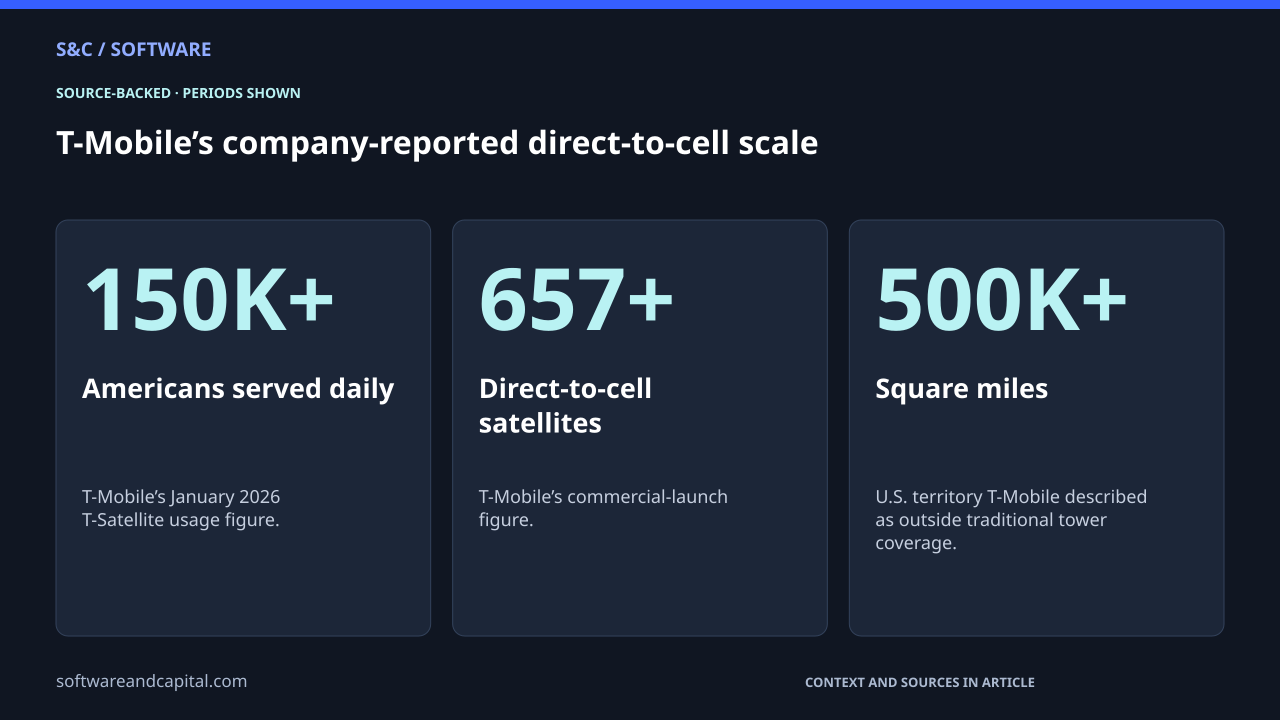
T-Mobile’s company-reported direct-to-cell scale
The satellite behaves like a cell tower in space
The key trick is compatibility with the cellular radio already inside the phone. Instead of asking a handset to speak a completely separate satellite language, the satellite carries cellular equipment and connects using spectrum the phone can already use.1
That is why T-Mobile can say many popular smartphones from roughly the last four years work with T-Satellite. The phone has not suddenly become more powerful. The network has put a compatible radio endpoint overhead.1
The link fills gaps. It does not replace 5G
T-Mobile positions the service for places where terrestrial towers cannot reach: remote roads, trails, rural job sites and situations where local infrastructure is unavailable. That makes direct-to-cell an extension of terrestrial coverage rather than a full substitute for ordinary broadband.1
The satellite link has different capacity and latency constraints from a dense ground network. Supported data experiences therefore depend on apps, device compatibility and service generation. A phone showing a satellite connection does not mean every app will behave exactly as it does on urban 5G.
Messaging arrived before richer data
T-Mobile’s rollout began with messaging and later expanded to satellite data for supported apps. The company has described voice as a later capability. That progression reflects the bandwidth challenge: a text message is far easier to deliver over a constrained link than a continuous high-bandwidth experience.1
Coverage is a moving system
Satellite availability depends on the constellation overhead, geography, an adequate view of the sky and the carrier’s supported spectrum and service. Device and plan eligibility also matter. Works with your existing phone is therefore not the same as works everywhere, on every phone, for every app.
The interesting shift is that the specialized hardware is moving from the consumer’s hand into the network. That changes who can use satellite connectivity: instead of buying a niche device for a rare trip, a mainstream phone can gain a fallback path when the normal tower map ends.
What to check before relying on direct-to-cell
- Whether your exact phone model and carrier plan are supported.
- Which functions are available: messaging, supported data apps, emergency features or voice.
- Whether the location has an adequate view of the sky and falls inside the service area.
- Whether the satellite service is intended as a coverage-gap fallback rather than a replacement for terrestrial broadband.
Direct-to-cell does not erase the differences between space and ground networks. It makes those differences less visible to the person holding the phone. That may be the biggest product change: satellite connectivity becomes a network mode rather than a separate gadget.
Sources and methodology
Sources checked September 24, 2026. Dates and periods for individual figures are stated beside them.
- T-Mobile: Reaching for the Stars ↗Accessed 2026-09-24
- T-Mobile: T-Satellite commercial launch ↗Accessed 2026-09-24
Scope and assumptions
Usage, satellite-count and coverage figures are company-reported and should be read as dated T-Mobile disclosures.
Capabilities vary by device, plan, app, geography and satellite availability; direct-to-cell is not equivalent to full terrestrial broadband.
Continue reading
PayPal Wants Your Home Wallet to Work Abroad →
Googlebook Is Google’s New Answer to the Mac and Windows PC →