Digital wallets work beautifully until you cross a border and discover the merchant uses a different one. PayPal World is built around a different strategy from winning that wallet war. Instead of asking every customer and merchant to adopt PayPal, it tries to connect the systems they already use.1, 2
PayPal World is designed to connect domestic wallets and payment systems rather than replace them. U.S. PayPal users can now scan Weixin Pay merchant QR codes in China without opening a Chinese bank account or installing another wallet. PayPal handles routing and currency conversion behind the scenes, while availability and fees still vary by market.1, 2
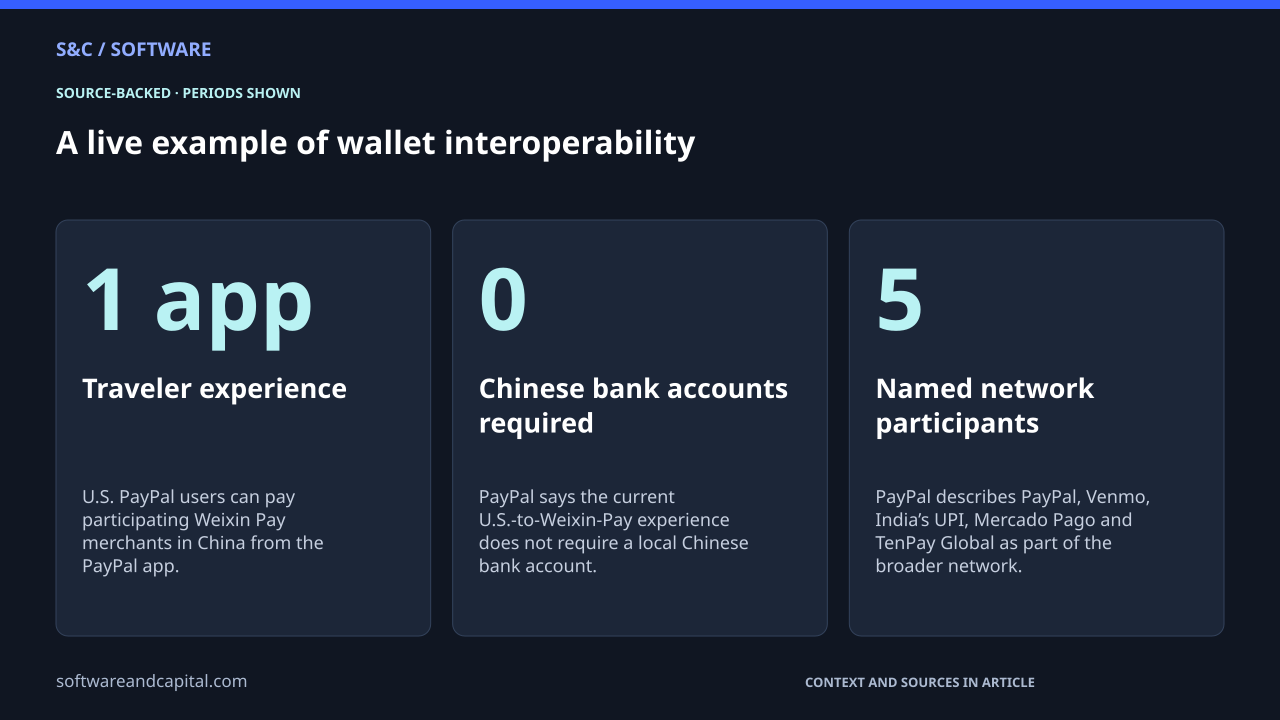
A live example of wallet interoperability
U.S. PayPal users can pay participating Weixin Pay merchants in China from the PayPal app.
PayPal says the current U.S.-to-Weixin-Pay experience does not require a local Chinese bank account.
PayPal describes PayPal, Venmo, India’s UPI, Mercado Pago and TenPay Global as part of the broader network.
The live China experience is narrower than the whole PayPal World vision. It proves one cross-border path is operating. It does not mean every wallet in the network can already transact with every other wallet in every country.1, 2
The product is a routing layer between wallets
| Step | Without interoperability | With PayPal World |
|---|---|---|
| Customer wallet | Traveler may need a local wallet or another payment method. | Customer can use a supported domestic wallet. |
| Merchant acceptance | Merchant accepts its local payment system. | Merchant can keep accepting the local system it already uses. |
| Routing | Payment networks must be connected separately. | PayPal World routes between connected systems. |
| Currency | Customer and merchant may use different currencies. | The platform handles conversion behind the scenes. |
| User setup | New accounts or local banking may be required in some cases. | The China example works without a new local wallet or Chinese bank account. |
That is closer to a translation layer than a new universal wallet. The consumer keeps a familiar interface. The merchant keeps a familiar acceptance network. PayPal World tries to handle the messy middle where identity, routing, currency conversion and network compatibility normally break the experience.2
Why interoperability can be more realistic than replacement
Payment systems are deeply local. Merchants, consumers, banks and regulators already have habits and infrastructure built around domestic networks. A global entrant can spend years trying to replace those habits, or it can connect them and make the cross-border transaction feel local on both ends.
PayPal says its network includes PayPal, Venmo, UPI, Mercado Pago and TenPay Global. That gives the company potential reach across very different payment ecosystems without requiring them to share one consumer brand.2
Interoperable does not mean fee-free or universal
The network still has economic and geographic constraints. PayPal says currency conversion fees can apply, and product availability varies by wallet and market. A supported connection in China does not prove identical pricing, acceptance or transfer options in India, Latin America or the United States.2, 1
That makes this different from the stablecoin settlement experiment in Deel’s payroll stack. PayPal World connects existing payment systems. Deel is changing the settlement asset available inside an existing payroll platform. Both are attempts to make cross-border money movement feel less fragmented.
What would show PayPal World is becoming real infrastructure
- More wallet-to-wallet combinations moving from announced partnerships into live transactions.
- Consistent merchant acceptance without new integrations for each local wallet.
- Transparent fees and exchange rates across connected markets.
- Meaningful usage by travelers, shoppers and cross-border senders rather than one-off demos.
PayPal World’s most interesting idea is that global payments may not need one global wallet. They may need a layer that makes local wallets understand one another. The China launch turns that architecture from a partnership slide into a real customer flow, while the rest of the network still has to prove how broadly it works.
Sources and methodology
Sources checked September 23, 2026. Dates and periods for individual figures are stated beside them.
- PayPal: U.S. travelers can pay Weixin Pay merchants in China ↗Accessed 2026-09-23
- PayPal: How PayPal World helps consumers shop globally ↗Accessed 2026-09-23
Scope and assumptions
The China flow is live for U.S. PayPal users, but broader wallet-to-wallet availability varies by market and transaction type.
PayPal World can still involve currency-conversion fees and does not make cross-border payments universally fee-free.
Named network participants do not imply every wallet can already transact directly with every other participant.
Continue reading
Deel’s Stablecoin Wallet Is in 80+ Countries. Is Payroll Becoming Crypto Infrastructure? →
76% of Shopify’s Revenue Came from Merchant Solutions in 2025 →
AI Search Orders on Shopify Are Up Nearly 13×. Is Chat Becoming a Storefront? →