Google has spent years putting Android on phones and ChromeOS on laptops. Googlebook deliberately blurs that line. The new premium-laptop category uses the Android technology stack, borrows desktop foundations from ChromeOS and builds Gemini into the experience, giving Google a fresh way to compete for the computer people use after they put down their phone.1
Googlebook is a new premium-laptop category built on the Android technology stack, desktop foundations from ChromeOS and Gemini. Five partner-made models start at $899. The important shift is strategic: Google is bringing Android’s app and phone ecosystem deeper into the laptop while trying to make AI part of the desktop itself.1, 2
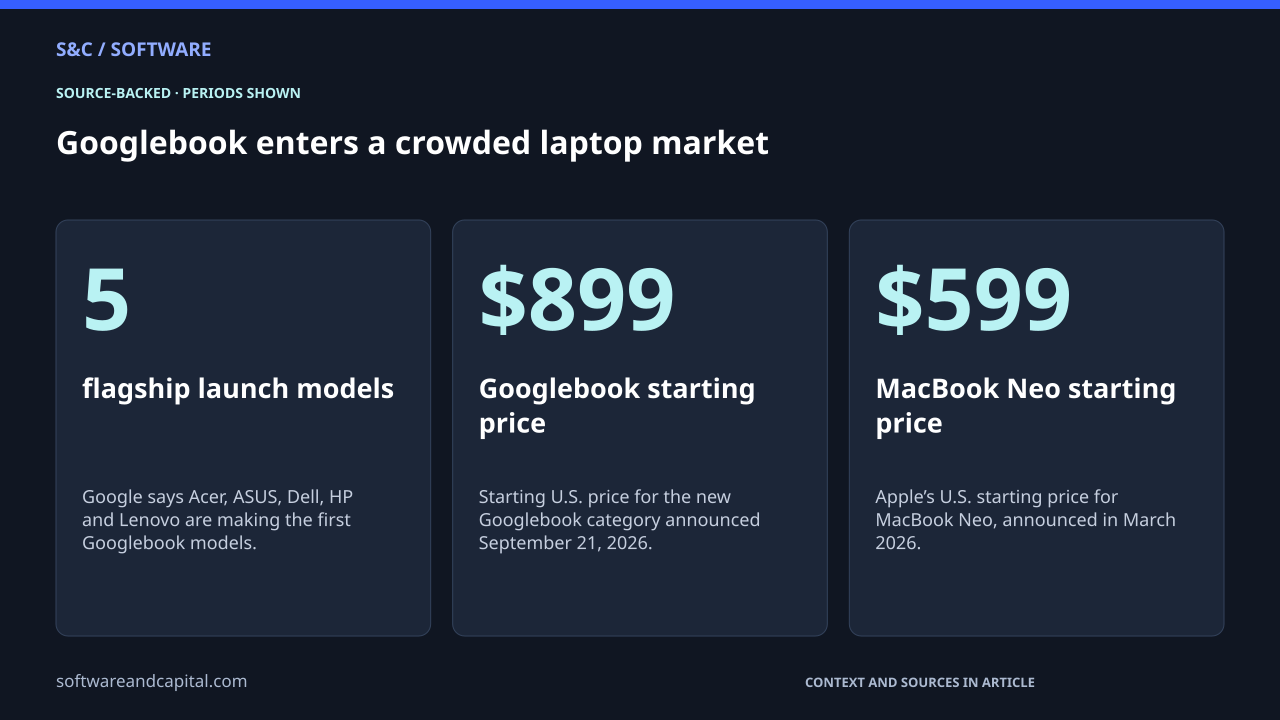
Googlebook enters a crowded laptop market
Those prices are not an apples-to-apples hardware comparison. Googlebook is a category spanning five partner devices, while MacBook Neo is one Apple model. The useful comparison is the platform decision underneath them: Google is trying to make Android, the web and Gemini feel native to a laptop, while Apple has lowered the price of entry to its own Mac ecosystem.
Google is bringing the Android foundation onto the laptop
Google says Googlebook is built on the Android technology stack and paired with desktop foundations from ChromeOS. It also includes the Play Store, a desktop-class Chrome browser with extensions and a Linux environment for developer tools. That combination is broader than simply stretching a phone interface onto a bigger screen.1
| Layer | What Googlebook uses | Why it matters |
|---|---|---|
| App ecosystem | Android apps plus the Play Store | The laptop inherits an app ecosystem already used on phones. |
| Desktop | ChromeOS-derived desktop foundations and Chrome browser | Google keeps familiar laptop conventions while changing the underlying app base. |
| AI | Gemini Intelligence, Magic Pointer, Rambler and generated widgets | AI is positioned as part of the desktop workflow rather than a separate website. |
| Developer tools | Linux environment, terminal and agent-development tools | The category is also pitched at technical users, not only casual Android users. |
The phone connection is part of the product, not an accessory
Googlebook can copy settings, saved passwords, Wi-Fi networks and messages from an Android phone during setup. Google also describes features for continuing a phone task on the laptop, opening phone files and streaming phone apps into a desktop window. The pitch is simple: an Android user should not have to rebuild their digital life when moving to a computer.1
That strategy connects with the broader shift described in our Gemini interface analysis. Google wants the assistant to follow users across more surfaces and interaction modes. Googlebook gives that strategy a larger screen, a keyboard and a desktop operating environment.
Gemini is being treated as part of the desktop
Google highlights three built-in AI features. Magic Pointer brings Gemini to whatever is on screen. Rambler turns spoken thoughts into structured notes. Create My Widget generates small desktop tools from natural-language instructions. Google also says Gemini can be disabled, a useful reminder that the new category is still a laptop first, not an always-on AI service.1
What will decide whether Googlebook becomes more than a launch moment
- App quality: Android apps need to feel natural with a keyboard, trackpad and large display.
- Hardware consistency: five launch partners give buyers choice, but the category still needs a clear experience across different machines.
- AI usefulness: Gemini features have to save enough friction to matter after the novelty wears off.
- Ecosystem pull: the phone-to-laptop connection has to be strong enough to make Android users care which PC platform they choose.
The $899 starting price also places Googlebook above Apple’s $599 MacBook Neo entry point. That does not make either machine the better buy because specifications and use cases differ. It does show that Google is launching Googlebook as a premium category rather than as a low-cost Chromebook replacement.2, 3
The most interesting Googlebook feature may not be any one AI button. It is the decision to put Android’s ecosystem, ChromeOS desktop ideas and Gemini under one laptop label. Google is betting that the computer and the phone should feel like two screens inside the same system. Whether buyers agree will matter more than the launch-day feature list.
Sources and methodology
Sources checked September 24, 2026. Dates and periods for individual figures are stated beside them.
- Google: Googlebook is here and ready for pre-order ↗Accessed 2026-09-24
- Google: Googlebook is raising the bar for premium laptops ↗Accessed 2026-09-24
- Apple: MacBook Neo is now available ↗Accessed 2026-09-24
Scope and assumptions
Googlebook is a category of partner-built devices, so the $899 starting price does not represent one standardized hardware configuration.
The Apple comparison is limited to documented positioning and starting price. It is not a performance or value ranking.
Long-term adoption, app quality and the durability of the AI features cannot be inferred from launch materials.
Continue reading
1B Monthly Users—and 63% Talk to Gemini Out Loud →