A restaurant order rarely needs a full-size car. DoorDash’s answer is Dot, an autonomous delivery vehicle it describes as roughly one-tenth the size of a car. But the more interesting idea is not replacing every Dasher with a robot. DoorDash is building a dispatch system that can choose among people, road robots, sidewalk robots and drones.1, 2
DoorDash’s Dot is a small autonomous delivery vehicle designed for local trips that do not require a full-size car. DoorDash’s broader strategy is multimodal: match humans, road robots, sidewalk robots and drones to different orders rather than assume one delivery mode wins every route. Dot is another option in that dispatch system, not a universal Dasher replacement.1, 2
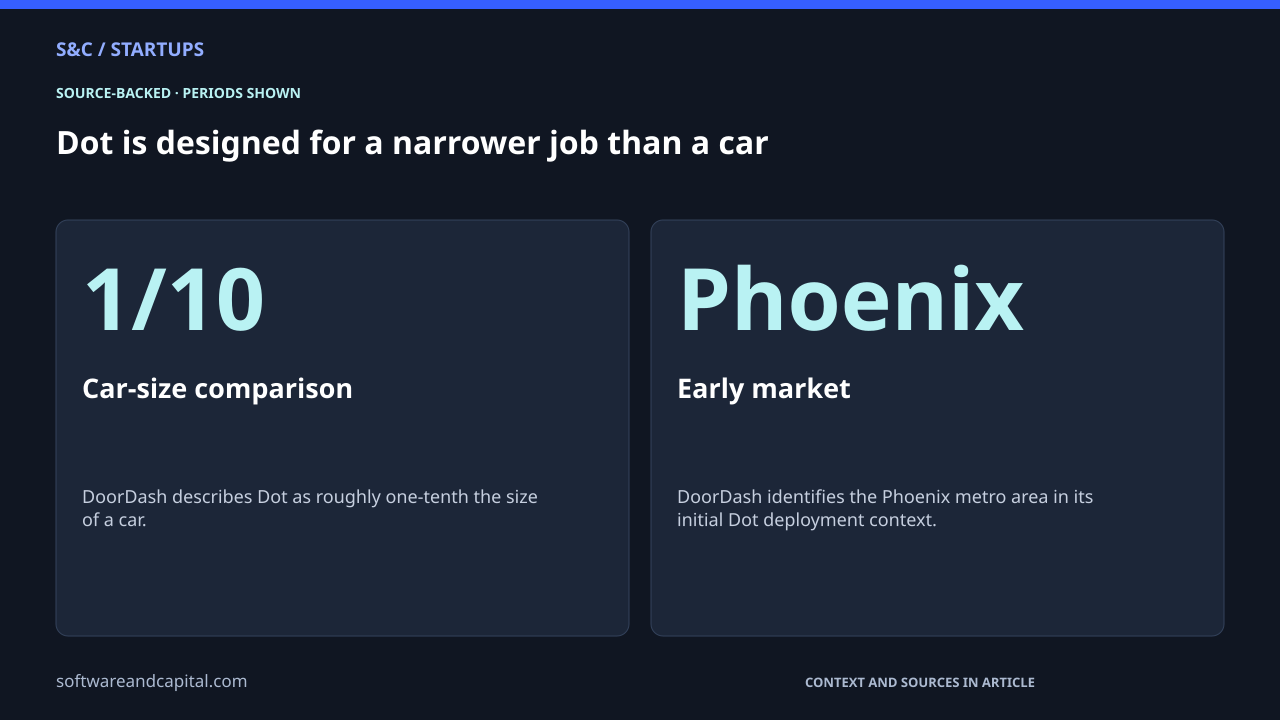
Dot is designed for a narrower job than a car
Delivery is a matching problem before it is an autonomy problem
Orders vary enormously. A single meal traveling a short suburban route has different requirements from a large grocery basket, a dense-city sidewalk trip or an urgent item that could travel by air. One vehicle type is unlikely to be optimal for every combination.
| Mode | Potential fit | Main constraint |
|---|---|---|
| Human Dasher | Flexible orders and unusual handoffs | Requires human time for the route. |
| Road robot | Local road-accessible deliveries | Needs safe operating territory and suitable loading. |
| Sidewalk robot | Short dense-area trips | Limited speed, range and sidewalk environment. |
| Drone | Light, time-sensitive point-to-point orders | Payload, weather, airspace and handoff constraints. |
Dot is another vehicle in the dispatch pool
DoorDash says its autonomous-delivery platform can determine which delivery method is appropriate for an order. That makes Dot less like a standalone robot product and more like a new resource inside a logistics marketplace that already coordinates merchants, consumers and human couriers.2
Why not just use a Dasher?
Humans remain unusually flexible. They can handle stairs, apartment lobbies, substitutions, unusual loads and changing conditions. A purpose-built robot can make more sense when the route and handoff are predictable enough that those capabilities are unnecessary. The economic question is not whether autonomy is impressive, but whether a specific order benefits from it.
That is also why the comparison with Walmart’s drone-delivery use case is useful. Drones solve a different route problem. Multimodal delivery treats each technology as a tool with a fit rather than declaring one technology the winner.
What a dispatch system has to consider
- Order size and weight.
- Distance and route environment.
- Required delivery speed.
- Weather and operating restrictions.
- Complexity of pickup and customer handoff.
Dot matters less as evidence that delivery people disappear than as evidence that delivery networks are gaining more vehicle choices. The competitive advantage may come from deciding which mode should handle each order, then making all of those modes feel like one service to the customer.
Sources and methodology
Sources checked September 25, 2026. Dates and periods for individual figures are stated beside them.
- DoorDash Dot ↗Accessed 2026-09-25
- DoorDash unveils Dot ↗Accessed 2026-09-25
Scope and assumptions
DoorDash does not disclose enough public unit-cost data here to claim Dot is cheaper than a human Dasher for a given order.
Early deployment conditions do not establish how broadly Dot can operate across cities, weather, routes or order types.
Continue reading
1 Million Drone Deliveries: When Does Flying a Walmart Order Make Sense? →
Amazon Has 1 Million Robots. What Happens to the Warehouse Job? →