A drone is a strange way to deliver a week’s groceries. It is a much more plausible way to deliver the one ingredient missing from dinner. Walmart said in May 2026 that it had passed one million drone deliveries, and its examples focus on exactly those urgent, small-item moments: printer ink, cold medicine and the forgotten pizza topping.1
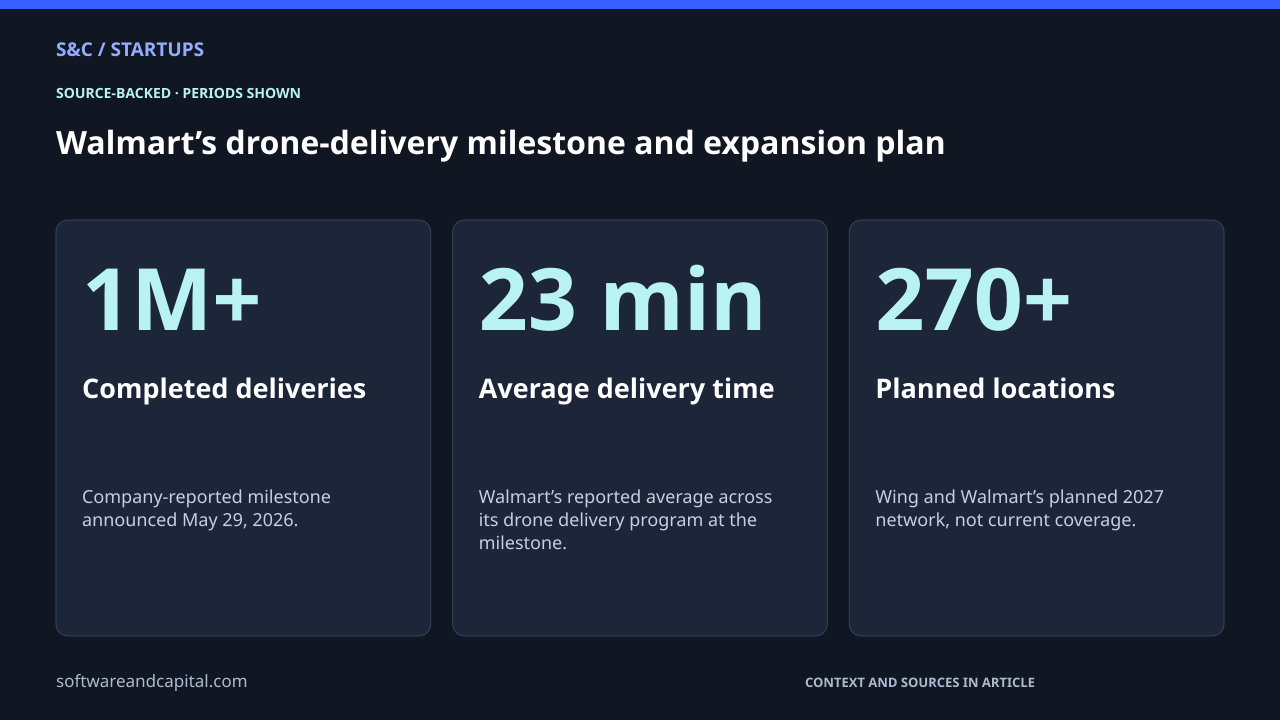
Walmart said it passed one million drone deliveries in May 2026, averaging 23 minutes across a then-current 66-store footprint. Wing and Walmart plan more than 270 drone-delivery locations reaching over 40 million Americans in 2027. The clearest use case is speed for small, urgent items, not proof that drones should replace every delivery route.1, 2, 3
Walmart’s drone-delivery milestone and expansion plan
The timeline matters. At the million-delivery milestone, Walmart said the service operated from 66 stores in four states across five metro markets. Wing and Walmart’s 270-plus-location network and more than 40 million-person reach are plans for 2027. They should not be read as today’s service footprint.1, 2
Drones are strongest when speed matters more than route density
Traditional delivery vehicles become efficient when they can carry many orders on one route. A drone can make sense for a different problem: one lightweight order that a customer wants very quickly and that can be flown directly from a nearby store.
| Order situation | Drone fit | Conventional vehicle fit |
|---|---|---|
| One small urgent item | Strong when the address is in range and the item fits the aircraft. | Often slower if it must wait for batching or a driver route. |
| Large weekly grocery basket | Limited by payload and order size. | Strong because one vehicle can carry many bags and products. |
| Dense batch of nearby orders | Can serve individual destinations quickly. | A route can spread driver and vehicle time across many orders. |
| Time-sensitive medicine or forgotten item | Speed can be the main customer value. | Still useful when drone eligibility, weather or airspace limits apply. |
That is why the milestone does not prove drones are the cheapest form of delivery overall. Walmart’s announcement gives delivery counts and speed, not a comparable cost per order against vans, couriers or pickup. The right conclusion is narrower: real customers are using the service often enough for the program to pass a million completed deliveries.1
Store density is part of the advantage
Walmart argues that thousands of stores close to communities give it a useful launch network. A drone does not need to cross a city if the item already sits in a nearby store. The physical retail footprint becomes a distributed logistics network rather than only a place customers visit.1
This is a different kind of automation from Amazon’s warehouse robots. Warehouse automation changes how goods move inside a building. Drone delivery changes the final trip from a local store to a customer’s address.
The expansion is becoming national, but the service is still selective
Wing and Walmart announced in January 2026 that they planned to add 150 stores over the following year and build a network of more than 270 locations in 2027. In June, Wing named seven additional metro areas, including San Diego, Philadelphia, Phoenix and the San Francisco Bay Area.2, 3
A national footprint does not mean every address or every product becomes drone-eligible. Range, payload, weather, airspace, local operations and store participation can all constrain service. The network can expand dramatically while remaining a specialized delivery option inside a broader logistics system.
The millionth delivery is evidence of use, not universal superiority
The metrics that would answer the harder business question
- Cost per completed drone order compared with a similar conventional delivery.
- Average payload, basket value and repeat usage by customers.
- Share of orders that are actually eligible for drone delivery in an active market.
- Reliability across weather, time of day and different neighborhood layouts.
A million deliveries moves retail drones beyond the demonstration phase, but it does not make the van obsolete. The clearest role is as an express lane for small, urgent orders. If that use case scales, drones may become another delivery mode customers barely think about until they suddenly need something in 23 minutes.1
Sources and methodology
Sources checked September 22, 2026. Dates and periods for individual figures are stated beside them.
- Walmart: one million drone deliveries milestone ↗Accessed 2026-09-22
- Wing and Walmart: 150-store coast-to-coast expansion ↗Accessed 2026-09-22
- Wing and Walmart: seven additional drone-delivery markets ↗Accessed 2026-09-22
Scope and assumptions
The one-million-delivery and 23-minute figures are company-reported, and the cited sources do not provide a comparable cost-per-delivery analysis.
The 270-plus locations and more than 40 million-person reach are future 2027 plans, not current service coverage.
AI-assisted research and editing. Our editorial standards.
Continue reading
Amazon Has 1 Million Robots. What Happens to the Warehouse Job? →
$16B for Driverless Rides: Why Robotaxis Need So Much Capital →