Duolingo finished 2025 with more than $1 billion in bookings and more than 50 million daily active users. Then management said the 2026 priority was to improve teaching and the free learner experience, even if that moderated near-term financial growth. For a company that already knows how to sell subscriptions, choosing more free-user growth is an interesting trade.1
Duolingo recorded $1.158 billion of bookings and $1.038 billion of revenue in 2025. In February 2026, management said it would deliberately prioritize teaching quality, the free learner experience and user growth even if that moderated near-term financial growth. Q2 2026 daily-active-user growth later accelerated to 23% year over year. Bookings, revenue and free-user growth measure different parts of that strategy.1, 2, 3
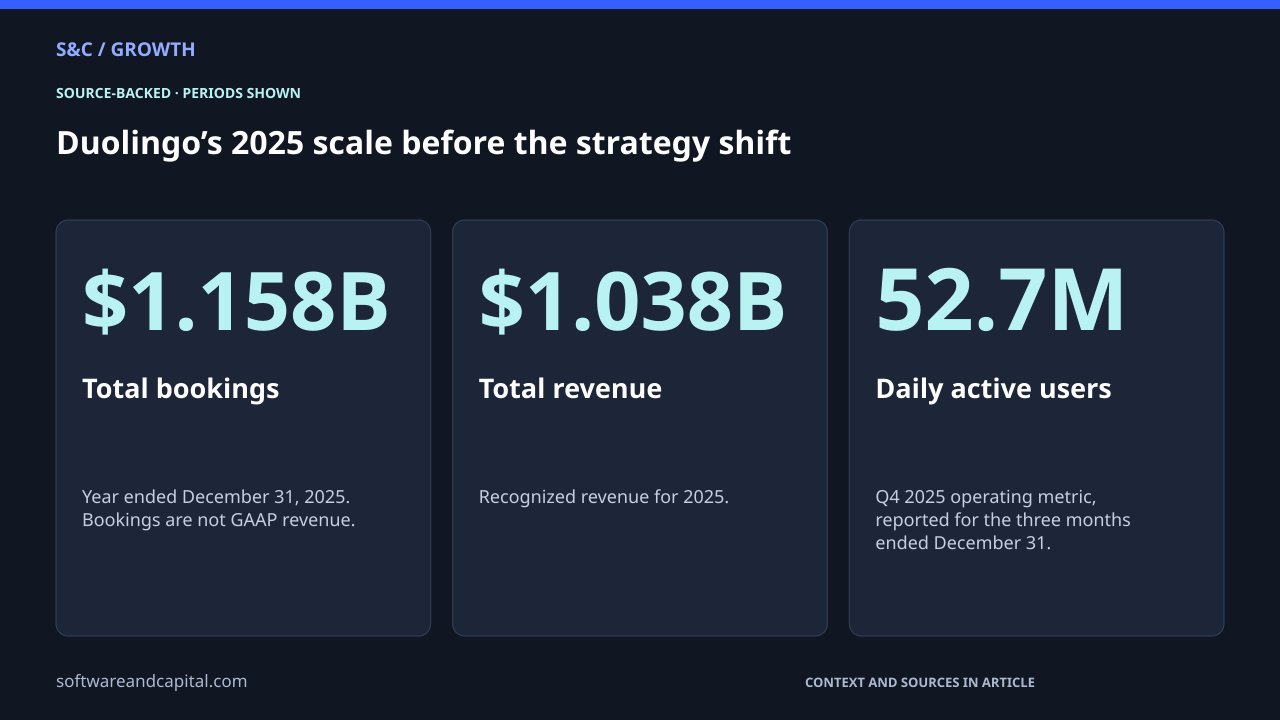
Duolingo’s 2025 scale before the strategy shift
The first important distinction is accounting. Duolingo defines bookings as the amount it expects to receive from transactions during the period. Subscription revenue is recognized over the life of a subscription, most of which lasts twelve months. That is why bookings can move ahead of revenue without being extra profit.2
The $1 billion milestone was bookings, not revenue
| Measure | 2025 | What it means |
|---|---|---|
| Total bookings | $1.158B | Transaction value recorded in Duolingo’s bookings metric. |
| Total revenue | $1.038B | Revenue recognized in the 2025 financial statements. |
| Subscription bookings | $996.3M | Bookings attributable to subscriptions. |
| Subscription revenue | $873.4M | Subscription revenue recognized during the year. |
The difference is most visible in subscriptions. Duolingo recorded $996.3 million of subscription bookings but $873.4 million of subscription revenue in 2025. The company explains that subscription revenue is generally recognized ratably over the subscription term, so cash-related demand signals and accounting revenue do not have to land in the same period.2
That makes the February 2026 strategy statement more notable. The company was not choosing user growth because it had failed to monetize. It was making the choice after a year in which subscription bookings rose 36% and total revenue rose 39%.2
Why give more attention to people who do not pay?
Duolingo said it would improve the free learner experience to strengthen word of mouth and feed growth engines such as chess, math and music. In a freemium business, the free product is not merely a preview page. It is the large surface on which people build a habit, recommend the product and eventually encounter paid features.1
The logic is a longer funnel: make the product useful to more people, keep more of them engaged, then give some of that audience reasons to pay. That does not guarantee more revenue. It explains why maximizing this quarter’s monetization and maximizing the long-term pool of engaged users can point in different directions.
The trade is easier to see beside Spotify’s subscription business. Spotify’s headline Premium count describes an established paid relationship. Duolingo’s strategy puts additional weight on widening and improving the free experience that can precede such a relationship.
The free audience is also part of Duolingo’s economics
Duolingo’s 2025 filing shows that subscriptions generated $873.4 million of revenue. Other revenue was $164.1 million, including advertising, the Duolingo English Test and in-app purchases. Advertising revenue rose as daily active users increased and more ads were served, according to the filing. Free usage can therefore support monetization even when a learner does not become a subscriber.2
That does not make every free learner equally valuable, or mean the company should maximize ads. Duolingo’s stated 2026 plan emphasized teaching and user growth. A free-product decision can affect word of mouth, retention, advertising opportunities and the pool of future subscribers at the same time.
Q2 2026 gave management an early user-growth signal
In August 2026, Duolingo said daily active users grew 23% year over year in Q2, an acceleration from Q1. Management said the results reinforced its strategy to improve the product and prioritize user growth. That is a company interpretation of an early operating result, not proof that the strategy will maximize long-term profit.3
The useful thing to watch next is whether user growth, paid relationships and revenue continue to move together over a longer period. A quarter of faster daily-user growth is encouraging for the stated goal. It does not settle whether slower near-term monetization produces a better business over several years.
A freemium business has two jobs
What the strategy is trying to balance
- Make the free product good enough that people start, return and recommend it.
- Create paid features valuable enough that a portion of that large audience chooses to subscribe.
- Keep the economics healthy while investing in new subjects, AI features and the product experience.
That balance is why the $1 billion bookings milestone does not end the growth question. Duolingo had already shown it could convert a large audience into substantial revenue. Its next bet is that serving more people well at the free layer can make the paid business larger later.
The owl’s most important customer may therefore be someone who has not paid yet. Not because free users are automatically profitable, but because in a freemium model they are the population from which attention, habit, word of mouth and future paid relationships can grow.
Sources and methodology
Sources checked September 21, 2026. Dates and periods for individual figures are stated beside them.
- Duolingo: Q4 and full-year 2025 results, SEC-filed exhibit ↗Accessed 2026-09-21
- Duolingo: 2025 Form 10-K ↗Accessed 2026-09-21
- Duolingo: Q2 2026 results, SEC-filed exhibit ↗Accessed 2026-09-21
Scope and assumptions
Bookings are a company-defined operating metric and are not GAAP revenue. The article does not treat the difference between bookings and revenue as profit or cash on hand.
The Q2 2026 DAU result is an early operating observation. It does not establish that prioritizing free-user growth will maximize future revenue, profit or shareholder returns.
AI-assisted research and editing. Our editorial standards.