For a listener, Spotify might be the soundtrack to a commute or the playlist that makes dinner less quiet. For the company, those habits add up to a very large business. Its Q2 2026 announcement paired 300 million Premium subscribers with €4.8 billion in quarterly revenue. The interesting question is what remains after the listening is paid for.1
Spotify reported 300 million Premium subscribers in Q2 2026 and revenue of €4.777 billion, rounded to €4.8 billion in its announcement. After cost of revenue and operating expenses, operating income was €655 million. Subscriber scale, revenue and the profit left at each stage measure different parts of the business.1, 2
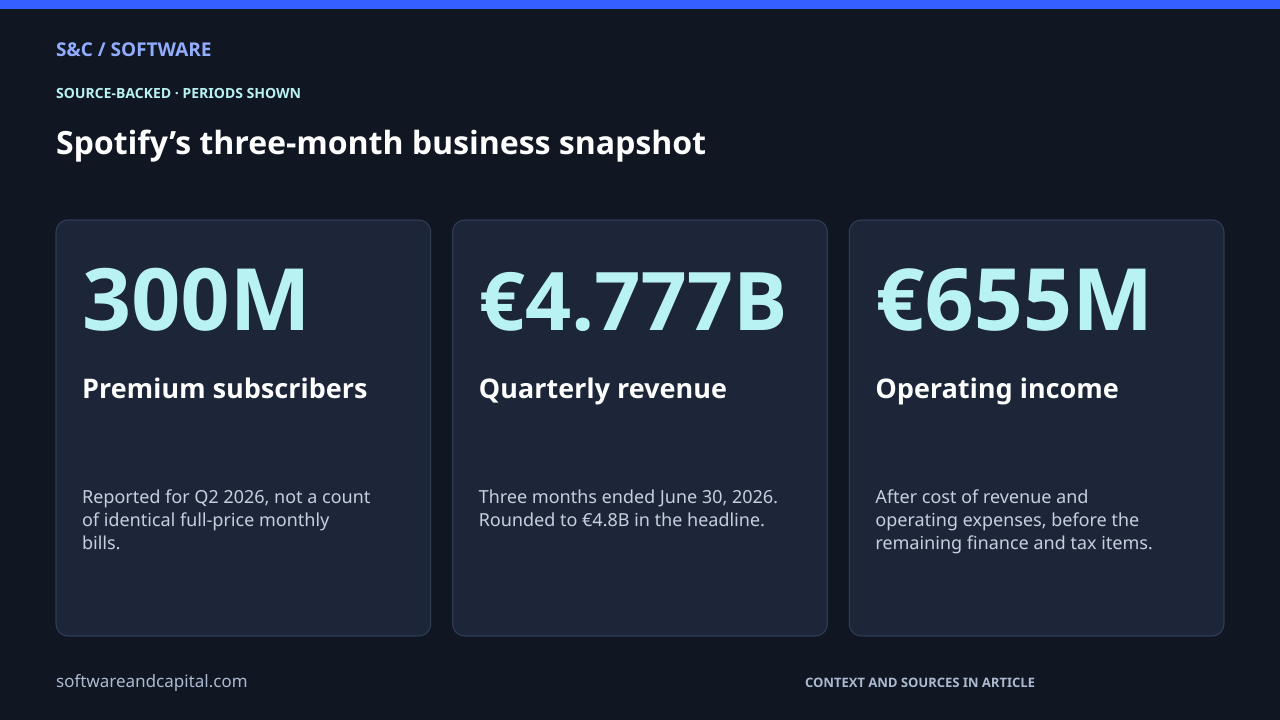
Spotify’s three-month business snapshot
The revenue number is the top of the story
Revenue records what the business earned from its services during the quarter. It is not the amount available to distribute to shareholders. Spotify’s statement first deducts cost of revenue, then the expenses of developing, selling and running the wider business. Those steps make the same quarter look very different depending on which line you read.
| Statement line | € millions | What it shows |
|---|---|---|
| Revenue | 4,777 | The starting amount for the quarter. |
| Less cost of revenue | 3,181 | Costs recognized against providing that revenue. |
| Gross profit | 1,596 | Revenue after that first deduction. |
| Less operating expenses | 941 | Research and development, sales and marketing, and administration. |
| Operating income | 655 | The result after both groups of expenses. |
Put the quarter on a €100 scale and the relationship becomes easier to picture. Approximately €66.6 went to cost of revenue, leaving €33.4 of gross profit. Operating expenses used another €19.7, leaving about €13.7 of operating income. These are calculations from the reported totals, not a statement about one particular subscription payment.2
Do not add gross profit and operating income together. The second is what remains from the first after further expenses. And operating income is not the same thing as cash flow or the final bottom line. Each measure answers a different question about how the business works.
A subscriber is not always a separate full-price bill
A household shows why multiplying a subscriber headline by the price on your own receipt can mislead. Spotify’s Premium Family documentation describes separate accounts for up to six household members, while one plan manager signs up and pays. A collection of individual listening accounts need not produce the same number of separate bills.3
That does not tell us the precise plan mix behind the 300 million figure. It tells us why the simple multiplication is not a substitute for reported revenue. Subscriber counts, product arrangements and money collected are related, but they are not interchangeable.
The company also reported 777 million monthly active users in Q2. That broader measure shows the reach of the service, while the Premium milestone describes a different relationship with it. Keep the company’s metric definitions attached instead of turning the figures into a homemade count of unique paying households.1
Why being part of the day matters
A subscription has to keep earning its place on the customer’s bill. A single memorable use may be enough to try a service. A habit gives people more reasons to return and more moments in which the product can justify its price. That is the business significance of the commute, the workout and the dinner playlist.
The challenge is that useful additions still have to fit the economics. A new feature can attract attention without increasing the amount customers are willing to pay. It can also add work and cost. A growing audience is valuable evidence of reach, but it does not settle those questions by itself.
The comparison with YouTube’s advertising and subscription business is useful here. A familiar media habit can support different ways of getting paid. Understanding the product a customer values is as important as recognizing the size of the audience.
Three questions for the next earnings headline
Read reach, revenue and profit separately
- Reach: how many people use the service, under the company’s stated definitions?
- Revenue: how much did the business earn during the period, rather than merely count at quarter-end?
- Economics: what remained after the costs of delivering and operating that business?
For Q2 2026, Spotify’s figures give us all three views: a large audience, a substantial revenue quarter and positive operating income. They do not guarantee what a new product or the next quarter will deliver.
The play button makes the product feel effortless. The financial statements show the work underneath: turn repeated listening into revenue, cover the costs, and retain enough to run and develop the service. Three hundred million Premium subscribers is a milestone. The route from €4.777 billion to €655 million explains the business behind it.
Sources and methodology
Sources checked September 21, 2026. Dates and periods for individual figures are stated beside them.
- Spotify: Q2 2026 earnings announcement, August 4, 2026 ↗Accessed 2026-09-21
- Spotify: Q2 2026 shareholder update and financial statements ↗Accessed 2026-09-21
- Spotify Support: Premium Family plan and billing structure ↗Accessed 2026-09-21
Scope and assumptions
All financial and audience figures describe Q2 2026. The per-€100 breakdown is calculated from company totals and is not the economics of an individual plan, market or listener.
Cost of revenue is not presented as a pure artist-payout figure. No stock recommendation, segment-profit estimate or forecast is made. The Family example illustrates billing structure, not the actual subscriber-plan mix.
AI-assisted research and editing. Our editorial standards.
Continue reading
YouTube’s $60B-Plus Year Wasn’t Just Advertising →
76% of Shopify’s Revenue Came from Merchant Solutions in 2025 →
Over $1B in Bookings: Why Duolingo Still Wants More Free Users →