The monthly subscription is the obvious part of Shopify’s business. It was not the biggest. In 2025, merchant solutions generated about three-quarters of revenue. Understanding that split changes the question from “how many shops pay a subscription?” to “how much business flows through Shopify, and which services do merchants use?”1
Shopify reported $11.556 billion in 2025 revenue. Merchant solutions contributed $8.804 billion, about 76%, while subscription solutions contributed $2.752 billion. The model combines access fees with services tied to merchant activity. Revenue share is not profit share: the two categories have very different costs.1, 2
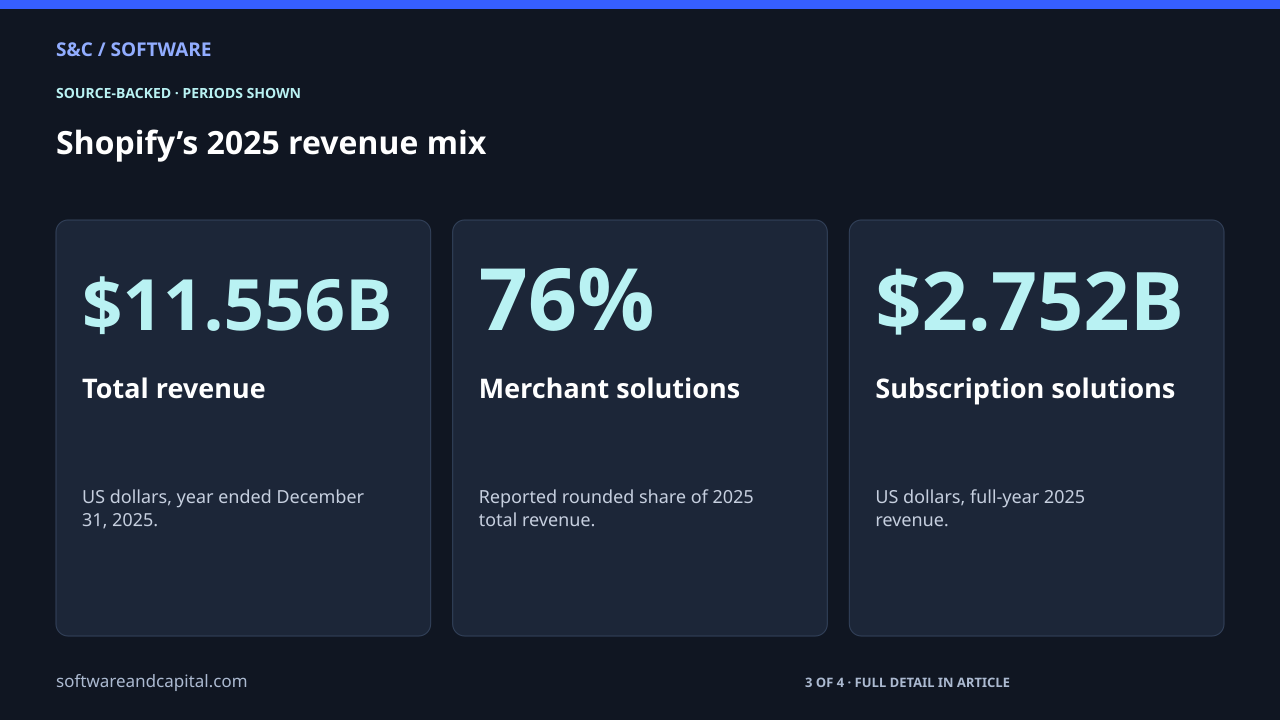
Shopify’s 2025 revenue mix
The subscription opens the door
Shopify describes two revenue components: subscription solutions and merchant solutions. Subscriptions include platform access, POS Pro, apps, themes and domain registrations. The company says payment-processing and currency-conversion fees from Shopify Payments are the main source of merchant-solutions revenue. Other services also contribute.1
That is a useful distinction for reading any software business. One customer relationship can support several revenue streams. A company can grow by attracting more customers, selling more services to existing ones, or participating in more of their activity. A subscriber count alone cannot tell you which mechanism is doing the work.
The bigger revenue stream has the lower gross margin
| Measure | Subscription solutions | Merchant solutions |
|---|---|---|
| Revenue | $2,752 | $8,804 |
| Cost of revenue | $520 | $5,481 |
| Gross profit: revenue minus its cost | $2,232 | $3,323 |
| Calculated category gross margin | 81.1% | 37.7% |
| Calculated share of total gross profit | 40.2% | 59.8% |
Subtract each category’s cost of revenue and the picture changes. Merchant solutions produces roughly 60% of gross profit, compared with its roughly 76% revenue share. Subscriptions contribute about 40% of gross profit from about 24% of revenue.1
This does not make one stream “good” and the other “bad.” It means a dollar of growth in one category does not have the same immediate economics as a dollar in the other. A larger, lower-margin business can still generate more gross profit in absolute dollars.
A revenue mix is not a verdict on the business
Gross profit is what remains after the costs classified as cost of revenue. It comes before operating expenses such as product development, marketing and administration. The table is therefore not a calculation of category net profit, and it is not a stock valuation.
The same caution applies to comparisons with other software companies. Two businesses can report similar growth while having different billing models, product mixes and direct costs. Before treating a headline revenue multiple as meaningful, understand what the company is actually selling.
Three questions for the next results release
- Is growth coming from subscription access, merchant services, or both?
- How much gross profit accompanies the additional revenue?
- Are changes in the mix making revenue and gross profit grow at different rates?
For someone building a software company, the lesson is not “add payments.” It is to separate the product that wins the customer from the services that expand the relationship, then examine the economics of each. The software-pricing guide applies that discipline from the buyer’s side.
Shopify’s subscription is an entry point, not a complete description of its business. The revenue split explains where the scale comes from. The gross-profit split explains why that is only half the story.
Sources and methodology
Sources checked September 21, 2026. Dates and periods for individual figures are stated beside them.
- Shopify: 2025 Form 10-K ↗Accessed 2026-09-21
- Shopify: fourth-quarter and full-year 2025 results ↗Accessed 2026-09-21
Scope and assumptions
This analyzes the year ended December 31, 2025, not the latest quarter or the current share price.
Category gross profits, margins and shares are calculations from reported revenue and cost-of-revenue figures. They are not category net profits or investment recommendations.
AI-assisted research and editing. Our editorial standards.