Most AI products ask a company to send work to somebody else’s infrastructure. Go.AI is selling the opposite architecture to banks, healthcare organizations and other regulated customers: install the AI inside the customer’s environment and keep the data path local or inside a private cloud.
Go.AI raised an $85 million Series A around an on-premises AI model for regulated organizations. The company says it has more than 200 customers, ARR up more than 8x year over year while profitable, and deployments processing more than 12.5 million queries a day. Those operating metrics are company-reported, but the architecture highlights a real cloud-versus-control tradeoff.1, 2
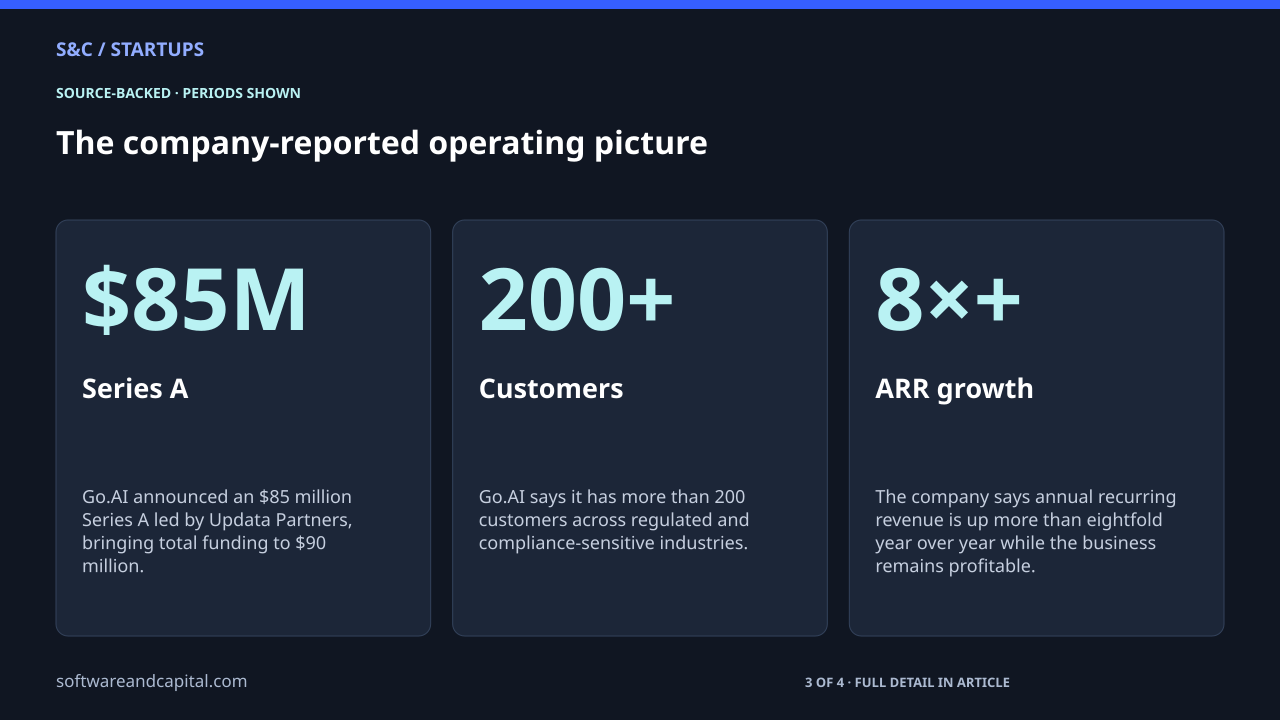
The company-reported operating picture
Go.AI announced an $85 million Series A led by Updata Partners, bringing total funding to $90 million.
Go.AI says it has more than 200 customers across regulated and compliance-sensitive industries.
The company says annual recurring revenue is up more than eightfold year over year while the business remains profitable.
On-premises changes who owns the execution environment
Go.AI says its software can run on customer-managed hardware or in a private cloud instance. That keeps proprietary data from being sent to a third-party model provider for the supported workflow, but it also moves more responsibility for hardware, uptime, upgrades and capacity planning back toward the customer and vendor.2
| Question | Cloud API | On-prem or private deployment |
|---|---|---|
| Data path | Sent to an external provider under its service terms | Designed to remain inside the customer-controlled environment |
| Billing | Often usage or token based | Go.AI says it uses fixed-fee pricing |
| Capacity | Provider scales shared infrastructure | Customer and vendor must plan local capacity |
| Model updates | Provider can change models quickly | Local stack may prioritize stability and control |
| Operations | Less hardware to own | More infrastructure responsibility |
Fixed-fee pricing changes the cost question
Updata describes Go.AI’s offering as fixed-fee rather than metered per token. That can make spending more predictable for high-volume workloads, but it does not prove the total cost is lower. Hardware, support, utilization and refresh cycles still matter.2
Regulated customers are buying control as much as intelligence
A bank or healthcare organization may care about auditability, data residency and uptime in ways that a consumer chatbot user does not. The attraction of an appliance model is that the execution environment becomes part of the product. The tradeoff is that control comes with more operational complexity.
The growth figures are not audited revenue
Go.AI’s customer count, ARR growth, profitability and query volume all come from the company or its lead investor. They are useful indicators of traction, but they do not reveal an ARR dollar figure, customer concentration, gross margin or the hardware economics behind the deployments.1, 2
What a buyer would still need to compare
- Total three-year hardware, software and support cost.
- Which models and workloads can run locally at the required performance level.
- How upgrades, security patches and model changes are handled.
- What happens when demand exceeds the installed capacity.
- Which compliance claims are independently certified rather than simply described by the vendor.
The AI workflow-cost guide explains why a cheap model call can still be an expensive completed task. Go.AI adds another layer to that calculation: whether the organization rents inference by usage or owns more of the execution environment itself.
Sources and methodology
Sources checked September 26, 2026. Dates and periods for individual figures are stated beside them.
- Go.AI: $85 million Series A ↗Accessed 2026-09-26
- Updata Partners: investment in Go.AI ↗Accessed 2026-09-26
Scope and assumptions
Customer count, ARR growth, profitability and query volume are company- or investor-reported and are not independently audited in the cited materials.
Fixed-fee pricing does not establish lower total cost because hardware, support and utilization still matter.
The article does not evaluate whether any deployment satisfies a specific legal or regulatory requirement.
Continue reading
2¢ vs 4¢: When the Cheaper AI Call Costs More →
OpenAI Cut Its New Model Prices in Half. What Gets Cheaper When Intelligence Does? →
A $100M Startup Is Betting the Next AI Bottleneck Is the Network →