AI drug discovery is easy to describe as a race from model to molecule. An IPO filing forces a more complete picture. Iambic has put its lead drug into human testing, but it is still an early-stage biotech company with no approved products, continuing losses and years of clinical development between a promising program and commercial medicine.
Iambic says its lead program IAM1363 moved from program launch to Phase 1 in about two years and is now in a Phase 1/1b trial. Its S-1 also shows the other side of AI drug discovery: no approved products, no product-sales revenue, a $50.1 million net loss in the first half of 2026 and years of clinical risk still ahead.1, 2
Iambic at the IPO filing
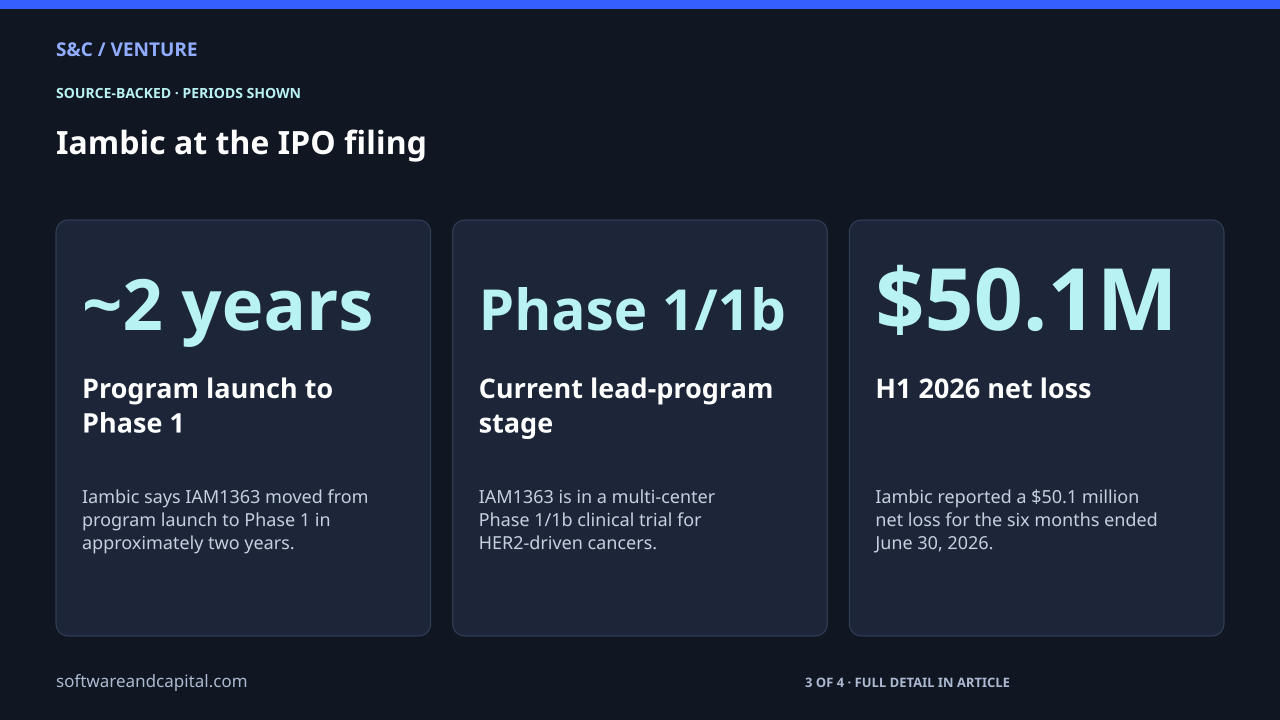
Iambic says IAM1363 moved from program launch to Phase 1 in approximately two years.
IAM1363 is in a multi-center Phase 1/1b clinical trial for HER2-driven cancers.
Iambic reported a $50.1 million net loss for the six months ended June 30, 2026.
Iambic states that it has no drug products approved for commercial sale and no revenue from product sales.
The two-year number describes speed to the clinic, not speed to a drug
Reaching Phase 1 means a candidate has entered human testing. It does not mean the drug works well enough to be approved, that later trials will succeed or that a regulator will allow it onto the market. Iambic’s own risk factors say its AI-integrated approach is novel and unproven and that it may never achieve profitability.1
| Stage | What Iambic has reached | What remains |
|---|---|---|
| Discovery | AI and automated experimental platform | Continued model and data improvement |
| Lead program | IAM1363 selected and advanced | Dose, safety and activity evidence |
| Clinical development | Phase 1/1b underway | Later-stage trials if early evidence supports them |
| Approval | No approved products | Regulatory review and successful development |
| Commercialization | No product-sales revenue | Manufacturing, launch and market adoption if approved |
The filing puts the economics next to the technology
Iambic has generated revenue from partnerships and collaborations, but it says product-sales revenue may be years away, if it arrives at all. The company reported net losses of $77.3 million in 2025 and $50.1 million in the first half of 2026 as it funded research, clinical development and its AI platform.1
Partnerships are part of the business before products
An AI-native biotech does not have to wait for an approved drug to create commercial relationships. Iambic’s filing describes strategic collaborations and its site presents the platform as something partners can use in their own programs. Those arrangements can bring research funding and milestone economics while Iambic’s own pipeline matures.1, 2
Public investors are being asked to underwrite both software and biology
The attraction is that better models and automated experiments could shorten parts of discovery. The risk is that biology still imposes clinical and regulatory gates that software iteration cannot skip. The IPO story therefore sits between two valuation frameworks: an AI platform that may improve with data and a biotech pipeline that can fail molecule by molecule.
What to watch after the IPO filing
- Safety and activity data from IAM1363 as the Phase 1/1b trial progresses.
- Whether later candidates move from preclinical work into human trials on similarly compressed timelines.
- How much revenue comes from collaborations versus future proprietary products.
- R&D spending and cash runway as the pipeline moves into more expensive clinical stages.
That is different from Anthropic’s wet-lab experiment, which asks how an AI agent can participate in scientific work. Iambic is the company-economics version: what happens when AI-assisted discovery has to survive clinical trials and the public markets.
Sources and methodology
Sources checked September 26, 2026. Dates and periods for individual figures are stated beside them.
- Iambic Therapeutics: Form S-1 ↗Accessed 2026-09-26
- Iambic Therapeutics: Pipeline ↗Accessed 2026-09-26
Scope and assumptions
IAM1363 remains in Phase 1/1b and no Iambic product has regulatory approval.
The approximately two-year timeline is company-reported and does not prove that AI will shorten later clinical-development stages.
The article discusses public filings and company economics, not the suitability of the IPO as an investment.
Continue reading
Anthropic Built a Wet Lab So Claude Can Test Its Biology Ideas →