A desktop Mac now tops out at 512GB of unified memory. That number matters because large AI models often hit a memory wall before they hit a processor wall. Apple is explicitly positioning the M5 Ultra Mac Studio for running large models on-device, turning the local-versus-cloud question into a real purchasing decision for some teams.
The M5 Ultra Mac Studio makes serious local AI more practical, but it does not make cloud inference obsolete. Apple offers up to 512GB of unified memory and 1.2TB/s of memory bandwidth, while multiple systems can be clustered. The decision still depends on model size, utilization, privacy, electricity, maintenance and the real price of the configured hardware.1, 2
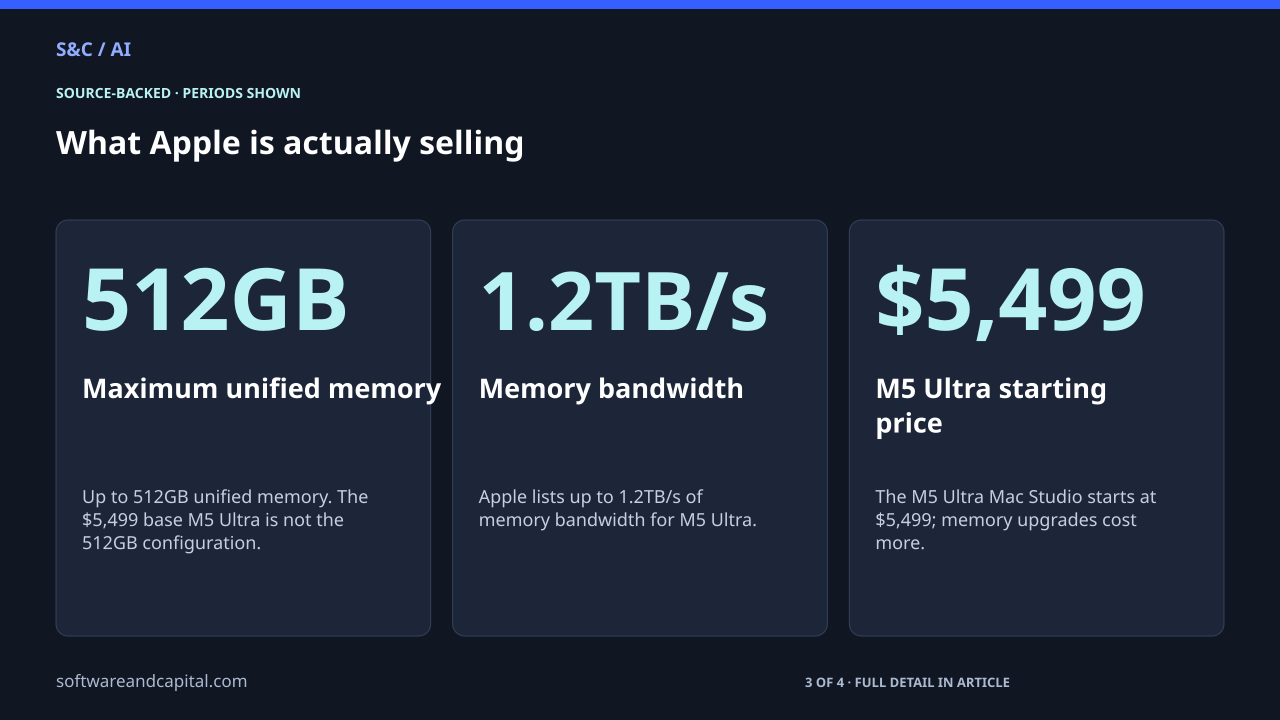
What Apple is actually selling
Up to 512GB unified memory. The $5,499 base M5 Ultra is not the 512GB configuration.
The M5 Ultra Mac Studio starts at $5,499; memory upgrades cost more.
Memory is what makes the machine interesting for AI
Cloud APIs hide the hardware. Local inference does not. A model must fit into available memory along with the software needed to run it. A 512GB shared-memory ceiling opens workloads that would be awkward on ordinary desktops, particularly large open-weight models or workflows that keep several models resident at once.
| Question | Local Mac Studio | Cloud API |
|---|---|---|
| Cost shape | Upfront hardware plus power and maintenance | Variable usage charges |
| Data path | Work can stay on local hardware | Prompts and data are sent to the provider under its terms |
| Capacity | Limited by purchased hardware and model fit | Can scale without buying local machines |
| Utilization | Idle hardware still costs money | Low usage can be inexpensive |
| Operations | Team owns setup, updates and failures | Provider operates the model infrastructure |
The $5,499 headline is not the price of 512GB
Apple’s base M5 Ultra price and its maximum-memory specification describe different configurations. The company says the 512GB option arrives in late October. Any break-even calculation that treats $5,499 as the fully loaded 512GB machine would be wrong before it starts.1, 2
A cluster makes the server analogy stronger
Apple also supports clustering Mac Studio systems over Thunderbolt 5 with remote direct memory access. Apple says four systems can create a larger shared memory pool and deliver up to three times the inference performance of one system in its tests. That is a vendor benchmark, but the architecture matters because it turns a desktop into a building block for a small local compute pool.1
There is no universal break-even point
A team running a model all day has a different cost problem from someone making a few API calls each week. Local economics improve when hardware is heavily utilized and the same model can be reused. Cloud economics improve when demand is intermittent, model requirements change quickly or a provider’s latest model is more valuable than owning fixed hardware.
The five numbers a real comparison needs
- The actual configured hardware price, not the base model price.
- The model’s memory footprint and expected tokens or requests per day.
- Electricity, cooling, support and staff time for local operation.
- The cloud provider’s real input, output, caching and batch prices.
- How long the team expects the purchased hardware to remain useful.
The existing AI workflow cost guide makes the same point at the software layer: cost per call is not the same as cost per successful task. A local machine adds another decision about who owns the compute underneath that workflow.
Sources and methodology
Sources checked September 26, 2026. Dates and periods for individual figures are stated beside them.
- Apple: Mac Studio with M5 Max and M5 Ultra ↗Accessed 2026-09-26
- Apple: New Mac mini and Mac Studio are available today ↗Accessed 2026-09-26
Scope and assumptions
Apple’s performance comparisons are vendor benchmarks and configuration-dependent.
The 512GB configuration price is not the $5,499 base price and was not yet shipping as of September 26.
No universal local-versus-cloud break-even is calculated because utilization, model choice, power and API pricing vary.
Continue reading
2¢ vs 4¢: When the Cheaper AI Call Costs More →
OpenAI Cut Its New Model Prices in Half. What Gets Cheaper When Intelligence Does? →