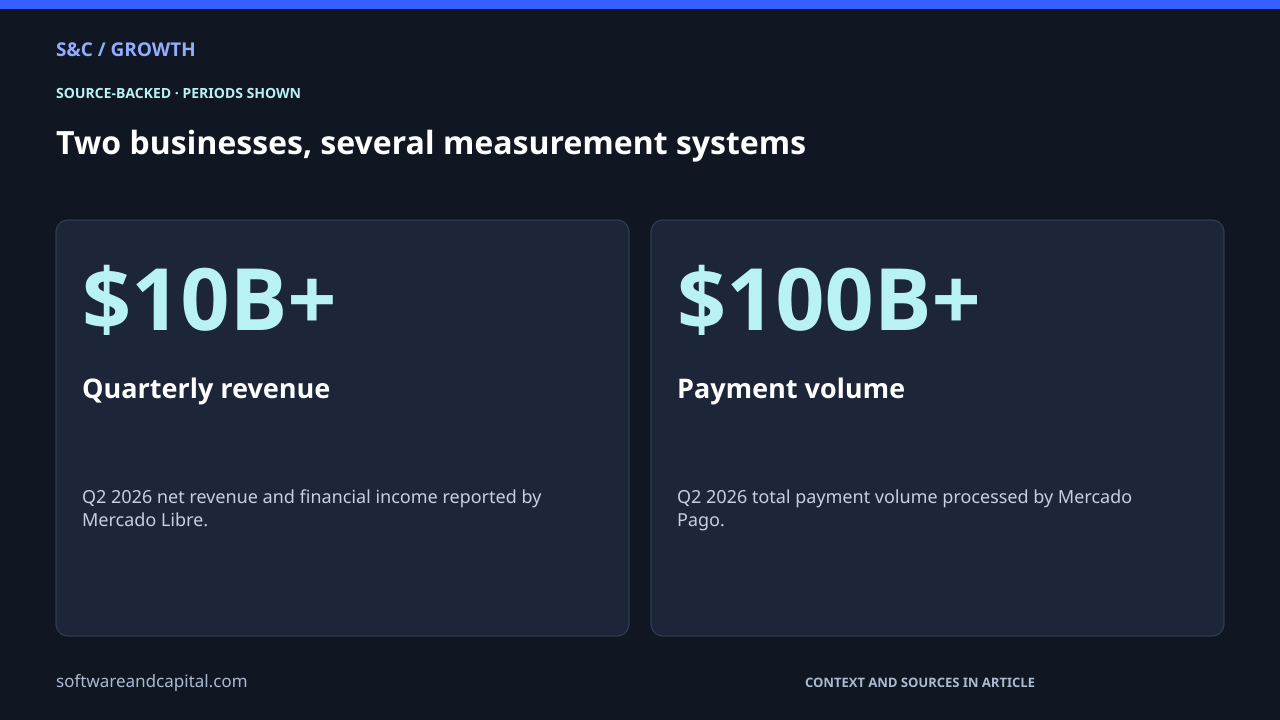
Mercado Libre crossed two very different thresholds in Q2 2026: more than $10 billion in quarterly net revenue and financial income, and more than $100 billion in payment volume. One is money the company recognizes in its business. The other is money moving through Mercado Pago. Their relationship explains the ecosystem better than either headline alone.1
Mercado Libre’s Q2 2026 results crossed $10 billion in quarterly net revenue and financial income while Mercado Pago processed more than $100 billion in total payment volume. The figures describe different things, but together they show why Mercado Libre is best understood as a commerce-and-fintech ecosystem rather than only an online marketplace.1, 2
Two businesses, several measurement systems
Commerce creates reasons to use fintech
A marketplace transaction naturally needs payment, fraud controls, seller settlement and sometimes credit. Building those services inside the ecosystem can reduce friction for commerce while giving Mercado Pago a stream of users and merchants with an existing reason to transact.2
Fintech can outgrow the marketplace boundary
The reverse relationship matters too. Mercado Pago can be used beyond Mercado Libre’s marketplace. Payments, accounts, credit and investment products can deepen the customer relationship even when a person is not currently shopping. That gives fintech its own growth surface while still reinforcing commerce.2
| Metric | What it measures | Do not confuse it with |
|---|---|---|
| Net revenue and financial income | Company-recognized business revenue | Gross merchandise value or payment volume |
| TPV | Value of payments processed | Mercado Libre revenue |
| Active users | People using ecosystem products | Paying customers in one product |
| Assets under management | Customer assets in financial products | Quarterly revenue |
Cross-ecosystem users are strategically valuable
A customer who shops, pays and uses financial products gives Mercado Libre more opportunities to create value than a customer with only one relationship. That does not prove every additional product is profitable. It explains why the company keeps connecting logistics, commerce and financial services rather than optimizing them as isolated businesses.
What the two headline numbers do not prove
- That $100 billion of payment volume becomes $100 billion of revenue.
- That every marketplace buyer uses Mercado Pago outside the marketplace.
- That fintech and commerce have the same margins or capital needs.
- That ecosystem breadth guarantees future growth at the same rate.
The useful picture is a flywheel with different gauges. Commerce supplies transactions and merchant relationships. Fintech can make those transactions easier and build a broader financial relationship. The gauges should stay separate even when the businesses reinforce each other.
Sources and methodology
Sources checked September 25, 2026. Dates and periods for individual figures are stated beside them.
- Mercado Libre Q2 2026 results ↗Accessed 2026-09-25
- Mercado Libre: About MELI ↗Accessed 2026-09-25
Scope and assumptions
Payment volume is not revenue, and the article does not infer take rate or profit from TPV alone.
The strategic flywheel is analysis of the company’s disclosed ecosystem, not evidence that every user adopts multiple products.