A SoFi customer can tap a familiar debit or credit card without thinking about a blockchain. The change happens after the purchase. SoFi and Mastercard say settlement using SoFiUSD is now live, meaning the institutions can use a dollar-backed digital token to settle card transactions while the checkout experience still looks like ordinary card payments.1, 2
SoFi is not asking cardholders to pay merchants with crypto. It is changing the settlement asset behind its Mastercard debit and credit program. SoFi says the program is expected to process more than $25 billion in annualized volume and is being migrated to SoFiUSD settlement, while the customer-facing card transaction can remain familiar.1, 2
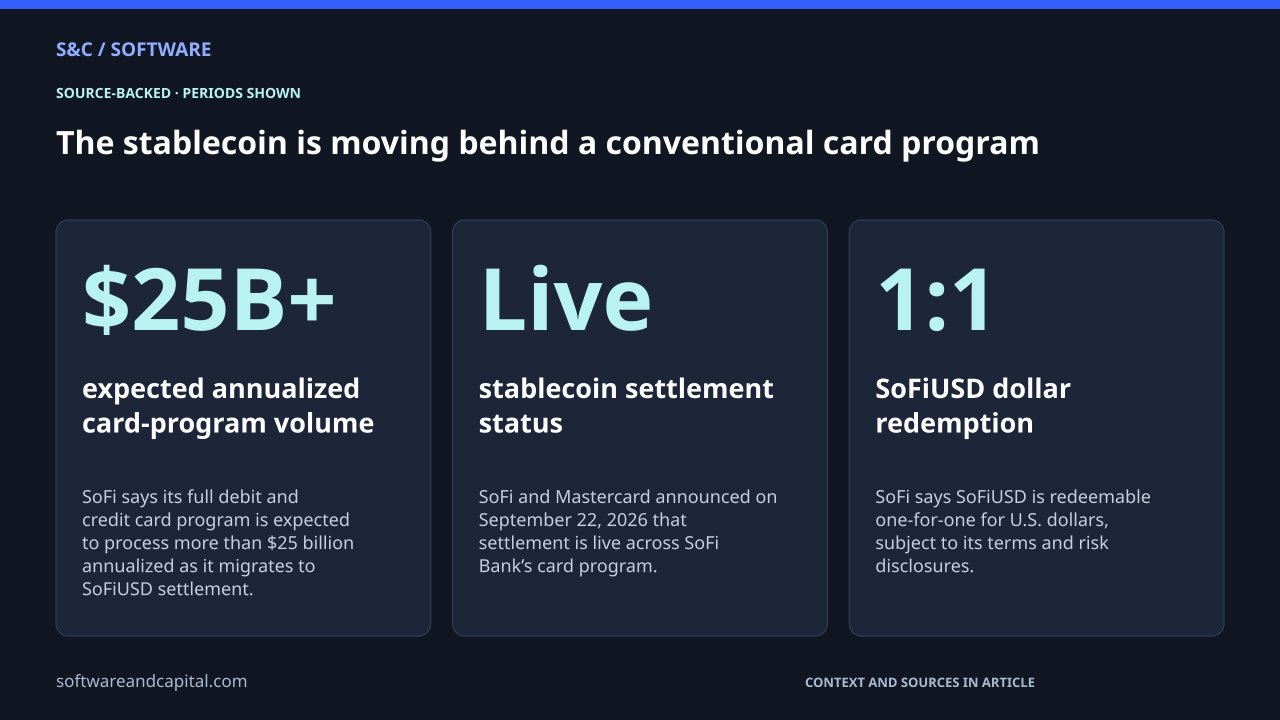
The stablecoin is moving behind a conventional card program
SoFi says its full debit and credit card program is expected to process more than $25 billion annualized as it migrates to SoFiUSD settlement.
SoFi and Mastercard announced on September 22, 2026 that settlement is live across SoFi Bank’s card program.
SoFi says SoFiUSD is redeemable one-for-one for U.S. dollars, subject to its terms and risk disclosures.
The $25 billion number needs careful wording. It is expected annualized volume for the card program, not stablecoin revenue and not a claim that $25 billion has already moved onchain. SoFi also discloses that SoFiUSD is not a bank deposit, is not FDIC or SIPC insured, is not legal tender and may lose value despite its one-for-one redemption design.1
The customer payment and the bank settlement are different events
When a customer buys something with a card, the network authorizes and routes the payment. Financial institutions later settle what they owe one another. Mastercard’s March announcement described SoFiUSD as an option for that second layer. The important distinction is that a merchant does not need to put a stablecoin button on the checkout page for stablecoins to be used in settlement.2
| Step | What the customer sees | What happens behind the scenes |
|---|---|---|
| Purchase | A normal SoFi debit or credit card transaction | The card network authorizes and routes the transaction. |
| Network accounting | No new consumer action | Mastercard calculates settlement obligations between participating institutions. |
| Settlement | Usually invisible to the cardholder | SoFi can use SoFiUSD as the settlement asset for its card program. |
| Redemption or liquidity | No requirement for the shopper to hold SoFiUSD | Institutional users can redeem SoFiUSD for U.S. dollars subject to the product terms. |
Why use a stablecoin when dollars already work?
Mastercard says stablecoin settlement can give partners more flexibility around timing and liquidity while operating alongside existing payment processes. Its broader June rollout also added stablecoin, intraday, holiday and weekend settlement options. Those are infrastructure choices for institutions, not evidence that every transaction is cheaper or faster in every case.3
SoFi’s September release goes further from plan to production. The company says its own debit and credit card program is migrating to blockchain-based settlement and that transactions are live on the blockchain. It also says merchants do not need to hold stablecoins or build new infrastructure to receive settlement through SoFi’s banking products.1
The bigger stablecoin story may be invisibility
Our Deel payroll analysis shows a worker choosing to hold or withdraw a stablecoin balance. Our PayPal World article shows existing wallets being connected across borders. SoFi’s card settlement is another model: the blockchain layer can matter to the institutions even when the shopper never handles a token.
What would show stablecoin card settlement is becoming infrastructure
- Volume actually settled: measured onchain settlement activity rather than expected card-program volume.
- More institutions: additional issuers, acquirers or merchants using stablecoin settlement beyond SoFi’s own program.
- Operational evidence: documented improvements in settlement timing, liquidity or availability under real conditions.
- Durability: continued use across changing interest-rate, regulatory and crypto-market environments.
The interesting part of SoFi’s launch is not that a shopper can suddenly spend stablecoins everywhere. It is almost the opposite. Stablecoins can move into ordinary financial infrastructure without asking consumers to change the way they pay. If that pattern spreads, the most important blockchain payment may be the one the cardholder never notices.
Sources and methodology
Sources checked September 24, 2026. Dates and periods for individual figures are stated beside them.
- SoFi: Stablecoin settlement goes live across Mastercard card program ↗Accessed 2026-09-24
- Mastercard: SoFiUSD settlement partnership ↗Accessed 2026-09-24
- Mastercard: Expanded stablecoin settlement capabilities ↗Accessed 2026-09-24
Scope and assumptions
The more-than-$25-billion figure is expected annualized card-program volume, not stablecoin revenue and not a statement that the full amount has already settled onchain.
Claims about faster settlement, liquidity and around-the-clock access are company and network descriptions of the mechanism. The article does not assert independently measured savings.
SoFiUSD carries product and regulatory risks and is explicitly disclosed as not being a bank deposit or FDIC-insured product.
Continue reading
Deel’s Stablecoin Wallet Is in 80+ Countries. Is Payroll Becoming Crypto Infrastructure? →
PayPal Wants Your Home Wallet to Work Abroad →
88% of Coinbase Net Revenue Now Comes From Outside Bitcoin Spot Trading →