An AI assistant on a phone waits until you pick it up. Glasses can be present while you walk, cook, work or talk to another person. Meta says millions of people now use its AI glasses every day. The attraction is obvious: the assistant can hear what you ask and, in some modes, see what you see.1, 2
Meta says millions of people use its AI glasses every day. Its current glasses combine audio, cameras and an AI assistant, while privacy safeguards include a visible capture LED for saved photos and video and camera disablement when that LED is blocked. Regulators also warn that wearable cameras can make recording and AI use less obvious to bystanders.1, 2, 3
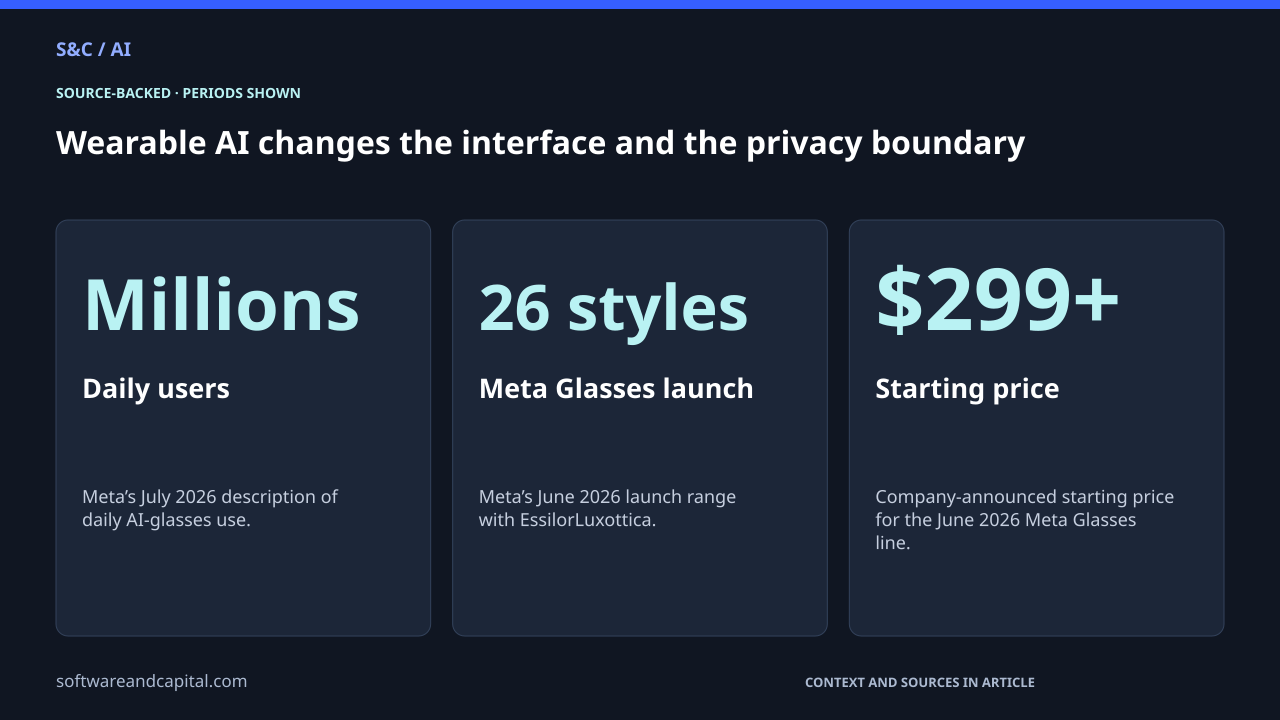
Wearable AI changes the interface and the privacy boundary
The important change is not simply miniaturization. Moving cameras, microphones and an assistant onto something worn all day makes technology easier to invoke and harder for everyone else to ignore. The wearer gains convenience. The people nearby gain a new reason to ask what the device is sensing or recording.
The assistant gets closer to the moment
Meta describes its glasses as a way to ask about what is in front of you, manage parts of the day hands-free, capture media and use live translation. That removes steps between a question and the surrounding context. The user does not have to point a phone, open an app and frame the scene in the same way.2
That is the same interface shift visible in Gemini’s voice and camera usage, but the hardware changes the frequency and social setting. A camera on the face can be available in moments when pulling out a phone would be conspicuous or inconvenient.
| Question | Phone | AI glasses |
|---|---|---|
| How is it invoked? | Take out device and open or speak to software. | Voice/touch can be available while the device is already worn. |
| What context can it receive? | Typed text, files, microphone and camera when activated. | Audio plus a wearer-perspective camera in supported features. |
| Who notices? | Holding up a phone is usually visible. | The hardware can resemble ordinary eyewear, so signals matter more. |
Meta built a recording signal because bystanders matter
Meta says saved photos and videos use a white capture LED, and that newer glasses disable the camera when the system detects the LED has been blocked or physically tampered with. The company presents the light as a signal to people nearby, not only feedback for the wearer.1
That safeguard also reveals the underlying problem: the wearer is not the only person affected by a wearable camera. The UK Information Commissioner’s Office said in September 2026 that smart glasses raise serious questions around surveillance, safety and trust, especially when people are recorded without their knowledge.3
The ICO also cautioned against treating the technology as inherently good or bad. Wearable cameras and AI can help with accessibility and navigation while creating opportunities for intrusive use. The policy problem is how to preserve useful applications while making sensing and data use understandable to the people around the wearer.3
Not every camera use looks like recording
Meta’s privacy explanation focuses the capture LED on media saved for a gallery. AI features can use camera input for other purposes, such as interpreting what the wearer is looking at. That distinction matters because a bystander may care about sensing even when a conventional photo or video is not being saved.1
The right question is therefore broader than “is the light on?” It includes what the device is processing, what gets stored, what is sent to a service, how long it is retained and how clearly another person can understand the interaction. Product rules can differ by feature and software generation.
Wearable AI competes on friction
Why glasses can change assistant use
- Availability: the device is already on the body when a question arises.
- Context: the assistant can potentially receive a wearer-perspective view instead of a written description.
- Hands-free use: the interaction can happen while the user is doing something else.
- Social trust: bystanders need understandable signals and safeguards because they did not choose to wear the device.
The smartphone made computing something people carry. AI glasses try to make an assistant something people wear. If that works, the biggest change may be less about any single model improvement and more about how often computing can enter an ordinary moment.
That same convenience is why privacy cannot be treated as a settings page for the owner alone. A face-worn assistant shares physical space with everyone nearby. The successful product has to work for the wearer without making everyone else wonder whether ordinary life has become invisible input.
Sources and methodology
Sources checked September 22, 2026. Dates and periods for individual figures are stated beside them.
- Meta: AI glasses privacy and capture-LED questions ↗Accessed 2026-09-22
- Meta: Meta Glasses launch with EssilorLuxottica ↗Accessed 2026-09-22
- UK ICO: Smart glasses, privacy and public trust ↗Accessed 2026-09-22
Scope and assumptions
Daily usage is company-reported and no independent market-share or retention estimate is asserted.
Privacy practices vary by feature and software version; the article does not claim the capture LED signals every type of AI camera processing.