A free YouTube session feels like a bargain funded by the occasional interruption. But the business is bigger than the ads you skip. Alphabet said YouTube’s 2025 revenue surpassed $60 billion when subscriptions were included, revealing a substantial paid business behind the familiar free screen.1
Alphabet said YouTube generated more than $60 billion across advertising and subscriptions in 2025. Its filing reports $40.367 billion in YouTube ad revenue. Subtracting that from the disclosed threshold implies more than $19.633 billion from subscriptions. That is a lower bound, not an exact subscription total or a profit figure.1, 2
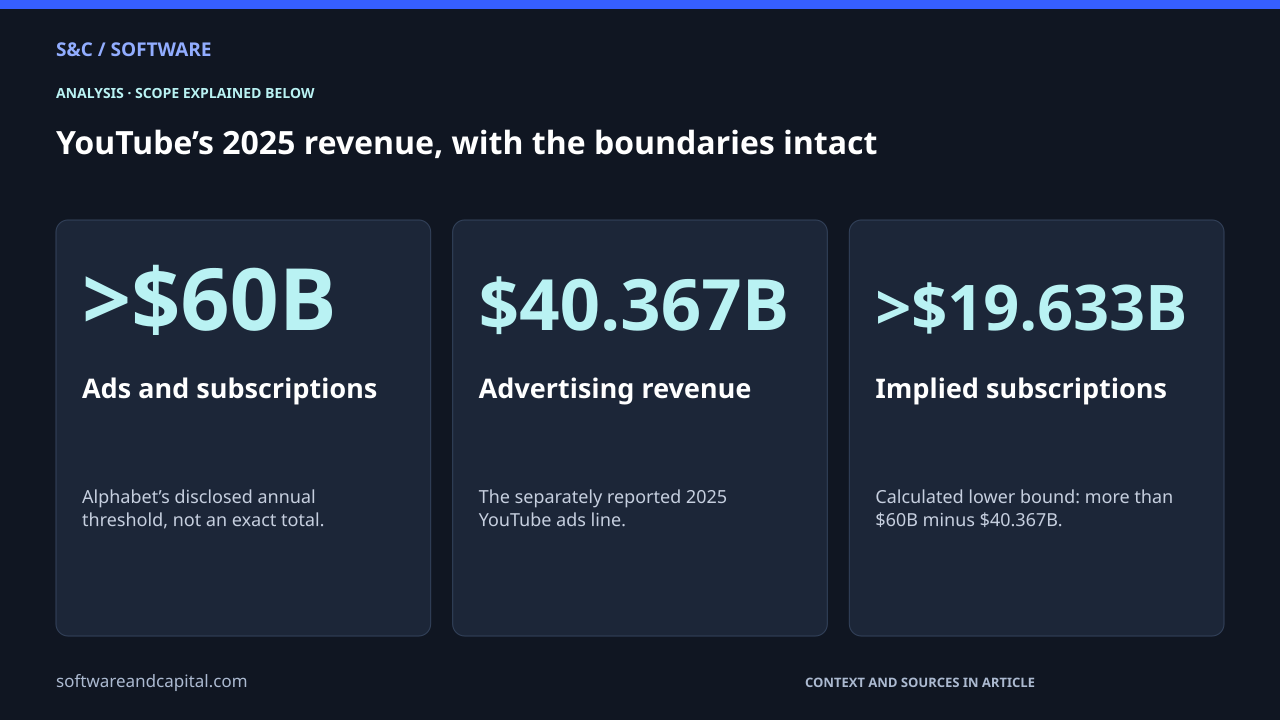
YouTube’s 2025 revenue, with the boundaries intact
The extra business is not hidden because people have never heard of paid YouTube. It is hidden by the way many readers encounter the numbers: a clear advertising line in the results table, and a broader total elsewhere in management’s explanation.
The same platform can sell different things
Alphabet lists YouTube TV, YouTube Music and Premium, and NFL Sunday Ticket among its consumer subscription offerings. Those services sell different experiences. A paid music or video experience is not the same product as a live-TV package, even though both sit under the YouTube name.2
That gives YouTube more than one way to earn money from the same broad audience. An advertiser pays for access to attention. A subscriber pays for a service or experience. The relevant question changes from “How many ads can this video carry?” to “What will this viewer pay to keep using?”
Management’s fourth-quarter call described growth in YouTube subscriptions, particularly Music and Premium. It also described advertising growth driven by direct-response demand. The two engines can move for different reasons, so one quarter’s ad growth is not a complete report card on the platform.3
A subtraction reveals scale, not a secret exact figure
The calculation is straightforward: more than $60 billion minus $40.367 billion leaves more than $19.633 billion. The result establishes a minimum implied subscription contribution within the combined definition. It does not reveal the exact revenue of Premium, Music or TV separately.1, 2
| Number | Scope | How to read it |
|---|---|---|
| More than $60B | YouTube ads plus subscriptions, 2025. | The advertising amount is already included. |
| $40.367B | YouTube advertising, 2025. | One component of that combined total. |
| $48.030B | Google subscriptions, platforms and devices, 2025. | A broader Alphabet category, not YouTube subscriptions alone. |
There is another tempting shortcut in the same results discussion. Alphabet said it had more than 325 million paid subscriptions across consumer services. That includes services beyond YouTube. It is not a YouTube-only subscriber count and cannot be used as one to calculate revenue per YouTube customer.1
The revenue is large. It is not all retained by YouTube
YouTube’s partner documentation illustrates one important cost relationship: creators who accept its Watch Page Monetization Module receive 55% of net advertising revenue under that module. Other features use other arrangements. Applying a blanket 55% rate to every dollar of the company’s revenue would therefore be wrong.4
The broader business also has to pay for its product and the content it offers. The published company reporting does not give a standalone YouTube net-profit figure. Revenue tells us what the business brings in, not what remains after all of those costs.2
The same distinction appears in Shopify’s revenue and gross-profit split. A larger revenue stream can have different economics from a smaller one. Recognizing the source of the money is the first step, not the final verdict on the business.
Why the subscription side changes the story
A subscription business depends on people finding enough continuing value to stay. For YouTube, that value may sit in convenience, music, television or a particular viewing package. Those are different reasons to pay, which is why a single label can conceal several customer relationships.
The important discovery is not that YouTube suddenly stopped being an advertising company. Advertising remained a huge reported business. It is that the ads line no longer describes the full scale of what the platform sells.
For the next YouTube results headline, ask which business it measures. An ad slowdown and a growing paid service could coexist. A rising combined total could also hide very different movements underneath. The familiar play button opens more than one revenue stream.
Sources and methodology
Sources checked September 21, 2026. Dates and periods for individual figures are stated beside them.
- Alphabet: Q4 2025 CEO remarks, February 4, 2026 ↗Accessed 2026-09-21
- Alphabet: 2025 Form 10-K, revenue and segment disclosures ↗Accessed 2026-09-21
- Alphabet: Q4 2025 earnings-call transcript ↗Accessed 2026-09-21
- YouTube Help: Partner earnings and revenue-sharing overview ↗Accessed 2026-09-21
Scope and assumptions
All financial figures concern calendar 2025 and were disclosed in February 2026. The subscription calculation is a lower bound derived from a threshold, not an exact segment disclosure.
YouTube product-level revenue and standalone net profit are not inferred from broader Google reporting. Revenue-sharing terms differ by feature.
AI-assisted research and editing. Our editorial standards.
Continue reading
76% of Shopify’s Revenue Came from Merchant Solutions in 2025 →