The most immediate use of clinical AI may be less dramatic than diagnosing a disease. Oracle is pushing its Clinical AI Agent deeper into the paperwork surrounding care: finding information in the chart, summarizing it, capturing structured nursing documentation and helping physicians create notes.
Oracle is extending its Clinical AI Agent into nursing workflows including chart search, summaries and voice-enabled discrete charting. Oracle also says physician note generation has saved more than 400,000 hours across U.S. health organizations. That figure is company-reported, but the deployment illustrates where clinical AI may scale first: administrative work embedded inside the EHR.1, 2
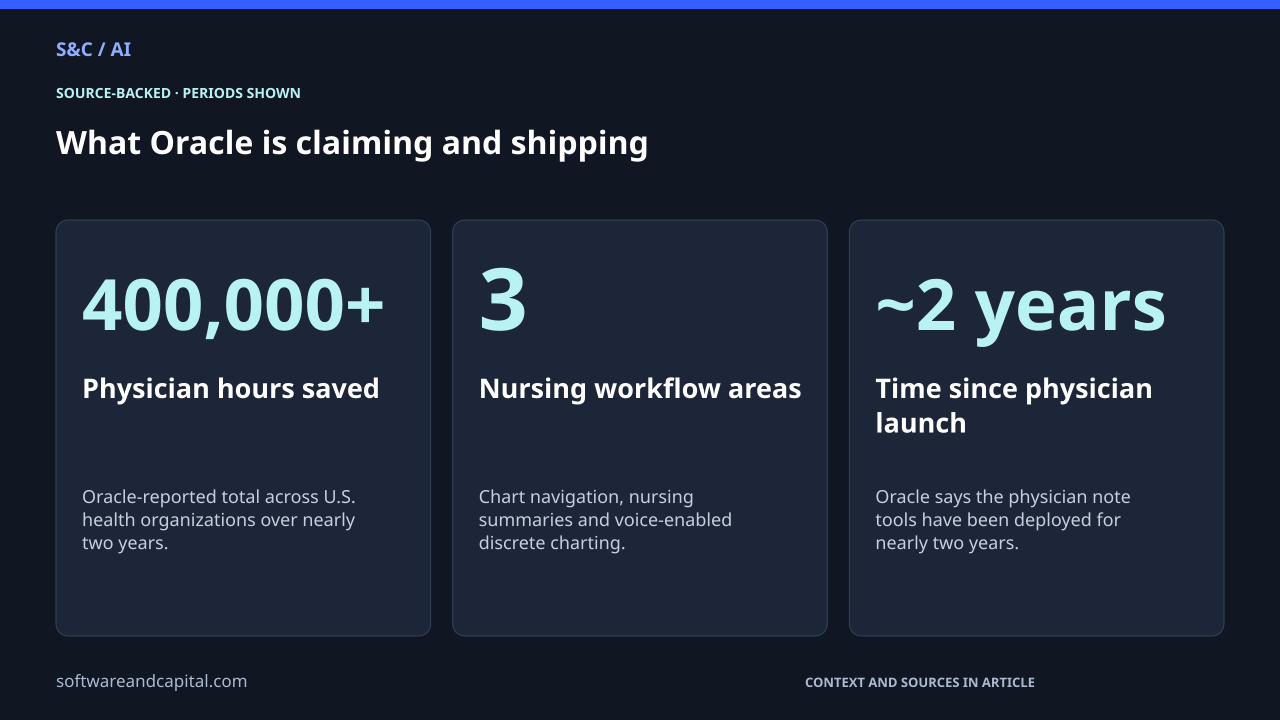
What Oracle is claiming and shipping
Oracle-reported total across U.S. health organizations over nearly two years.
Oracle says the physician note tools have been deployed for nearly two years.
The product sits inside the EHR
Oracle says the nurse capabilities are embedded in Oracle Health Foundation EHR. That placement matters because documentation automation is most useful when it can see the authorized chart context and put structured information back into the workflow without forcing the clinician into another application.1
| Task | AI role described by Oracle | Who remains responsible |
|---|---|---|
| Chart navigation | Search and surface information | Clinician interprets the record |
| Nursing summary | Generate a concise view of chart information | Nurse validates relevance and accuracy |
| Discrete charting | Capture structured documentation by voice | Nurse reviews the charted information |
| Professional coding | Suggest charge codes in supported workflows | Organization retains coding and billing responsibility |
The 400,000-hour figure needs a denominator
Oracle repeats the 400,000-hour savings claim across recent product announcements, but the public releases do not provide a controlled study, the total number of clinicians, the number of notes or an independent audit. It is useful evidence of claimed scale, not proof of a universal productivity gain.1
Why paperwork may be the easier beachhead
Administrative tasks have a clearer finish line than diagnosis. A note exists or it does not. A chart field is populated or it is not. That does not make errors harmless, but it gives health systems a narrower workflow to review before expanding AI into decisions with more direct clinical consequences.
What stronger evidence would look like
- Time studies that report minutes saved per clinician and the number of cases observed.
- Error and correction rates before and after AI-assisted documentation.
- Independent comparisons across health systems rather than only vendor-reported totals.
- Evidence that time saved in documentation actually becomes more patient-care time rather than another administrative task.
The distinction mirrors S&C’s medical AI evidence guide. A tool can be useful without making an autonomous medical decision. For Oracle’s product, the near-term business case is the time and friction around care, not replacing clinical judgment.
Sources and methodology
Sources checked September 26, 2026. Dates and periods for individual figures are stated beside them.
- Oracle: Clinical AI Agent for nurses via PR Newswire ↗Accessed 2026-09-26
- Oracle: Clinical AI Agent coding, dictation and chart review via PR Newswire ↗Accessed 2026-09-26
Scope and assumptions
The 400,000-hour figure is Oracle-reported and the public materials do not provide a denominator or independent audit.
The article does not claim improved patient outcomes or recommend clinical use of the product.
Nursing and physician workflows differ by organization and EHR configuration.
Continue reading
Why So Much Medical AI Is Hiding in Radiology →
Airbnb Says AI Now Resolves Nearly 45% of Support Issues Without a Human →