AI productivity claims are usually hard to pin down because the unit of work keeps moving. Airbnb’s customer-support disclosure is unusually concrete. The company measures what happens to issues that begin with its AI assistant, then separately reports what happened to customer-support-related cost per booking. That gives us two useful numbers without pretending they answer every labor question.1, 2
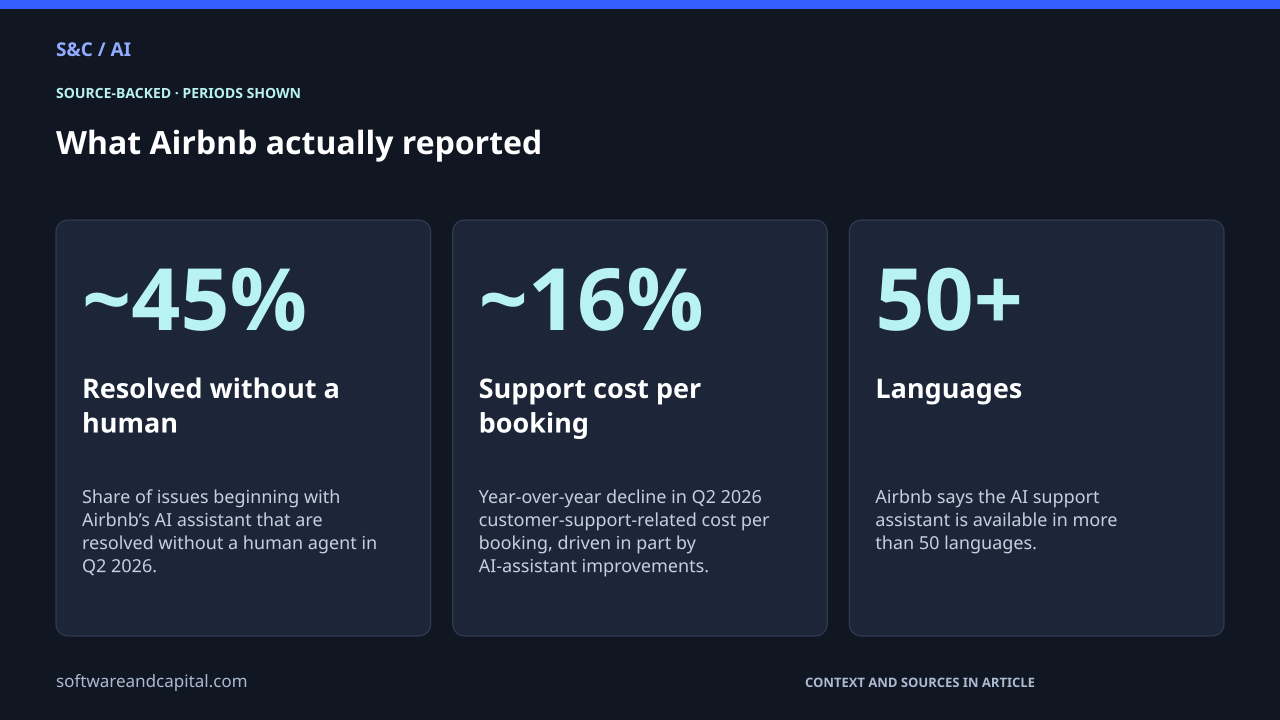
Airbnb says nearly 45% of issues that begin with its AI assistant are resolved without a human agent. In Q2 2026, customer-support-related cost per booking fell about 16% year over year, driven in part by AI improvements. The figures show operating leverage in one bounded workflow, not that AI caused all savings or replaced support staff.1, 2
What Airbnb actually reported
Share of issues beginning with Airbnb’s AI assistant that are resolved without a human agent in Q2 2026.
Year-over-year decline in Q2 2026 customer-support-related cost per booking, driven in part by AI-assistant improvements.
The denominator matters. Airbnb did not say AI resolved 45% of every support interaction. It said nearly 45% of issues that begin with the AI assistant are resolved without a human. Customers who bypass the assistant or cases that escalate immediately sit outside that specific measure.1, 2
Resolution rate is a workflow metric, not a jobs count
A resolved issue means a human agent did not have to finish that particular case. It does not reveal staffing levels, hours worked, issue complexity, or whether employees were reassigned to harder cases. The metric is useful because it measures a completed support outcome, but it cannot support a layoff claim on its own.1
That distinction mirrors the broader point in our AI job-exposure analysis: automation can change tasks before it cleanly changes job titles. Customer support gives us a narrower place to watch that process because issue resolution is easier to count than an entire occupation.
The cost metric moved in the same direction
Airbnb reported that customer-support-related cost per booking fell about 16% year over year in Q2. The company says the decline was driven in part by improvements to the AI assistant. Those words matter. They support AI as a contributor to the savings, not a claim that AI caused the entire 16% decline.1, 2
| Metric | What it supports | What it does not prove |
|---|---|---|
| Nearly 45% AI resolution | A large share of AI-started support issues can now finish without a human agent. | That 45% of all Airbnb support is automated, or that the same rate applies to every issue type. |
| ~16% lower support cost per booking | Airbnb’s support cost per booking fell materially year over year. | That AI alone created the full cost decline or that total support spending fell by 16%. |
| More than 50 languages | The assistant is deployed across a broad language footprint. | Equal quality, issue mix or resolution rates in every language and market. |
Customer support has a useful boundary for AI
Support work contains repeated questions, account context and well-defined outcomes such as resolving a booking issue or handing the case to a person. That makes it easier to create a sensible escalation path than in an open-ended role where “done” is hard to define. Meta is making a similar bet with Business Agent, though its disclosed metrics are different.
The important design choice is the handoff. An assistant can handle routine cases cheaply only if it recognizes when a customer needs a human. A high containment rate with poor outcomes would not be operating leverage. Airbnb does not disclose satisfaction or error rates for AI-resolved cases in these materials, so cost and containment cannot stand in for quality.1, 2
The next useful number is quality after automation
What would make the operating-leverage case stronger
- Customer satisfaction or repeat-contact rates for AI-resolved issues versus human-resolved issues.
- Resolution rates by issue type, especially for simple versus complex cases.
- The share of total support volume that begins with the AI assistant.
- How support staffing and human-agent workload change as AI containment rises.
Airbnb’s disclosure is useful precisely because it is narrower than the usual AI productivity headline. We can see one workflow, one completion metric and one cost metric moving together. That is stronger evidence of operational change than a demo. It is still not enough evidence to turn a support statistic into a sweeping claim about jobs.
Sources and methodology
Sources checked September 23, 2026. Dates and periods for individual figures are stated beside them.
- Airbnb: Second-quarter 2026 financial results ↗Accessed 2026-09-23
- Airbnb: Q2 2026 shareholder letter, SEC-filed exhibit ↗Accessed 2026-09-23
Scope and assumptions
The nearly 45% figure applies only to issues that begin with Airbnb’s AI assistant, not all customer-support contacts.
Airbnb says AI improvements contributed to the 16% decline in support-related cost per booking but does not quantify AI’s share of that decline.
The cited materials do not disclose staffing changes, issue mix, customer satisfaction or error rates for AI-resolved cases.
Continue reading
1M Businesses Already Use Meta’s AI Agent. Is Customer Service Becoming a Meta Product? →
1 in 4 Workers Is Exposed to AI. That Is Not a Layoff Forecast →
Amazon Has 1 Million Robots. What Happens to the Warehouse Job? →