Most ecommerce systems know what a customer bought. OuterSignal wants brands to know who the buyer is: occupation, interests, social reach, family signals and other context layered onto the order history. The company has raised $22 million to turn that richer profile into automated marketing actions.1, 2
OuterSignal raised a $22 million Series A for a customer-intelligence platform that connects to commerce or CRM data, enriches buyer records with public information and uses the resulting profiles for segmentation, VIP detection, campaigns and advertising. The company says it serves thousands of businesses. The useful distinction is provenance: purchase data, public enrichment and model-derived or clustered attributes do not carry the same certainty.1, 2
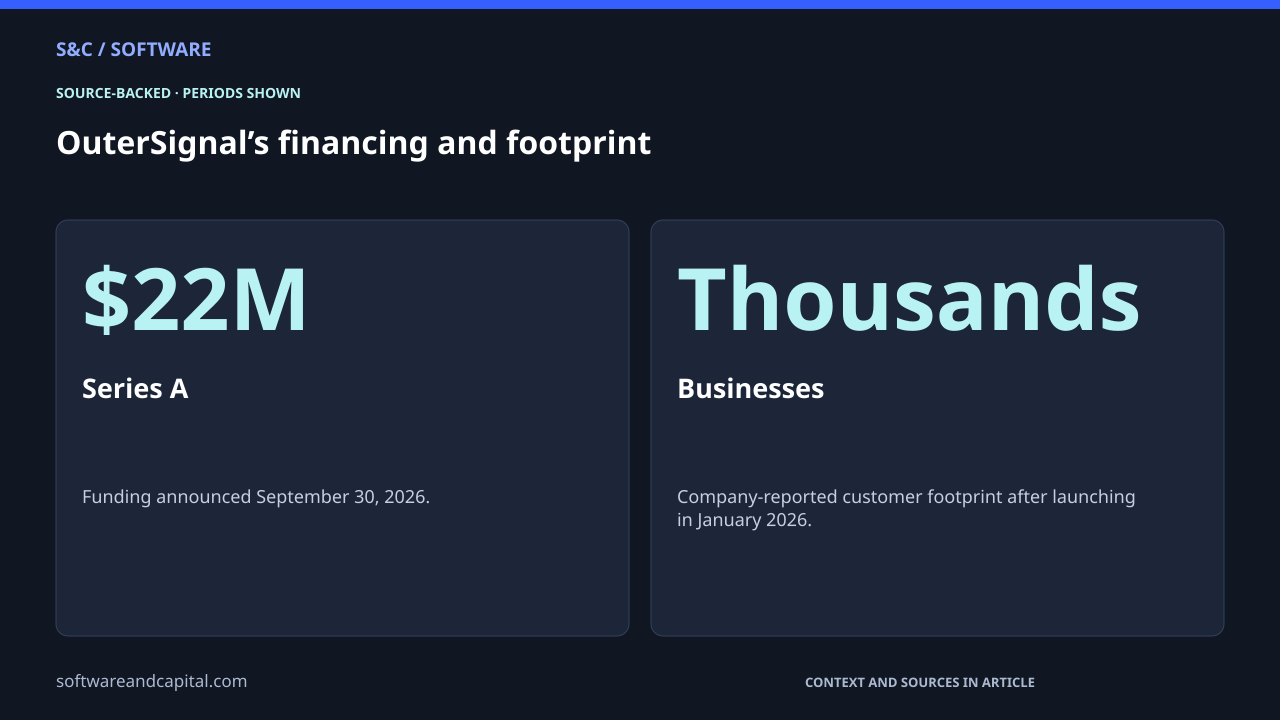
OuterSignal’s financing and footprint
The important distinction is where each attribute came from
OuterSignal connects first-party commerce or CRM records with public information to enrich a customer profile. It then groups and activates those profiles for marketing. A purchase amount is observed first-party data. an occupation or interest sourced elsewhere has different provenance. a persona label can be an inference built on top.1, 2
| Profile layer | Example | Confidence question |
|---|---|---|
| First-party transaction | Order history, spend, products | Was it directly observed by the brand? |
| Public enrichment | Occupation, social presence, public biography | Is the source current and correctly matched? |
| Derived segment | VIP, persona or behavioral cluster | How was the label inferred? |
| Automated action | Campaign, alert or ad audience | Should the action require review or an exclusion rule? |
1:1 personalization is really a data-provenance problem
The marketing promise is obvious: stop treating every buyer as an anonymous row. The harder part is keeping observed facts separate from enrichment and inference. A campaign can become more specific at the same time that the underlying profile becomes less certain.1
Agents turn the profile into action
OuterSignal describes 'agentic personalization' as software that can identify people, build segments and activate campaigns without a team hand-building every audience. That makes governance important because errors can move directly from the data layer into customer-facing actions.1
Four questions a brand should ask
- Which profile fields come directly from our own customer records?
- Which fields were enriched from outside sources and how recently?
- Which labels are inferred rather than observed?
- Which automated actions can run without human review or customer exclusion rules?
The next generation of personalization may know far more about each buyer than a traditional CRM. That can make marketing more relevant. It also makes data provenance part of the product: the brand needs to know not only who the system thinks the customer is, but why.
Sources and methodology
Sources checked October 1, 2026. Dates and periods for individual figures are stated beside them.
- OuterSignal: $22M Series A announcement ↗Accessed 2026-10-01
- OuterSignal: Customer intelligence platform ↗Accessed 2026-10-01
Scope and assumptions
Customer counts, performance lift and campaign results are company-reported.
Public-data enrichment and inferred personas can be inaccurate or stale. the article does not independently audit OuterSignal’s matching or privacy controls.
Continue reading
Pinterest Handles 80B Searches a Month. More Than Half Are Commercial →
AI Search Orders on Shopify Are Up Nearly 13×. Is Chat Becoming a Storefront? →
Salesforce Is Buying an AI Company That Interviews Customers—and Simulates Them →