Customer research has traditionally forced a trade-off between depth and scale. Interviews are rich but slow. Surveys reach more people but flatten the conversation. Salesforce is buying Listen Labs because AI promises a third option: conduct many open-ended interviews and then use the resulting research to simulate customer reactions.1, 2
Salesforce signed a definitive agreement to acquire Listen Labs, whose platform uses AI to conduct customer interviews and build simulations from research data. Listen Labs says its participant network exceeds 50 million people and supports interviews in more than 120 languages. The deal price was not disclosed, and simulated customers still require validation against real behavior.1, 2
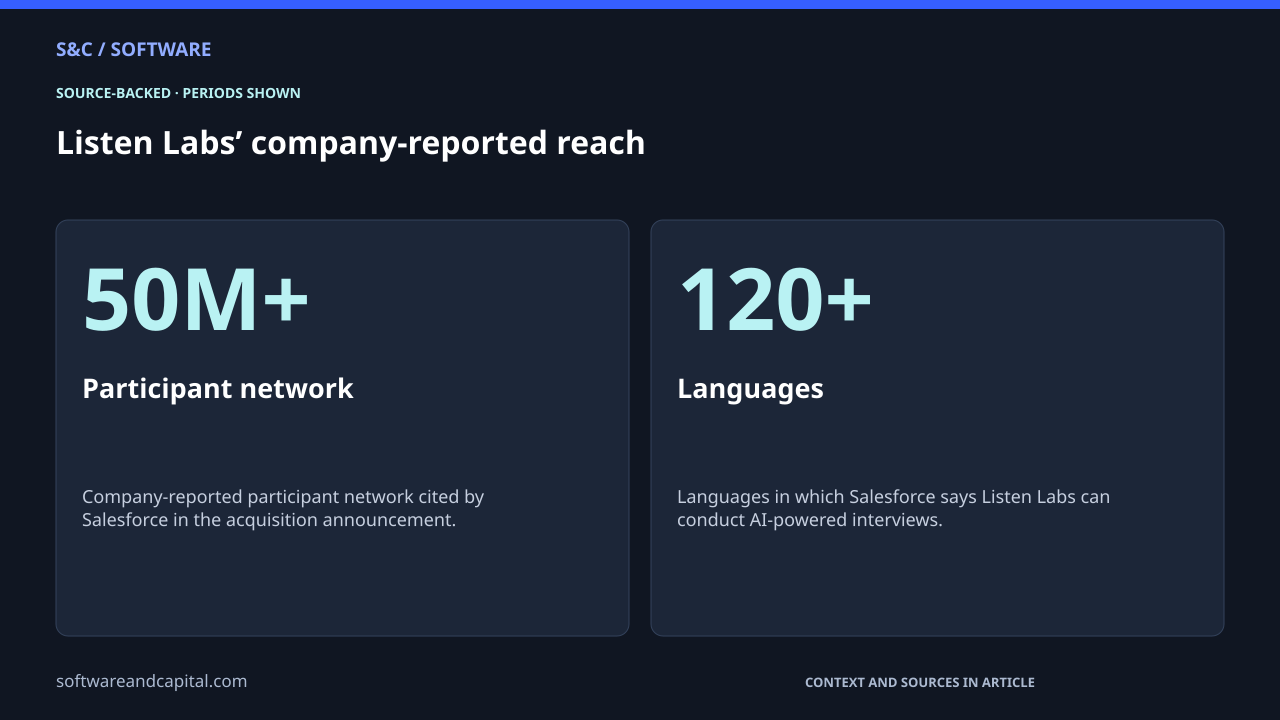
Listen Labs’ company-reported reach
Real interviews and simulated customers are not the same evidence
The platform’s first layer involves actual participants. AI agents can conduct interviews, ask follow-up questions and synthesize responses. The simulation layer is different: models use research and other data to represent how a customer segment might respond to a future question.1, 2
| Layer | Input | What it can support |
|---|---|---|
| AI-run interview | Responses from real participants | Observed statements from the recruited sample |
| Customer simulation | Models built from research and other data | Hypotheses about how a segment may respond |
Simulation can make research faster and easier to over-trust
A synthetic customer can be queried repeatedly without recruiting another person. That makes it useful for exploring ideas. It also creates a validation problem: a model can produce a plausible answer even when real customers would behave differently.
Salesforce can connect research to operating data
Salesforce says it plans to combine Listen Labs with its customer-data and agent products. Strategically, that can shorten the path from a research question to customer records, analysis and an operational response. The acquisition has not yet closed.1
A sensible evidence ladder
- Use simulations to generate or narrow hypotheses.
- Check important hypotheses against real participants or observed customer behavior.
- Keep the sample, segment and data period visible when interpreting interview findings.
- Do not convert a synthetic response rate into a real customer metric.
The acquisition is interesting because it puts qualitative research inside the AI operating stack. The harder question is not whether a simulated customer can answer convincingly. It is whether the simulation predicts anything that survives contact with actual customers.
Sources and methodology
Sources checked September 29, 2026. Dates and periods for individual figures are stated beside them.
- Salesforce: agreement to acquire Listen Labs ↗Accessed 2026-09-29
- Listen Labs: AI customer research platform ↗Accessed 2026-09-29
Scope and assumptions
The acquisition is subject to customary closing conditions and Salesforce did not disclose the purchase price.
Participant-network size and language coverage do not establish that customer simulations predict real-world behavior accurately.
Continue reading
70,000 Employees Use Salesforce’s Internal AI Agent. The Hard Part Was Cleaning the Knowledge Base →
1M Businesses Already Use Meta’s AI Agent. Is Customer Service Becoming a Meta Product? →