AI agents are usually described as cloud software. Perplexity is making the boundary more explicit. Portable Computer can run tasks on supported Windows hardware, work with local files and connected apps, and call cloud models only when the workflow needs reasoning the local stack cannot provide.
Perplexity’s Portable Computer can run AI tasks and recurring workflows locally on supported PCs without consuming Computer credits for local inference. When a task needs more advanced research or reasoning, the system can use cloud models. It is a hybrid architecture, not a claim that every action or every byte always stays on the device.1, 2
The local-cloud split
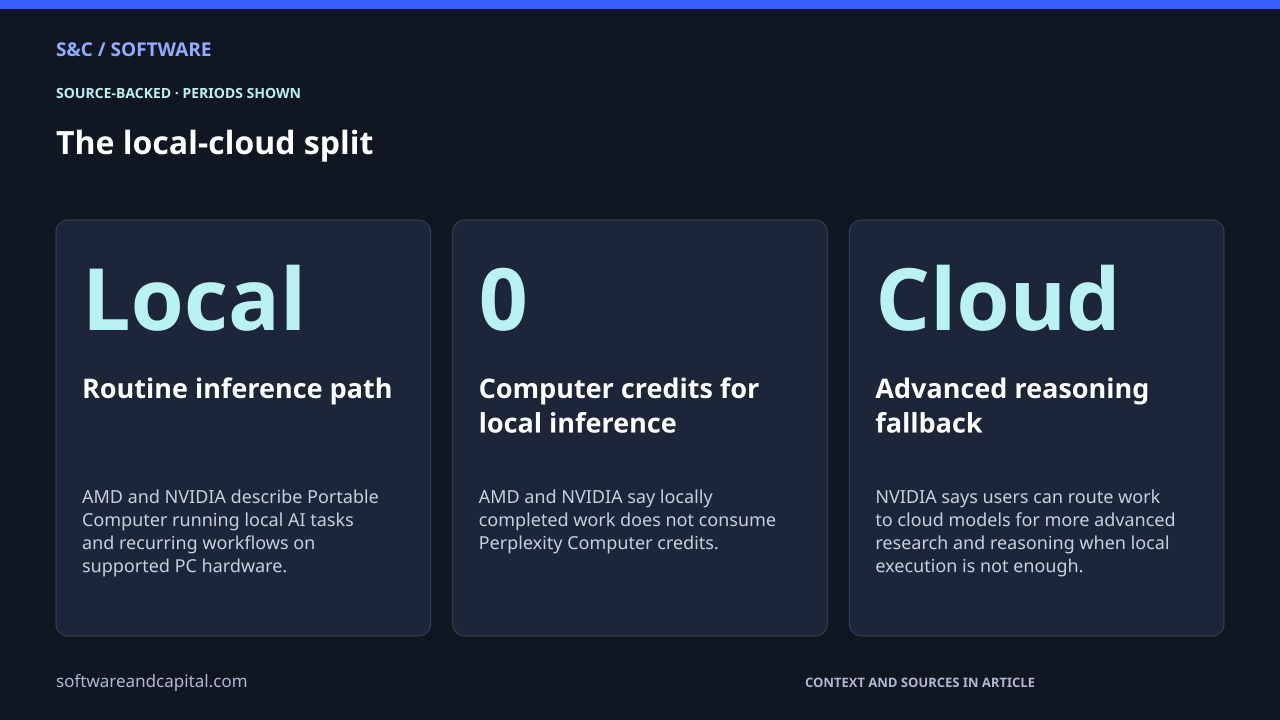
AMD and NVIDIA describe Portable Computer running local AI tasks and recurring workflows on supported PC hardware.
AMD and NVIDIA say locally completed work does not consume Perplexity Computer credits.
NVIDIA says users can route work to cloud models for more advanced research and reasoning when local execution is not enough.
Local-first is not local-only
The useful distinction is where each step runs. A local model can analyze files, organize work or execute recurring workflows on the PC. A harder research or reasoning step can be routed to the cloud. That means ‘local-first’ describes the default execution path, not a guarantee that every step remains on-device.1, 2
| Step | Likely execution layer | What can leave the PC |
|---|---|---|
| Local file analysis | Local device | Nothing necessarily leaves for inference |
| Recurring local workflow | Local device | Depends on any external services the task invokes |
| Advanced research or reasoning | Cloud model when used | Task context needed for that cloud step |
Credit economics and compute economics are different
Not spending Computer credits on local inference does not make the computation free. The user supplies the PC, electricity and hardware capacity. The cloud model path has a different cost structure. Portable Computer therefore shifts part of the AI bill from metered service usage into hardware the customer already owns or chooses to buy.
Privacy improves only for the steps that stay local
AMD and NVIDIA position the product for sensitive local work, but hybrid systems require precise language. A local step can keep content on the machine. A cloud escalation creates a new data boundary. The privacy question belongs at the step level, not the product-name level.1, 2
When local execution becomes attractive
- The task repeatedly uses sensitive local files that do not need cloud reasoning.
- The PC has enough memory and compute to run the selected local models comfortably.
- The workflow runs often enough that avoiding metered inference is meaningful.
- The user is willing to own hardware setup, updates and local resource constraints.
This is the software-side companion to S&C’s Mac Studio local AI analysis. That article asks when owning powerful hardware makes sense. Portable Computer shows what the application layer can look like when software actively chooses between that local hardware and cloud intelligence.
Sources and methodology
Sources checked September 26, 2026. Dates and periods for individual figures are stated beside them.
- AMD: Perplexity Portable Computer comes to Ryzen AI Max PCs ↗Accessed 2026-09-26
- NVIDIA: Perplexity Portable Computer on Windows RTX PCs ↗Accessed 2026-09-26
Scope and assumptions
The feature is limited to supported hardware, operating systems and Perplexity subscription access.
Local inference avoids Perplexity Computer credits but still uses customer-owned hardware and electricity.
Cloud escalations create an external data path, so local-first does not mean every step remains on-device.
Continue reading
Apple Put 512GB of Memory in a Desktop. Is the Mac Becoming a Local AI Server? →
OpenAI Cut Its New Model Prices in Half. What Gets Cheaper When Intelligence Does? →
Meta’s AI Can Send Emails and Make Purchases. What Should You Let It Touch? →