A satellite image usually looks like a picture. Hyperspectral imaging is closer to a stack of measurements. Pixxel’s Firefly satellites split reflected light into more than a hundred spectral bands, which can reveal material and environmental differences that ordinary color imagery cannot easily show.
Pixxel raised a $100 million Series C, bringing total funding to $195 million. Its six-satellite Firefly constellation is already in orbit, and the company is expanding beyond imagery into Earth-intelligence software, sovereign systems and manufacturing. The financing shows ambition and deployment progress, not proof that the economics of hyperspectral Earth observation are already durable.1, 2
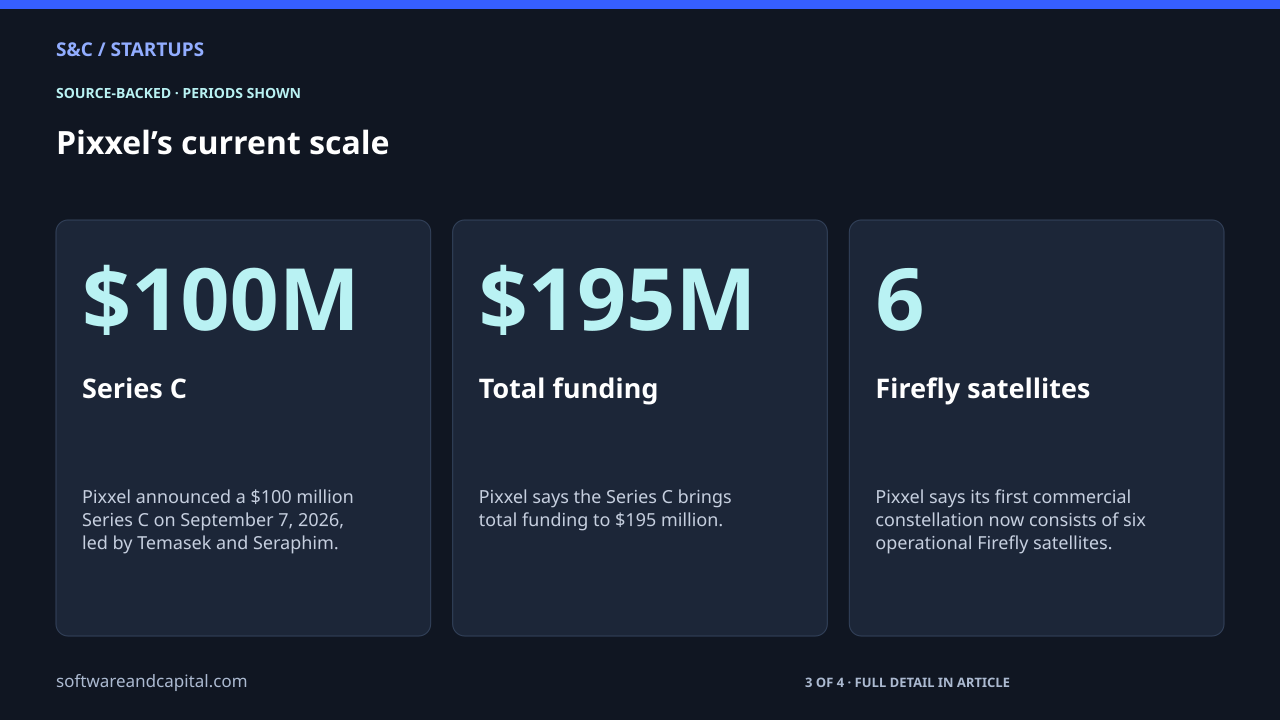
Pixxel’s current scale
Pixxel announced a $100 million Series C on September 7, 2026, led by Temasek and Seraphim.
Pixxel says its first commercial constellation now consists of six operational Firefly satellites.
Pixxel says each Firefly can capture more than 135 spectral bands at 5-meter resolution across a 40-kilometer swath.
The product is not just a satellite image
The useful output is a signal that can distinguish materials, vegetation stress, emissions or other surface conditions based on spectral signatures. A customer therefore needs both the sensor in orbit and software that turns large amounts of spectral data into something operationally useful.
| Layer | What it does | Potential customer value |
|---|---|---|
| Firefly satellites | Capture hyperspectral data | Observe changes that ordinary imagery may miss |
| Aurora software | Turns sensor data into analysis | Make the data easier to search and use |
| Sovereign systems | Dedicated national or institutional capability | More control over collection and access |
| Manufacturing | Build satellite systems and payloads | Sell infrastructure as well as data |
Six satellites make the commercial story more concrete
Pixxel launched the first three Fireflies in January 2025 and another three in August 2025, taking the constellation to six. The company says the group can revisit locations frequently enough to support monitoring use cases rather than one-off demonstrations.2
The Series C broadens the company beyond hyperspectral imagery
Pixxel says the new capital will support additional sensing satellites, Earth-intelligence software, sovereign space systems and manufacturing. That is a broader strategy than selling one imagery feed. It aims to own more of the chain from collecting a signal to helping a customer act on it.1
Funding is not the same as proven unit economics
A $100 million round says investors are willing to finance the expansion. It does not reveal gross margin, customer concentration, satellite replacement costs or whether software revenue can outweigh the capital intensity of building and launching spacecraft. Those are the numbers that will determine whether a planetary-data platform becomes a durable business.
What to watch as Pixxel scales
- How much revenue comes from raw imagery versus higher-value software and analytics.
- Whether commercial and government customers sign recurring contracts rather than one-off projects.
- The cost and cadence of replacing satellites as the constellation ages.
- Whether broader sensing and manufacturing businesses improve or dilute the economics of the original hyperspectral product.
S&C’s direct-to-cell satellite guide looks at satellites as connectivity infrastructure. Pixxel is a different business model: the satellite is a sensing layer, and the commercial value depends on turning that signal into information a customer can use.
Sources and methodology
Sources checked September 26, 2026. Dates and periods for individual figures are stated beside them.
- Pixxel: $100 million Series C ↗Accessed 2026-09-26
- Pixxel: Firefly constellation reaches six satellites ↗Accessed 2026-09-26
Scope and assumptions
Funding and deployment do not establish profitability, recurring revenue or attractive unit economics.
Performance specifications and constellation descriptions are company-reported.
The article does not independently validate the claim that the round is the largest ever for an Indian space-technology company.