Most AI companies try to get onto a screen. Plaud sells a physical recorder that sits in the room first, then charges for software that turns the captured conversation into transcripts, summaries and searchable information. The company says that combination helped it reach $100 million in annual recurring revenue within two years.1, 2
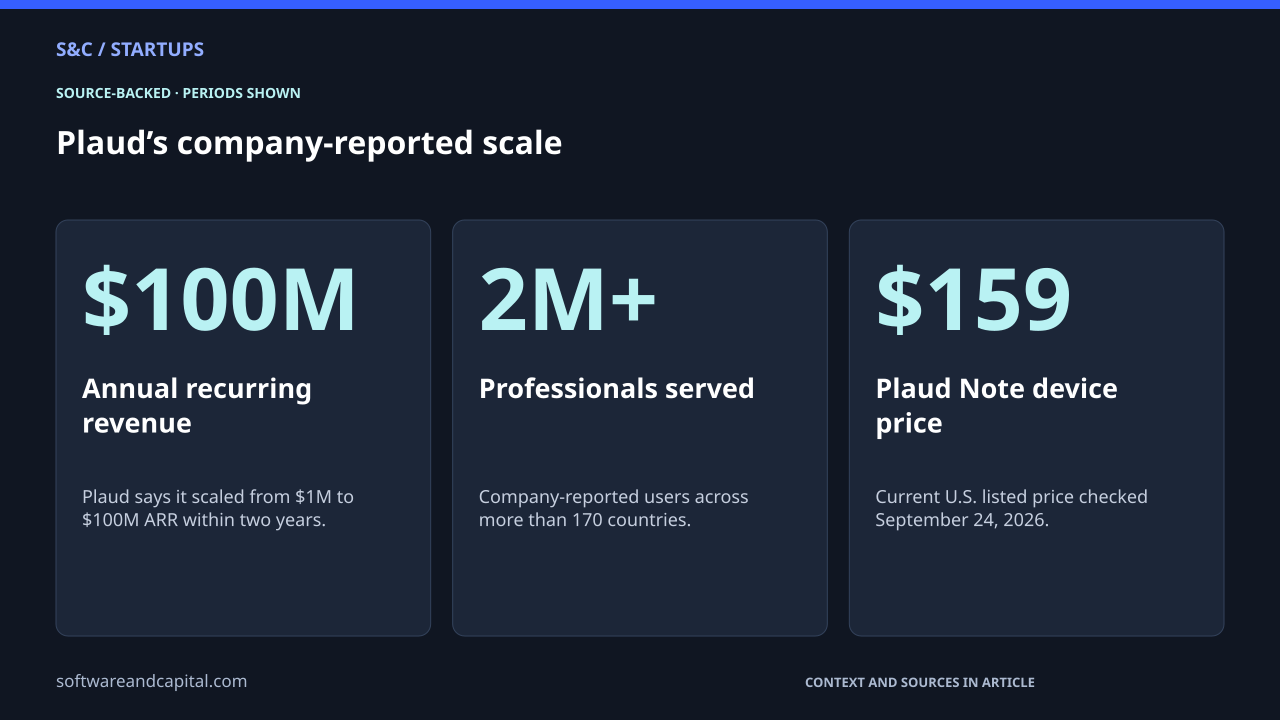
Plaud says it scaled from $1 million to $100 million in ARR within two years and now serves more than 2 million professionals. Its model combines dedicated recording hardware with recurring AI transcription and analysis plans, then extends the software into integrations and an embedded product. The ARR and user figures are company-reported, not audited public-company disclosures.1, 2, 3
Plaud’s company-reported scale
The $100 million figure is Plaud’s own ARR claim. Plaud is not a public company filing audited recurring-revenue disclosures, so the number should be read as company-reported scale rather than independently verified financial reporting.1
The hardware gets the microphone into the workflow
Plaud Note is a dedicated recorder for calls and in-person conversations. Plaud lists the device at $159 and includes a free Starter plan with 300 transcription minutes per month. The device therefore does more than create one-time hardware revenue: it places Plaud’s software at the point where the conversation is captured.2
That placement matters. A general AI assistant can summarize audio after someone uploads it. A purpose-built recorder reduces the steps between a meeting and the software service. Hardware can become customer acquisition and workflow integration at the same time.
The recurring layer starts after the recording
Plaud currently lists a Pro plan with 1,200 transcription minutes per month and an Unlimited plan with higher transcription capacity, alongside summaries, Ask Plaud and workflow features. That makes the economic model look less like selling a gadget and more like selling an entry device plus recurring software usage.2
We cannot infer how much of Plaud’s reported ARR comes from each plan, geography or customer type from the cited material. The useful point is structural: a device sale can create an installed base, while subscriptions create a recurring relationship with that installed base.
Plaud is also trying to move beyond its own hardware
Plaud Embedded is a research-preview product for vertical software companies that want conversation capture and AI processing inside their own products. Plaud describes that move as an evolution toward infrastructure for other software companies, not only an expansion of its recorder lineup.3
If that strategy works, the hardware becomes one distribution channel rather than the boundary of the company. Plaud can reach a professional through its own recorder or potentially through another company’s application. The same conversation-processing layer sits behind both.
Physical AI products carry a permission problem too
A recorder can be easier to use precisely because it is always ready to capture a conversation. Plaud’s own product pages tell users to inform other people and get their permission before recording, while noting that privacy laws vary. Adoption therefore depends on social and legal permission as well as transcription quality.2
That is a different version of the privacy tension in AI glasses. Both products bring AI closer to real-world conversations. The form factor changes who notices the device and how consent is communicated.
The business model in four steps2, 3
- Sell or distribute a recorder that captures conversations where work happens.
- Use the device to bring recordings into Plaud’s transcription and analysis software.
- Offer recurring plans for greater transcription capacity and AI workflow features.
- Extend the conversation layer into other software through integrations and Plaud Embedded.
Plaud’s reported $100 million ARR makes the model worth watching because it is not purely a hardware story or purely a SaaS story. The recorder is the doorway. The recurring software—and whether Plaud can make that software useful beyond its own devices—is the more interesting business underneath it.
Sources and methodology
Sources checked September 24, 2026. Dates and periods for individual figures are stated beside them.
- Plaud: scales from $1M to $100M ARR ↗Accessed 2026-09-24
- Plaud Note: device and AI plan details ↗Accessed 2026-09-24
- Plaud: introducing Plaud Embedded ↗Accessed 2026-09-24
Scope and assumptions
Plaud’s ARR and user counts are company-reported and are not audited public-company disclosures.
The cited sources do not disclose ARR composition, hardware gross margin, subscriber count or retention, so those economics cannot be inferred.
Continue reading
Millions Use AI Glasses Every Day. The Assistant Is Moving Onto Your Face →