A management buyout has an obvious conflict built into the structure. The executive team knows the business from the inside, but in a take-private it can also sit on the buying side. Priority Commerce’s deal shows the governance machinery public companies use to handle that tension.
Priority agreed to a CEO-led take-private at $8.05 per unaffiliated share and about $1.6 billion of enterprise value. A special committee of independent directors recommended the deal, and closing still requires regulatory approvals plus approval from a majority of shares not affiliated with the buyer group. The agreement is signed, but the company remains public until those conditions are met.1, 2
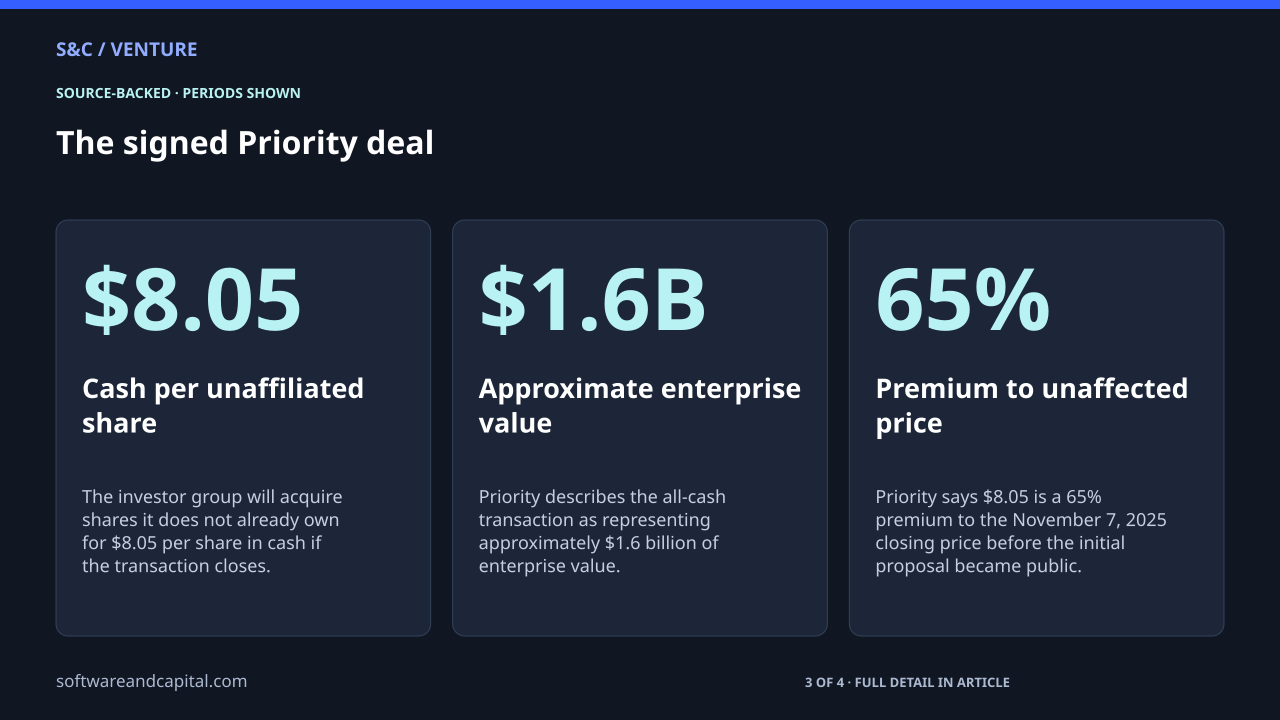
The signed Priority deal
The investor group will acquire shares it does not already own for $8.05 per share in cash if the transaction closes.
Priority describes the all-cash transaction as representing approximately $1.6 billion of enterprise value.
Priority says $8.05 is a 65% premium to the November 7, 2025 closing price before the initial proposal became public.
Priority says the deal price is a 38% premium to the September 18, 2026 closing price immediately before the definitive agreement announcement.
Why the CEO cannot simply negotiate with himself
Chairman and CEO Thomas Priore leads the investor group. Priority says a special committee made up of independent and disinterested directors evaluated the proposal with its own legal and financial advisers and unanimously recommended the agreement. That committee is meant to create a negotiating body whose interests are separate from management’s buying group.1
| Party | Role | Why it matters |
|---|---|---|
| CEO-led investor group | Buyer | Already knows and partly owns the company |
| Special committee | Reviews and negotiates the proposal | Creates an independent decision process |
| Unaffiliated stockholders | Vote on the deal | Majority approval is a closing condition |
| Searchlight funds | Provide part of the equity financing | Supports the buyer group’s funding |
| Regulators | Review required approvals | Deal cannot close until conditions are satisfied |
Enterprise value is not the cash check to public holders
The approximately $1.6 billion figure is enterprise value, a measure that reflects the value of the operating business and its financing structure. The $8.05 figure is the per-share cash price for stockholders outside the investor group. Multiplying one headline number by another would mix different definitions.1
The minority vote is a real closing condition
Priority says the transaction requires approval by holders of a majority of common shares not affiliated with the investor group. That matters because the buyer already has an ownership relationship with the company. The unaffiliated vote is designed to prevent the buyer group’s own shares from deciding the transaction by themselves.1, 2
Signed does not mean completed
The company expects closing in the first half of 2027, subject to regulatory and stockholder approvals and other customary conditions. Until closing, Priority remains a public company. If the transaction completes, its shares will stop trading on Nasdaq and the company will cease being an SEC reporting company.1, 2
From proposal to private company
- Nov. 7, 2025
Unaffected reference price
Priority uses this closing price as the reference point before public disclosure of the buyer group’s preliminary proposal.1
- Sep. 21, 2026
Definitive agreement announced
Priority signs the CEO-led take-private agreement at $8.05 per unaffiliated share.1
- H1 2027 expected
Potential closing
Closing remains subject to regulatory approvals, the unaffiliated-stockholder vote and other conditions.1, 2
Four questions to ask about any management buyout
- Who sits on the independent committee and which advisers does it use?
- What price comparison is the quoted premium using?
- Which shareholders are allowed to vote on the transaction?
- Is financing committed, and which approvals still have to occur before closing?
The Stripe tender-offer article explains liquidity without an IPO. Priority is the opposite direction: public shares are being bought out so the company can leave the market entirely. In both cases, the transaction structure matters as much as the headline valuation.
Sources and methodology
Sources checked September 26, 2026. Dates and periods for individual figures are stated beside them.
- Priority Technology Holdings: SEC-filed take-private announcement ↗Accessed 2026-09-26
- Priority Technology Holdings: SEC-filed transaction FAQ ↗Accessed 2026-09-26
Scope and assumptions
The transaction is signed but has not closed and remains subject to stockholder, regulatory and other conditions.
Enterprise value and the per-share cash consideration are different measures and should not be combined.
The article explains process and governance, not whether $8.05 is a fair investment value.
Continue reading
$159B Valuation: Stripe’s Payday Without an IPO →
5 Numbers That Explain Where Figma’s IPO Money Went →
94M Filipinos Have Used GCash. Now Its Parent Wants to Go Public →