A fintech app can bundle many financial experiences without the company behind it operating a U.S. national bank. Revolut is trying to change that structure. Its public application asks regulators for permission to establish an insured national bank in Stamford, Connecticut, built around the same broad financial ecosystem as the Revolut app.2
Revolut’s proposed U.S. national bank would bring deposit accounts, lending, credit cards, payments, foreign exchange and other financial products into one regulated bank built around the Revolut app. The OCC’s application tracker shows the charter application was approved on September 2, 2026, but the public application also seeks federal deposit insurance and describes the bank as proposed rather than already operating.1, 2
| Layer | Proposed bank role | Evidence in application |
|---|---|---|
| Deposits | Demand deposit and interest-bearing savings accounts for individuals and businesses | Listed as core products |
| Credit | Personal loans, consumer and business credit cards, and business term loans | Listed as traditional credit offerings |
| Money movement | Transfers between Revolut accounts, foreign exchange and remittance features | Included in proposed products and services |
| Digital assets | Buying, selling and holding digital assets plus related payment and remittance features | Included in proposed product set |
The strategic idea is to put more of the product inside one regulated bank
Revolut’s application describes a broad financial ecosystem ranging from traditional consumer and business deposits and credit to cross-border transfers, investment and trading offerings. The proposed bank would be a wholly owned subsidiary within Revolut’s U.S. holding-company structure.2
That makes the charter a vertical-integration story. Instead of treating banking as only an interface layer, Revolut is seeking to operate a regulated institution that can directly hold deposits and originate several forms of credit while remaining connected to the wider app experience.
Deposits and lending change the economics and the responsibility
The application lists demand deposits, interest-bearing savings accounts, unsecured personal loans, retail credit cards, business credit cards and business term loans among the proposed core products. Those are balance-sheet banking activities, not simply software features layered over someone else’s products.2
Owning those activities also means owning more regulated responsibility. The application includes capital planning, risk management, compliance, deposit-insurance requirements and a proposed management team for the bank. A charter does not remove regulation. It moves more of the regulated operation inside Revolut.2
The bank is meant to connect with the wider Revolut product
Revolut says the proposed bank would offer products through a multi-tier subscription model and would combine banking with foreign exchange, payments, investment tools and digital-asset features. Some products would be provided directly by the bank and others through affiliates or third parties.2
That distinction matters. Becoming a bank does not mean every feature in a financial super-app has to sit on the bank’s own balance sheet. It creates a regulated core around which other financial services can still be connected.
The OCC has approved the charter application, but the public record still describes a proposed bank
The OCC’s Corporate Applications Search shows the application was received on March 4 and approved on September 2, 2026. The underlying interagency filing also seeks federal deposit insurance and repeatedly describes Revolut Bank US as proposed. Approval of the charter application is therefore an important milestone, not evidence that every planned banking product is already live.1, 2
What the charter tells us about Revolut’s U.S. strategy1, 2
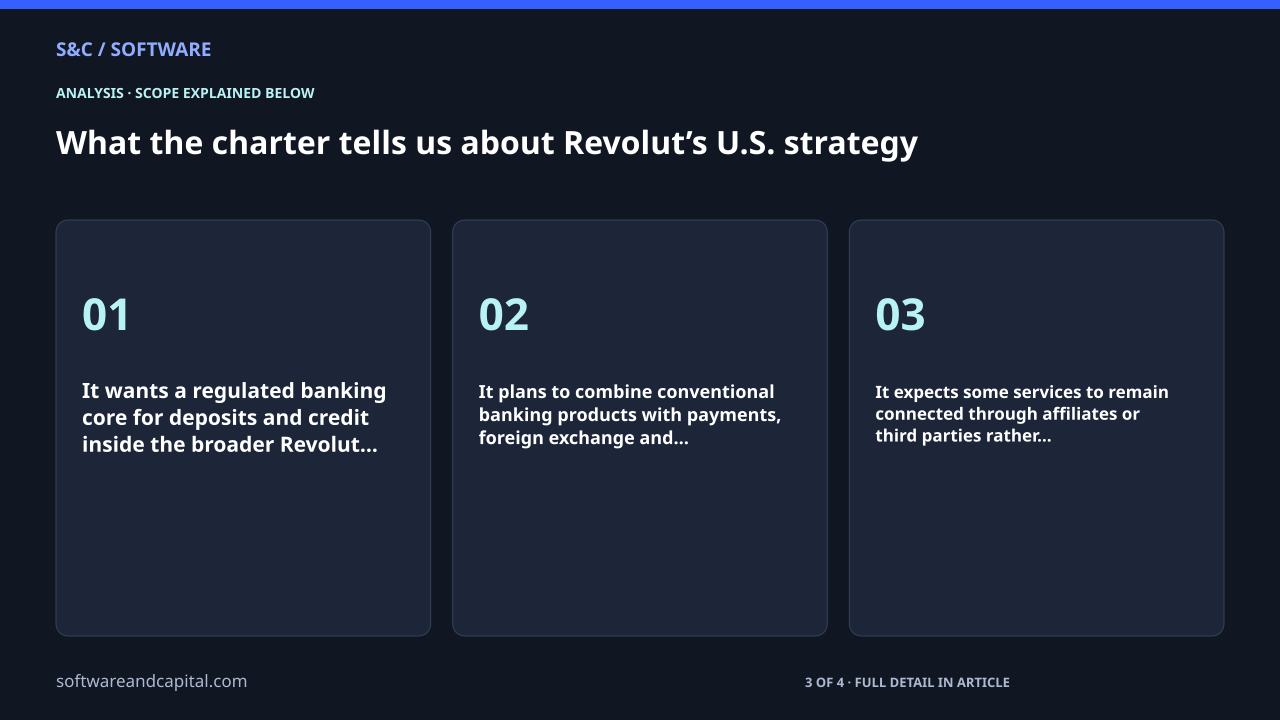
- It wants a regulated banking core for deposits and credit inside the broader Revolut ecosystem.
- It plans to combine conventional banking products with payments, foreign exchange and other financial services.
- It expects some services to remain connected through affiliates or third parties rather than forcing everything onto the bank itself.
- The September OCC approval advances the plan, but the cited public record still concerns a proposed insured national bank.
The useful lesson goes beyond Revolut. Fintech competition is partly a choice about which layers to own. PayPal World is building connectivity across existing payment systems. Revolut’s bank application points in the other direction: bring more of the regulated financial core inside the company’s own structure.
Sources and methodology
Sources checked September 24, 2026. Dates and periods for individual figures are stated beside them.
- OCC Corporate Applications Search: Revolut Bank US, N.A. ↗Accessed 2026-09-24
- Revolut Bank US, N.A. interagency charter and federal deposit insurance application ↗Accessed 2026-09-24
Scope and assumptions
The OCC application tracker shows approval of the charter application, while the underlying public filing describes a proposed bank and seeks federal deposit insurance; this article does not treat every planned product as already operating.
The article explains the proposed bank structure and does not estimate future profitability, funding costs or customer adoption.