Enterprise agents often look impressive in a clean demo because the question is clear and the source material is curated. Salesforce’s internal rollout exposed the messier problem. When Employee Agent met a real corporate knowledge base, overlapping policies and stale text produced confusing answers that humans had learned to work around.
Salesforce says Employee Agent reached 70,000 users, handled more than 300,000 conversations in its first year and achieved a 97.7% self-service rate. But Salesforce also says its 1,000-plus internal knowledge articles contained overlapping policies and outdated text that initially confused the agent. The deployment is a useful reminder that enterprise agent quality depends heavily on the information underneath it.1, 2
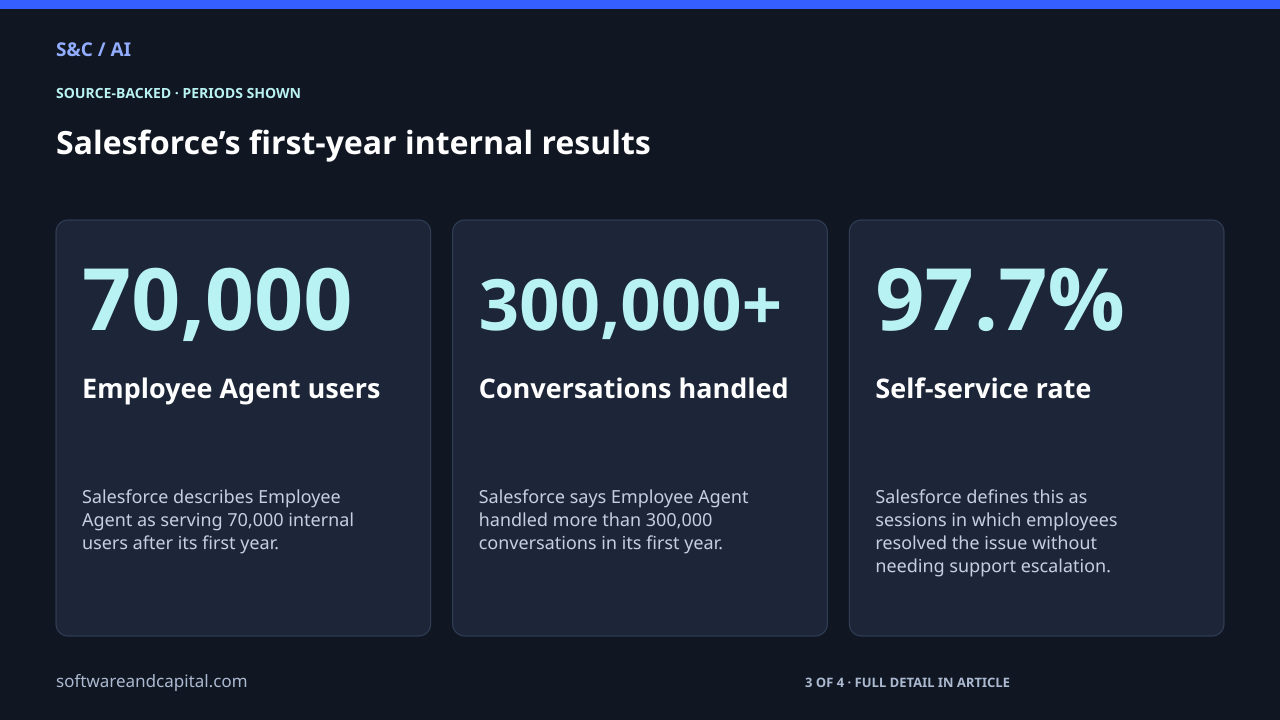
Salesforce’s first-year internal results
Salesforce describes Employee Agent as serving 70,000 internal users after its first year.
Salesforce says Employee Agent handled more than 300,000 conversations in its first year.
Salesforce defines this as sessions in which employees resolved the issue without needing support escalation.
Salesforce says its internal library had more than 1,000 articles with overlapping policies and outdated text that required cleanup.
The agent inherited the company’s information problems
Salesforce says humans could naturally filter through duplicate policies and outdated wording, while the agent treated the material more literally. The fix was not merely a better prompt. The company had to improve the structure and quality of the information the agent was allowed to use.1
| Layer | Failure mode | Operational response |
|---|---|---|
| Knowledge | Outdated or overlapping policy text | Consolidate and maintain authoritative sources |
| Scope | Agent tries to answer beyond its job | Define supported questions and actions |
| Escalation | Difficult cases get trapped in self-service | Route exceptions to a person or support process |
| Adoption | Employees keep using old channels | Put the agent where routine work already happens |
| Measurement | A demo looks good but operations do not improve | Track resolution, case volume and user behavior |
Customer Zero is useful, but it is still vendor evidence
Salesforce describes a broader Customer Zero process in which tens of thousands of employees use products before external customers do. That creates a large internal test environment, but the resulting adoption and case-reduction figures are still reported by the company selling the product. They are operational evidence, not an independent benchmark for every enterprise.2, 1
Self-service is a workflow outcome, not a model score
A 97.7% self-service rate is easy to mistake for an accuracy score. It is not. Salesforce defines the metric around sessions ending without the employee escalating the issue. That can be commercially useful, but it does not directly tell us the factual error rate of every answer.1
The transferable lesson is information architecture
An enterprise agent sits on top of permissions, policies, documents and systems that were often designed for human navigation. Giving the agent access does not automatically make that information coherent. In many deployments, cleaning the knowledge layer may be as important as choosing the model.
Questions to ask before blaming the model
- Is there one authoritative source for the policy or several conflicting versions?
- Does the agent know which questions it should refuse or escalate?
- Are permissions preventing it from seeing the source needed for a correct answer?
- Is the organization measuring resolution quality as well as reduced ticket volume?
The pattern complements Airbnb’s AI support story. Airbnb shows how much support work a deployed AI system can resolve. Salesforce shows the less visible prerequisite: the company knowledge underneath the agent has to be organized well enough to trust.
Sources and methodology
Sources checked September 26, 2026. Dates and periods for individual figures are stated beside them.
- Salesforce: What Salesforce learned after using Employee Agent for a year ↗Accessed 2026-09-26
- Salesforce: How Salesforce pilots its own software ↗Accessed 2026-09-26
Scope and assumptions
All deployment metrics in the article are company-reported rather than independently audited.
A self-service rate does not directly measure factual accuracy or employee satisfaction for every session.
Salesforce’s internal environment may not generalize to organizations with different data, permissions or support processes.
Continue reading
Airbnb Says AI Now Resolves Nearly 45% of Support Issues Without a Human →
1M Businesses Already Use Meta’s AI Agent. Is Customer Service Becoming a Meta Product? →