“Series A” still sounds like a young company raising its first serious institutional round. In 2026, that label can sit on a financing larger than many late-stage rounds. Crunchbase counts at least 114 Series A financings of $100 million or more globally this year.1
Crunchbase counts at least 114 global Series A rounds of $100 million or more in 2026, totaling about $33 billion. The label no longer reliably tells you that a company is small or lightly capitalized. More than 70% of those mega-Series-A rounds went to AI-focused companies, where capital needs and investor concentration can be unusually large.1, 2, 3
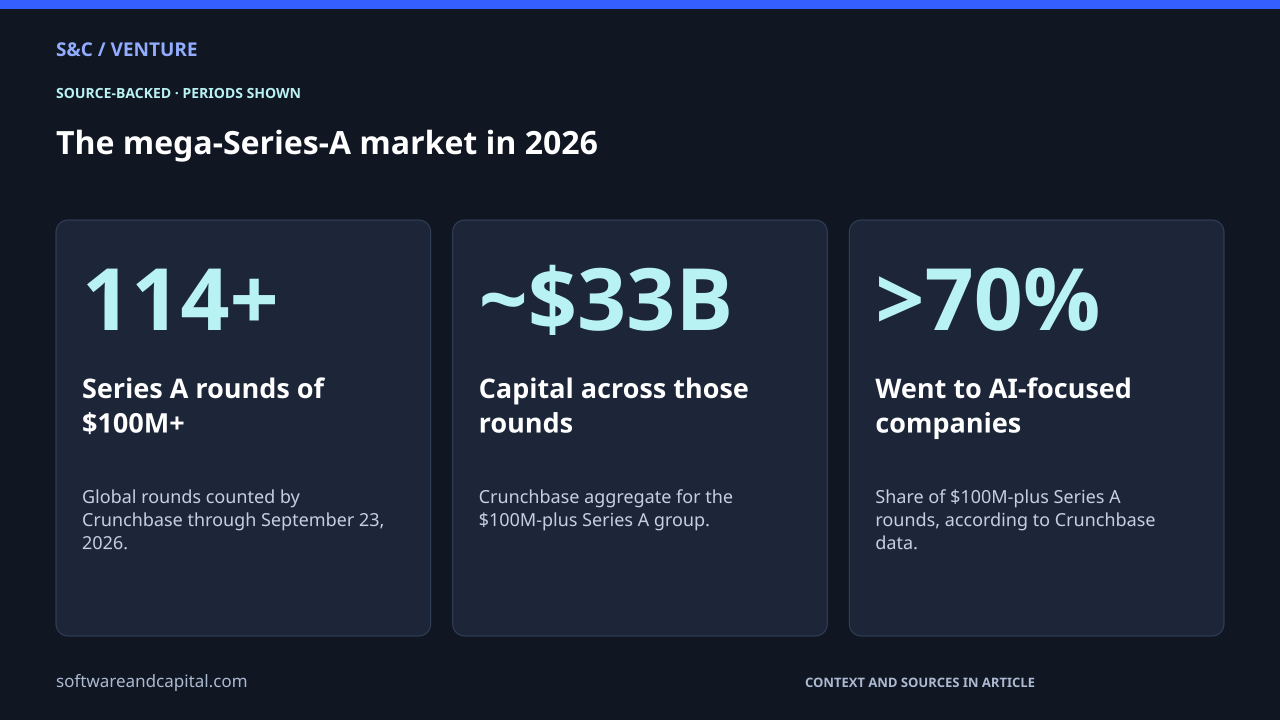
The mega-Series-A market in 2026
These are Crunchbase database figures, not an official census of global venture capital. Round labels are also not standardized. The value of the dataset is that it shows how far the old shorthand has stretched, not that every company calling a financing “Series A” is at the same stage.1
A financing stage is a label, not a company-size measurement
Series letters describe a financing sequence more reliably than they describe age, revenue, headcount or technical maturity. A capital-intensive company can need enormous sums early. A business carved out of an established company can arrive at its first outside round with assets and teams that do not resemble a conventional seed startup.
XPENG’s robotics business is an extreme example. XPENG said the unit raised more than $900 million at a post-money valuation above $6.3 billion in what it described as the robotics business’s first funding round. That makes the stage label accurate in sequence while making “early” a poor description of financial scale.2
AI is doing much of the stretching
Crunchbase says more than 70% of the $100 million-plus Series A rounds in its 2026 dataset went to AI-focused companies. The same concentration appears elsewhere in venture data: our Carta analysis found that more than 60% of capital raised by companies on Carta in Q1 went to AI.1
The datasets cover different populations and should not be combined into one market share. Together they illustrate the same caution: a broad stage label can hide a market where certain AI companies raise on a completely different scale from typical startups.
Not every $100M Series A is a robotics factory
Scaled Cognition announced a $100 million Series A in June to build enterprise AI systems focused on reliability. Its round shows that the phenomenon is not limited to physical infrastructure. Software and model companies can also raise nine figures at the A stage when investors are willing to fund expensive research and rapid expansion.3
The better questions come after the letter
What a Series A label does not tell you
- How old the company or business unit is.
- Whether it already has meaningful revenue or customers.
- How much physical infrastructure, compute or research capital the plan requires.
- Whether the round is the company’s first financing or the first financing for a carved-out business.
- Whether a $100 million round reflects broad market conditions or unusually concentrated investor demand.
That last point matters when reading the 114-round headline. Crunchbase says roughly half of these mega-Series-A deals were U.S.-based and that AI dominated the group. The number therefore describes a striking pocket of the venture market, not the normal experience of every founder raising an A.1
Series A still tells you where a financing sits in a company’s chosen sequence. It just no longer tells you enough about the scale of the business or the check. In 2026, the letter is the beginning of the explanation, not the conclusion.
Sources and methodology
Sources checked September 24, 2026. Dates and periods for individual figures are stated beside them.
- Crunchbase News: Jumbo-Sized Series A Rounds Are On The Rise ↗Accessed 2026-09-24
- XPENG: robotics business raises over $900 million ↗Accessed 2026-09-24
- Scaled Cognition: $100 million Series A ↗Accessed 2026-09-24
Scope and assumptions
The 114-round and $33 billion aggregates come from Crunchbase’s database rather than an official regulatory census.
Series naming is not standardized, and XPENG Robotics is a business associated with an established public company rather than a conventional standalone seed-stage startup.
Continue reading
AI Took Over 60% of Carta’s Q1 Funding. What About Everyone Else? →
$16B for Driverless Rides: Why Robotaxis Need So Much Capital →