“Venture is back” sounds like good news for every founder trying to raise. Carta’s Q1 2026 data tells a more uneven story. Companies on its platform raised $30.4 billion during the quarter, but more than 60 cents of every venture dollar went to AI companies.1
Carta recorded $30.4 billion of startup funding in Q1 2026, and more than 60% of capital raised by companies on its platform went to AI companies. Foundational-model companies alone accounted for 14.2% of total capital. The figures describe Carta’s dataset, not the entire global venture market, and they show a recovery concentrated in a narrow part of the market.1, 2
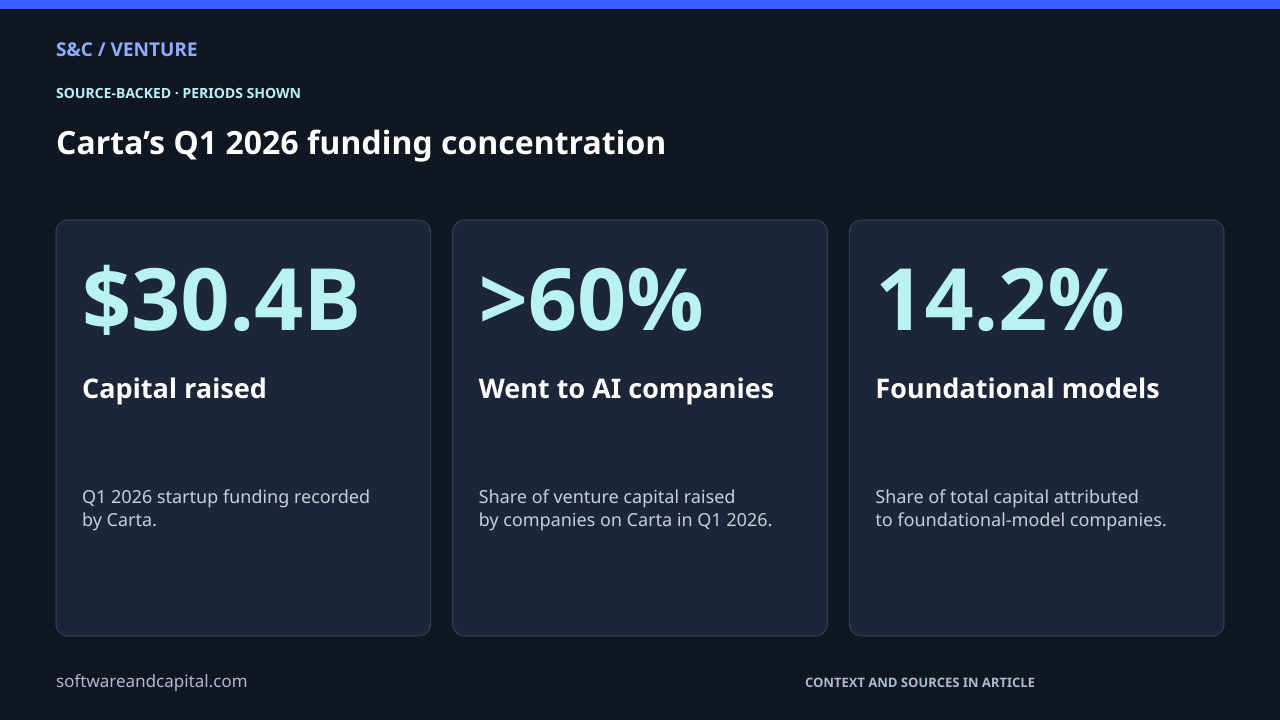
Carta’s Q1 2026 funding concentration
The scope matters. Carta is describing companies on its platform, not every venture deal in the United States or the world. Within that population, the data shows a striking concentration of capital in AI and an even more extreme premium for a small set of foundational-model companies.1
The headline recovery contains two different markets
Carta says a Series A foundational-model startup in its Q1 2026 data was raising at a $300 million median valuation, compared with $55 million for a non-AI startup at the same stage. That is about 5.5 times higher. A single “Series A valuation” benchmark therefore hides very different markets.1
| Company type | Series A median valuation | How to read it |
|---|---|---|
| Foundational-model AI | $300M | A high-capital subset of the AI market in Carta’s dataset. |
| Non-AI | $55M | The median cited by Carta for non-AI Series A companies. |
| Ratio | About 5.5× | Calculated from the two reported medians, not a forecast for a specific startup. |
That does not mean a founder can add “AI” to a pitch deck and receive a 5.5-times higher valuation. Medians describe groups of financings that differ in product, growth, capital needs and investor demand. The comparison shows market separation, not a pricing formula.
SaaS shows how concentrated the money became
Carta reports that 83% of capital raised by SaaS companies in its Q1 dataset went to AI startups. SaaS has historically been a major part of Carta’s private-market data, which makes that concentration especially revealing. It suggests that “software funding” and “AI software funding” were increasingly different experiences during the quarter.1
The concentration was not created from nowhere in one quarter. Carta’s 2025 review had already found an AI valuation premium at every stage from Series A onward. At Series A, the median AI valuation was 38% higher than the non-AI median in 2025. By Q1 2026, the foundational-model subset was much more extreme.2, 1
What does “everyone else” see?
If more than 60% of the capital in the dataset went to AI, less than 40% went to non-AI companies. That is a boundary, not an exact non-AI dollar figure, because Carta reports the AI share as “over 60%.” It also does not tell us that fewer than 40% of funded companies were non-AI. Capital share and company count are different measures.1
The report also says down rounds fell to 11.4% and later-stage Series B and Series C primary pre-money valuations rose from the prior year. Those are signs of a broader market improvement. The point is that the improvement did not distribute capital evenly across sectors or company types.1
The same market can feel hot and cold at once
Three questions to ask before using a venture benchmark
- Population: is the figure global venture funding, U.S. funding or companies on a particular platform?
- Company type: does the benchmark mix AI, non-AI and capital-intensive foundational models?
- Stage and statistic: are you comparing the same financing stage and the same definition of valuation?
That discipline matters when reading individual-company funding headlines too. Stripe’s employee tender is a private liquidity event, not a conventional fundraising round. Figma’s IPO mixes company capital with shareholder liquidity. The word “money” covers very different transactions.
The Q1 2026 story is therefore not simply that venture capital recovered. It is that the recovery became highly concentrated in AI, and within AI, a small group of foundational-model companies operated on a different financial scale. Founders outside that pocket were participating in the same market cycle without necessarily experiencing the same market.
Sources and methodology
Sources checked September 21, 2026. Dates and periods for individual figures are stated beside them.
- Carta: State of Private Markets Q1 2026 ↗Accessed 2026-09-21
- Carta: State of Private Markets 2025 in Review ↗Accessed 2026-09-21
Scope and assumptions
The figures describe companies and financings captured in Carta’s dataset. They are not a census of global venture capital.
The greater-than-60% AI share does not permit an exact non-AI capital total, and group medians do not predict a particular company’s valuation.
AI-assisted research and editing. Our editorial standards.
Continue reading
$159B Valuation: Stripe’s Payday Without an IPO →
5 Numbers That Explain Where Figma’s IPO Money Went →
$16B for Driverless Rides: Why Robotaxis Need So Much Capital →