Robotics companies are easy to judge by the demo and hard to judge by the business. Skild AI has now published a more useful set of numbers: it says it crossed $100 million in annual recurring revenue ten months after its first commercial deployment.1
Skild AI says it crossed $100 million in annual recurring revenue ten months after its first commercial deployment, with more than 60 paying customers and $50 million of recognized revenue. The company says roughly 90% of revenue comes mainly from manipulation tasks and 10% from mobility. These figures are company-reported and ARR is not recognized revenue.1, 2
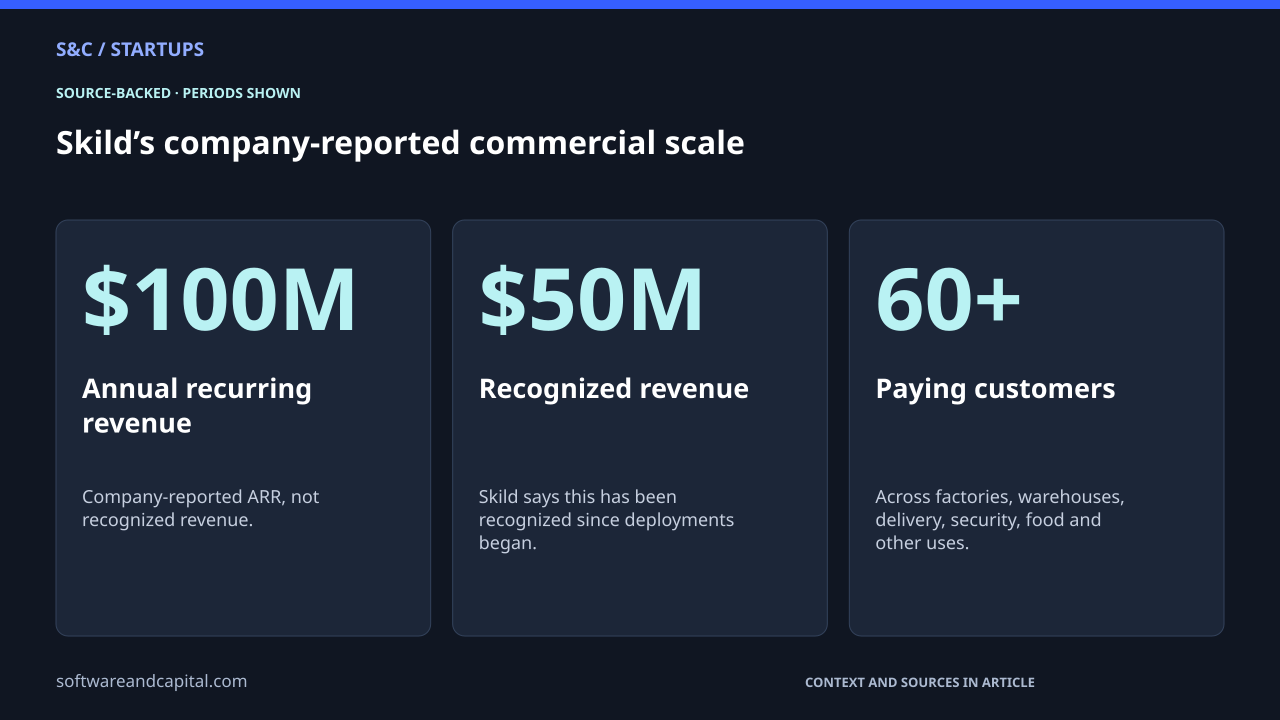
Skild’s company-reported commercial scale
Most of the disclosed revenue is manipulation, not mobility
Skild says mobility accounts for 10% of revenue, including 4% from AMR solutions associated with its Zebra and Fetch Robotics acquisition. The remaining roughly 90% comes mainly from manipulation tasks.1
That mix matters because physical AI is often discussed as one market. Moving a mobile robot through a facility and controlling two arms for assembly or food preparation are different jobs with different hardware and deployment constraints.
ARR and recognized revenue answer different questions
The $100 million figure annualizes recurring commercial activity. The $50 million figure is revenue Skild says it has already recognized. Neither is the same as the $1.4 billion Series C announced earlier in 2026, which is financing rather than customer revenue.1, 2
The model is supposed to travel across robot bodies
Skild’s pitch is that one general-purpose intelligence layer can work across different embodiments and tasks instead of requiring a separate software stack for every machine. Commercially, that makes the reusable robot intelligence the scalable asset even when deployments use different hardware.1
That is a different commercialization test from Agility’s contracted humanoid orders. Orders show demand for a particular robot platform. Skild is arguing that the reusable layer can sit across many kinds of robots.
The disclosure is useful precisely because it has boundaries
Skild is private, and these figures are company-reported rather than audited public-company filings. Acquired AMR activity is also part of the business. The numbers therefore do not prove that robotics foundation models have reached software-like economics.
What to watch next
- How much recognized revenue catches up with the reported ARR base.
- Whether manipulation remains the dominant commercial workload.
- How much future growth comes from Skild Brain deployments versus acquired AMR activity.
- Whether a general model reduces deployment effort across genuinely different robot bodies and environments.
Physical AI can increasingly be discussed with commercial measures instead of only benchmark videos. The next question is whether those recurring numbers keep scaling as deployments become larger and less curated.
Sources and methodology
Sources checked September 25, 2026. Dates and periods for individual figures are stated beside them.
- Skild AI: The Hidden Pillar of Robotics ↗Accessed 2026-09-25
- Skild AI Series C ↗Accessed 2026-09-25
Scope and assumptions
Financial and customer figures are company-reported and unaudited.
ARR is not recognized revenue, and acquired AMR activity contributes to the disclosed mix.