Coding agents became popular as a private workflow: one developer opens a tab, gives the agent a task and reviews the result. Slack Code is designed around the opposite assumption. If an agent is doing meaningful multi-step work, the rest of the team should be able to see the plan, inspect the output and intervene before the task disappears into a private session.
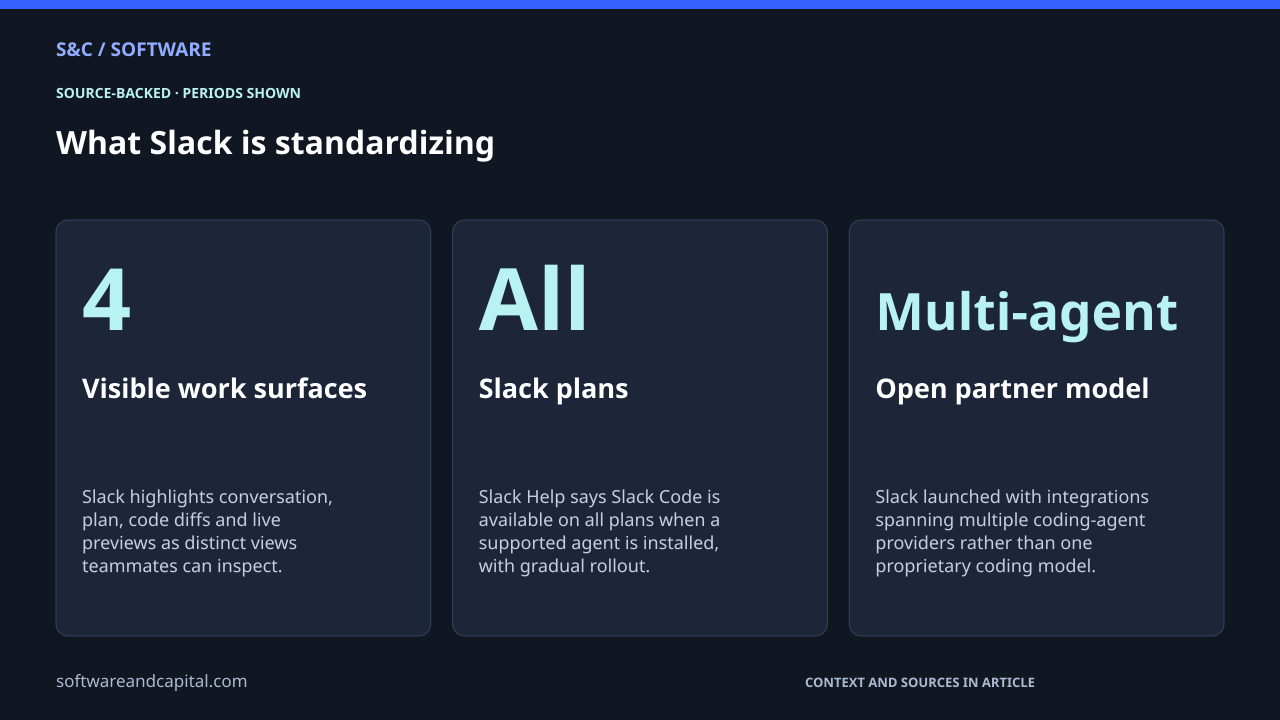
Slack Code moves longer-running agent work into temporary shared channels. Teammates can see the conversation, plans, code diffs and live previews, add context and review work before it ships. The product does not prove coding agents produce better code. It changes who can observe and shape the work before it reaches the pull request.1, 2
| Work layer | Private tab | Slack Code |
|---|---|---|
| Context | Mostly one user’s session | Shared channel context can carry forward |
| Plan | Visible to the individual | Dedicated plan can be visible to teammates |
| Changes | Reviewed after handoff | Code diffs can appear inside the shared session |
| Prototype | Often opened elsewhere | HTML previews can be shown in the channel |
| Collaboration | One person relays feedback | Teammates can join and respond directly |
The product is about supervision before the pull request
Slack’s developer documentation says agents can publish code diffs, structured views, HTML previews and canvases inside the session. The channel gives engineers, product managers, designers and other collaborators a place to review work while it is happening rather than waiting for a finished patch or summary.1
The channel is temporary, but the record stays
Slack Help describes code channels as temporary spaces created automatically by supported agents for a task or project. Teammates can be added, and the channel can be archived when the work is complete while its context remains searchable. That makes the collaboration surface closer to a project room than a permanent team channel.2
What Slack is standardizing
Visibility is not the same as code quality
Slack provides the collaboration surface, not evidence that an agent’s patch is correct. A visible diff can make review easier to coordinate, but teams still need repository tests, code review and deployment controls. The launch materials do not establish faster delivery, fewer bugs or better software quality.
This moves the collaboration boundary earlier
GitHub already gives teams a shared place to review agent involvement once work reaches a pull request. Slack Code moves some of that shared supervision upstream, into the planning and execution stage. The distinction matters because many product decisions and misunderstandings happen before the final diff exists.
What to watch as coding becomes multiplayer
- Whether teams actually keep non-engineers involved once the agent begins changing code.
- How permissions for agents and code channels map to repository and production access.
- Whether shared previews reduce late-stage rework or simply add another collaboration surface.
- How much work still migrates back to IDEs, pull requests and CI for the final technical review.
S&C’s GitHub pull-request agent analysis covers the downstream review layer. Slack Code is the upstream counterpart: the agent session itself becomes shared before the pull request is the center of attention.
Sources and methodology
Sources checked September 26, 2026. Dates and periods for individual figures are stated beside them.
- Slack Developer Docs: Announcing Slack Code ↗Accessed 2026-09-26
- Slack Help: Build with AI as a team using Slack Code ↗Accessed 2026-09-26
- Slack: August 2026 feature drop ↗Accessed 2026-09-26
Scope and assumptions
Slack’s launch materials describe product behavior but do not provide controlled productivity or defect-rate evidence.
Availability depends on supported agents and Slack’s gradual rollout.
Repository tests, code review and deployment controls remain outside the claim that work is visible in Slack.