SoftBank’s latest OpenAI check is not being funded only with cash from the balance sheet. The company has issued a large package of public bonds just before the third $10 billion tranche of its 2026 OpenAI commitment. That turns a private AI investment into a visible cost-of-capital story for bond investors too.
SoftBank issued about $11.1 billion of dollar- and euro-denominated senior notes. The company says proceeds will help fund the third $10 billion tranche of its $30 billion 2026 OpenAI follow-on investment and general corporate purposes. The bond sale makes the financing cost of a private AI investment visible in public credit markets.1, 2
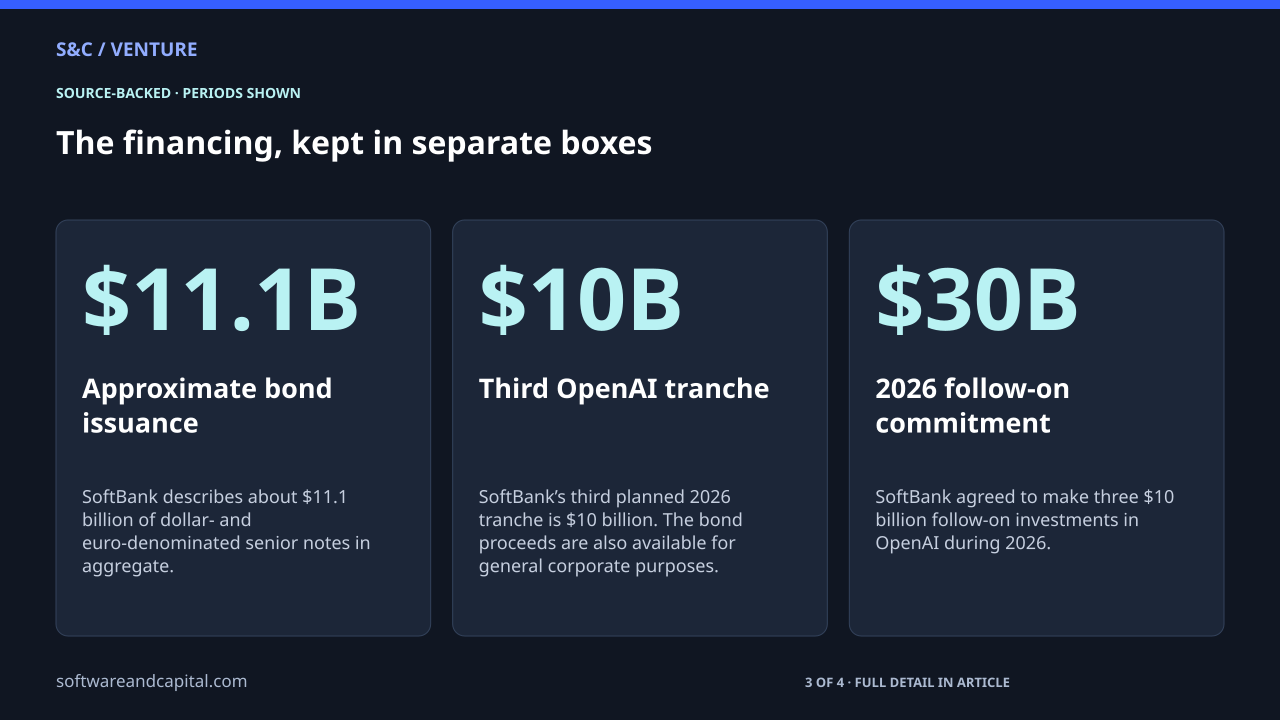
The financing, kept in separate boxes
SoftBank describes about $11.1 billion of dollar- and euro-denominated senior notes in aggregate.
SoftBank’s third planned 2026 tranche is $10 billion. The bond proceeds are also available for general corporate purposes.
SoftBank agreed to make three $10 billion follow-on investments in OpenAI during 2026.
SoftBank said completion of the $30 billion follow-on investment would take its expected OpenAI ownership interest to approximately 13%.
The bond sale is larger than the OpenAI payment
That does not mean $11.1 billion is being wired to OpenAI. SoftBank says the proceeds are intended for the final $10 billion tranche and general corporate purposes. Keeping those uses separate matters because debt raised, cash invested and the value of the OpenAI stake are three different numbers.1, 2
| Step | Amount or role | What it is not |
|---|---|---|
| Bond investors | About $11.1B of notes | Not an equity investment in OpenAI |
| SoftBank | Receives debt proceeds | Not free capital because interest and principal are owed |
| OpenAI tranche | $10B planned third payment | Not the full amount of the bond issuance |
| OpenAI stake | Preferred shares in the follow-on round | Not a publicly traded SoftBank bond |
The coupons make the cost of capital visible
SoftBank’s release lists several dollar and euro tranches with different maturities and coupons. That is the useful contrast with a venture round: the investor receives debt with contractual interest and repayment terms, while SoftBank takes the equity risk of the OpenAI investment on the other side.1
SoftBank had already planned to refinance bridge borrowing
When SoftBank announced the $30 billion follow-on investment, it said the consideration would initially be funded with bridge loans and then replaced over time with other financing and asset measures. The bonds are therefore part of a broader financing plan rather than a surprise decision to borrow for AI at the last minute.2
AI capital is reaching beyond venture equity
The larger point is not that debt is unusual for SoftBank. It is that one of the most prominent private AI investments is large enough to influence public bond issuance. The AI capital cycle now touches venture funds, corporate balance sheets, project finance, public equity and public credit markets.
Four distinctions worth keeping straight
- Bond principal is money SoftBank borrows, not OpenAI revenue.
- The $10 billion tranche is part of a larger $30 billion 2026 follow-on investment.
- Coupon payments are SoftBank financing costs, not a return guaranteed by OpenAI.
- A private-company valuation and a bond rating answer different questions.
S&C has already looked at Alphabet and Oracle raising equity for AI infrastructure. SoftBank is the complementary case: public debt markets are also becoming part of the financing stack behind very large AI bets.
Sources and methodology
Sources checked September 26, 2026. Dates and periods for individual figures are stated beside them.
- SoftBank: Issuance of foreign currency-denominated senior notes ↗Accessed 2026-09-26
- SoftBank: Follow-on investments in OpenAI ↗Accessed 2026-09-26
Scope and assumptions
The bond proceeds can also be used for general corporate purposes and should not be treated as fully ring-fenced to OpenAI.
The OpenAI investment remains a private-company equity exposure and the article does not evaluate whether the securities are attractive investments.
Continue reading
Alphabet and Oracle Raised $69.5B in Equity While Scaling AI Infrastructure →
CoreWeave Grew From $229M to $5.1B—and Still Lost $1.2B →
Anthropic at $965B: What Does a $47B Run Rate Actually Mean? →