Alphabet and Oracle are not startups short of access to capital. Yet both have recently sold large amounts of stock while racing to expand AI infrastructure. Together they reported $69.5 billion of net equity proceeds. The useful question is not whether every dollar pays for GPUs. It is why enormous technology companies are adding fresh equity during such a capital-intensive expansion.1, 3
Alphabet reported $49.6 billion of net equity proceeds in June 2026, while Oracle reported $19.9 billion of net proceeds from its Q1 FY27 at-the-market stock program. Both companies were also scaling capital-intensive AI infrastructure. The proceeds were for broad corporate purposes that include infrastructure, they should not be described as $69.5 billion earmarked solely for AI.1, 2, 3, 4
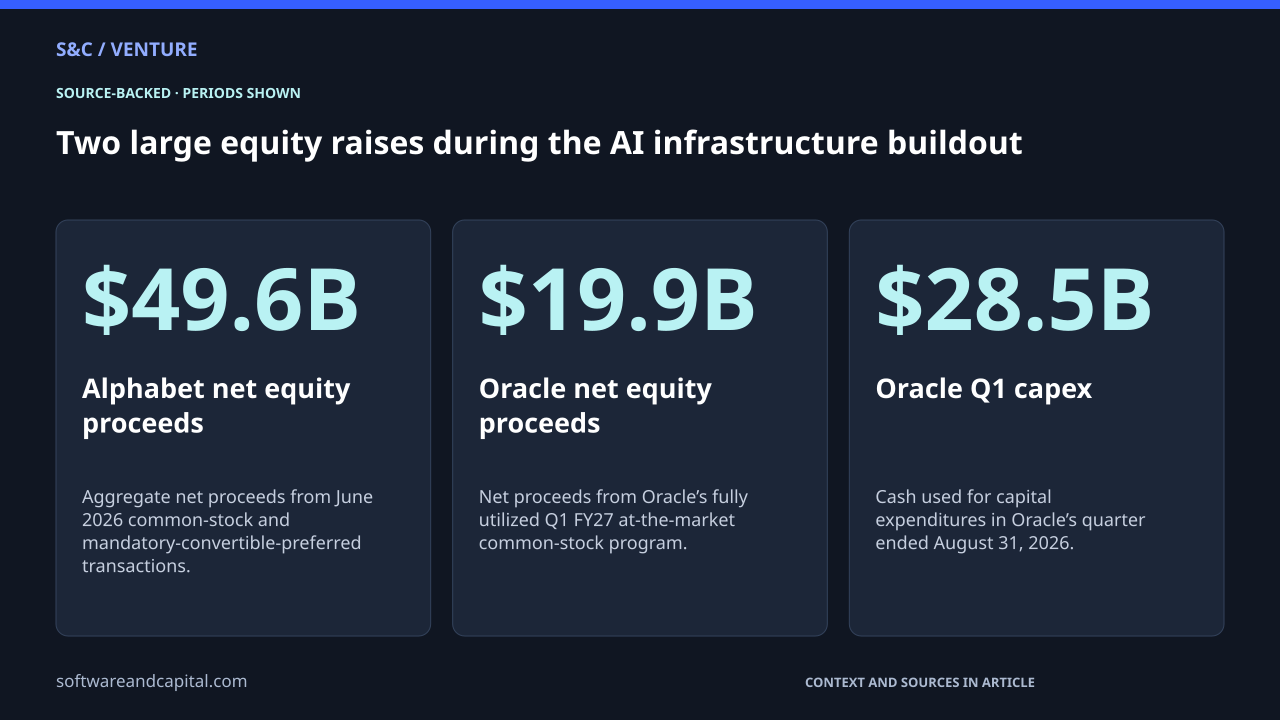
Two large equity raises during the AI infrastructure buildout
Aggregate net proceeds from June 2026 common-stock and mandatory-convertible-preferred transactions.
Net proceeds from Oracle’s fully utilized Q1 FY27 at-the-market common-stock program.
The $69.5 billion total combines net proceeds disclosed by each company. It does not mean the companies jointly created an AI fund or earmarked all of that cash for data centers. Alphabet says its proceeds are for general corporate purposes, including AI infrastructure and global compute. Oracle’s filing says ATM proceeds are for general corporate purposes that may include capital expenditures.1, 3
Alphabet used several equity instruments at once
Alphabet completed a public common-stock offering, a private common-stock placement to a Berkshire Hathaway affiliate and an offering of mandatory convertible preferred stock. The company reports $49.6 billion of aggregate net equity proceeds. It says those proceeds will support general corporate purposes, including capital expenditures to scale AI infrastructure and global compute.1, 2
| Company | Structure | Reported net proceeds | Stated use |
|---|---|---|---|
| Alphabet | Public common stock, private common placement and mandatory convertible preferred stock | $49.6B aggregate net proceeds | General corporate purposes, including capital expenditures to scale AI infrastructure and global compute. |
| Oracle | At-the-market common-stock program, about 141M shares issued in Q1 FY27 | $19.9B net proceeds | General corporate purposes, which may include capital expenditures, debt repayment, investments, acquisitions, dividends or repurchases. |
Alphabet also established a separate $40 billion at-the-market program, but as of June 30 it had not sold shares under that program. Those potential future shares therefore do not belong in the $49.6 billion completed-proceeds figure.1
Oracle’s capital need is visible in the cash-flow statement
Oracle spent $28.5 billion on capital expenditures in Q1 FY27, up $20.0 billion from the prior-year quarter. It also reported $19.9 billion of net proceeds from the completed ATM program. At the same time, Oracle said AI Cloud training and inference demand was growing faster than supply and that it had booked more than $30 billion of additional AI cloud contracts in the quarter.3, 4
That does not make the stock sale a one-for-one funding source for AI hardware. Cash from operations, customer prepayments, debt and other financing also matter. What the filing does show is the scale of the balance-sheet movement happening alongside the infrastructure expansion.3
The financing story sits underneath the cloud growth story
In our cloud-growth analysis, Google Cloud and Oracle both reported unusually strong growth tied partly to AI infrastructure demand. This financing view shows the other side of that growth. Serving demand requires data centers, GPUs, networking and power before the revenue fully arrives.2, 4
That is why revenue growth and financing cannot be read separately in an infrastructure boom. Strong demand can make large investments attractive while also increasing the amount of capital a company is willing to raise. Equity is one tool in that funding mix, alongside operating cash flow, debt, leases and customer financing.
Equity proceeds are not the same thing as AI spending
Four numbers that should stay separate
- Equity proceeds: cash received from completed stock transactions after the disclosed issuance costs when a net figure is used.
- Capital expenditures: cash spent to acquire or build long-lived assets during a period.
- Contract bookings or remaining performance obligations: customer commitments that may become revenue over time.
- AI infrastructure spending: the subset of investment actually tied to compute, data centers, networking and related capacity.
The striking number is $69.5 billion of net equity proceeds from two companies already large enough to generate enormous operating cash flows. The more useful lesson is why they raised it. AI infrastructure growth is forcing even the biggest technology companies to think actively about the mix of cash flow, debt and equity that supports the next layer of compute.
Sources and methodology
Sources checked September 23, 2026. Dates and periods for individual figures are stated beside them.
- Alphabet: Q2 2026 Form 10-Q ↗Accessed 2026-09-23
- Alphabet: Q2 2026 results, SEC-filed exhibit ↗Accessed 2026-09-23
- Oracle: Q1 FY27 Form 10-Q ↗Accessed 2026-09-23
- Oracle: Q1 fiscal 2027 results ↗Accessed 2026-09-23
Scope and assumptions
Alphabet and Oracle both describe broad corporate uses for the proceeds, the article does not attribute all $69.5B exclusively to AI infrastructure.
Alphabet’s financing combined several equity instruments, while Oracle used an at-the-market common-stock program, so the transactions are not structurally identical.
Oracle’s $28.5B quarterly capex and AI-cloud bookings provide context for capital intensity but are not a direct tracing of ATM proceeds to specific assets.
Continue reading
Cloud Growth Is Accelerating Again. AI Demand Is the Common Thread →