A buyer and seller do not always have to agree on one number. SoundThinking’s take-private deal splits the price in two: shareholders get $8 per share in cash at closing, then can receive as much as another $3 if the company hits specified revenue milestones after the sale.1
SoundThinking agreed to be acquired for $8 per share in cash plus a contingent value right, or CVR, worth up to $3 per share if specified 2027 revenue milestones are achieved. The upfront enterprise value is about $114 million and maximum potential value about $159 million. The extra $3 is contingent, not guaranteed consideration.1, 2
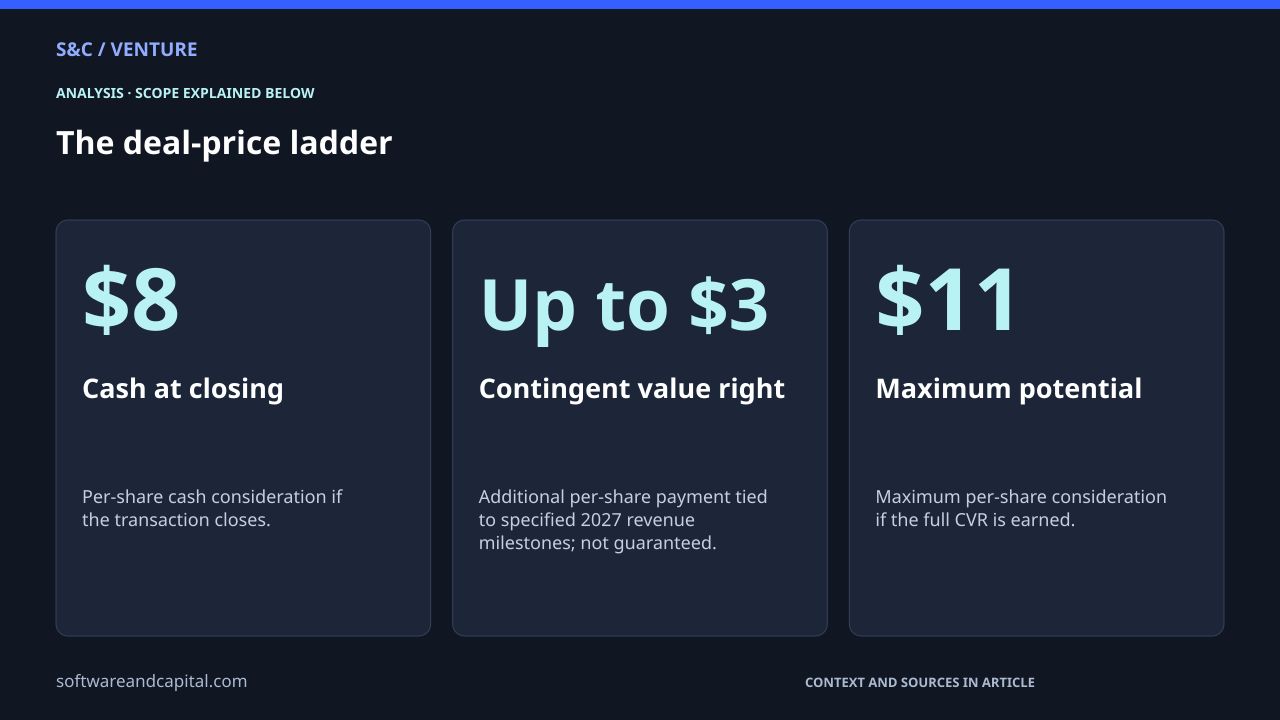
The deal-price ladder
A CVR moves part of the valuation argument into the future
A contingent value right gives shareholders an additional payment only if defined events occur. Here, the trigger is future revenue performance. The buyer can avoid paying the full headline price if the business misses the milestones, while sellers keep some upside if performance proves stronger.1
| Outcome | Buyer | Shareholder |
|---|---|---|
| Revenue misses CVR thresholds | Pays the $8 closing consideration, not the full potential $11 | Does not receive the unearned contingent amount |
| Revenue reaches all specified thresholds | Pays the additional CVR consideration | Receives up to the full $3 additional amount |
The headline maximum is not the closing price
The companies describe an upfront enterprise value of roughly $114 million and maximum potential value of roughly $159 million. The higher figure assumes the contingent consideration is earned. It should not be presented as guaranteed deal value.1
Why use this structure?
A CVR can bridge a valuation gap when the parties disagree about future performance or when a near-term milestone is unusually important. Instead of forcing the buyer to pay for the optimistic case immediately, the contract makes part of the price conditional.
Four things to check in any CVR
- The exact milestone and measurement period.
- Whether payments are all-or-nothing or scale across thresholds.
- What happens if the acquired business is reorganized before the milestone date.
- Whether the CVR is transferable or separately tradable.
The structure turns a valuation disagreement into a contract. SoundThinking shareholders know the cash they receive if the deal closes. The remaining value depends on what the business does afterward.
Sources and methodology
Sources checked September 29, 2026. Dates and periods for individual figures are stated beside them.
- SoundThinking: acquisition announcement ↗Accessed 2026-09-29
- SoundThinking investor relations ↗Accessed 2026-09-29
Scope and assumptions
The transaction remains subject to closing conditions.
The maximum $3 CVR payment is contingent and should not be treated as guaranteed consideration.
Continue reading
5 Numbers That Explain Where Figma’s IPO Money Went →
Anthropic at $965B: What Does a $47B Run Rate Actually Mean? →