A token with a stock ticker can mean very different things. Under the SEC’s September 17 framework, the important question is not whether the asset lives on a blockchain. It is whether the holder has the same economic and governance rights as the traditional share underneath it.1, 2
Under the SEC’s September 2026 exemption, qualifying tokenized NMS stock must give holders the same rights and privileges as the equivalent traditional stock, including dividends and voting rights. Synthetic trackers are excluded. The blockchain changes the trading and recordkeeping machinery; it does not turn a qualifying tokenized share into a different economic claim.1, 2
| Structure | What the holder has | Dividends and votes | SEC exemption |
|---|---|---|---|
| Traditional NMS stock | A conventional share of a U.S.-listed company | Rights of that share class | Trades through existing market structure |
| Qualifying tokenized NMS stock | A tokenized security with the same rights and privileges as the equivalent traditional stock | Must preserve them | Can trade on a qualifying Tokenized Securities Venue under the temporary conditions |
| Synthetic stock tracker | A separate instrument designed to track a stock’s economics or price | Not the same shareholder claim | Excluded from this exemption |
The token is not supposed to change the shareholder rights
The SEC says a Tokenized Securities Venue, or TSV, must verify that a tokenized NMS stock gives holders the same rights and privileges as the equivalent traditional class. Chairman Paul Atkins’ statement makes the practical examples explicit: that includes the right to receive dividends and exercise voting rights.1, 2
That is the dividing line between tokenizing a security and manufacturing a synthetic lookalike. The latter can offer economic exposure without making the buyer a holder of the underlying stock. The SEC’s temporary exemption does not cover those synthetic products.2
What changes is the market machinery
The exemption allows qualifying venues to bring buyers and sellers together through permissioned automated market makers and liquidity pools. The smart contracts must be public and auditable and deployed on a public, permissionless distributed ledger. Access to the trading venue itself remains permissioned.1
That combination is easy to miss. “Onchain” does not mean anyone can anonymously trade any U.S. stock in any pool. The SEC conditions include participant-access standards, limits on symbols and volume, public operating disclosures and trading halts that follow the underlying stock’s halt on its primary exchange.1
The issuer gets a say when a third party tokenizes the stock
A third party can tokenize an NMS stock under the framework without being affiliated with the issuer, but the venue must give the issuer written notice and an opportunity to object before making it available. Atkins describes the issuer’s ability to prevent its security from trading on a TSV as an investor-protection condition.1, 2
Temporary means temporary
The SEC says the exemptions expire five years after publication and has requested public comment while it considers longer-lasting rules. Anti-fraud and anti-manipulation provisions continue to apply. This is therefore a controlled route for market experimentation, not a wholesale replacement of U.S. securities regulation.1, 2
For a reader, the useful test is simple: ignore the word “tokenized” for a moment and ask what legal and economic claim the instrument represents. The same discipline helps when reading about stablecoins moving into card settlement. The technology layer can change while the underlying financial claim still needs a precise definition.
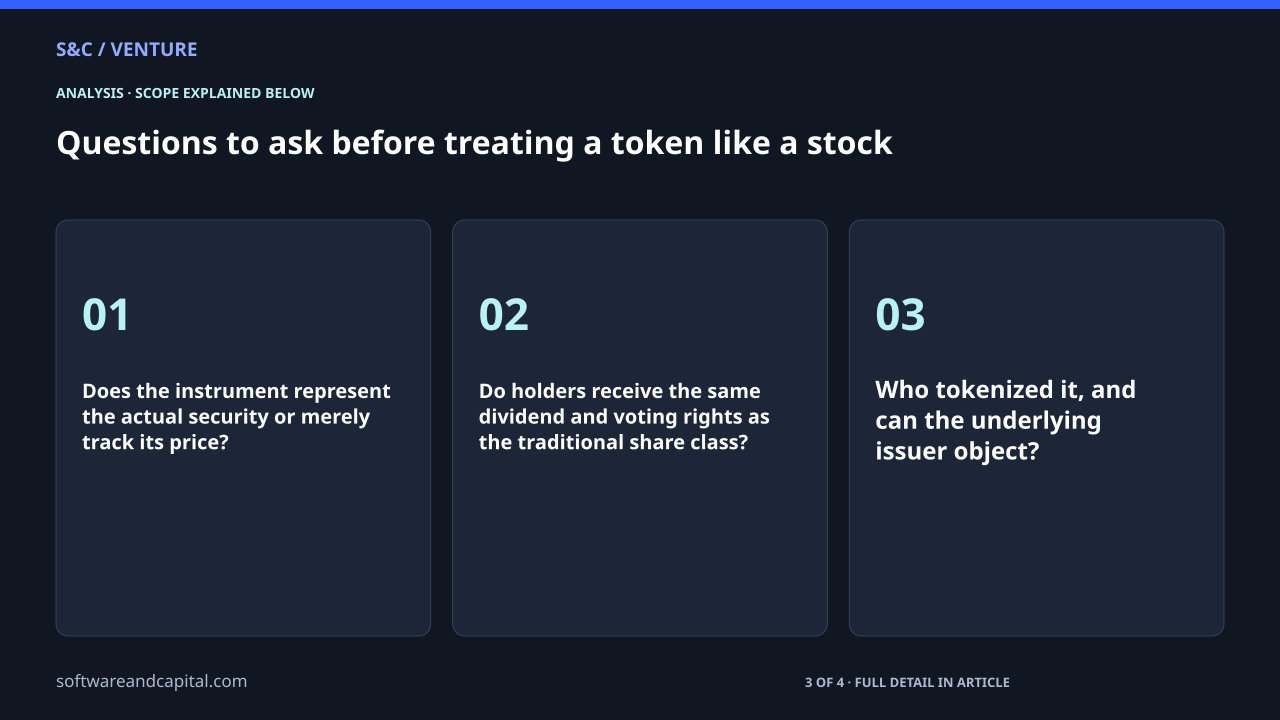
Questions to ask before treating a token like a stock1, 2
- Does the instrument represent the actual security or merely track its price?
- Do holders receive the same dividend and voting rights as the traditional share class?
- Who tokenized it, and can the underlying issuer object?
- Where does it trade, who can access that venue and what rules apply when the underlying stock stops trading?
Tokenization can change how a share is traded, transferred and recorded without changing what ownership is supposed to mean. The SEC’s new framework is interesting precisely because it tries to preserve that distinction: new rails, familiar shareholder rights.
Sources and methodology
Sources checked September 24, 2026. Dates and periods for individual figures are stated beside them.
- SEC: Innovation Exemption for tokenized NMS stock ↗Accessed 2026-09-24
- SEC Chairman Atkins: Innovation Exemption statement ↗Accessed 2026-09-24
Scope and assumptions
The SEC exemption is temporary and conditional and does not cover every tokenized-equity product or venue.
This explains the public regulatory framework and does not recommend a security, trading venue or investment strategy.
Continue reading
SoFi Is Moving a $25B Card Program Onto Stablecoin Rails →
88% of Coinbase Net Revenue Now Comes From Outside Bitcoin Spot Trading →