Coinbase is still a crypto company, but it is becoming a less simple one. The company once made an easy shorthand for the Bitcoin cycle: more Bitcoin trading meant more fees. Its latest revenue mix shows why that shortcut is getting weaker. Coinbase says only 12% of Q2 net revenue came from Bitcoin spot trading.1
Coinbase says 88% of Q2 2026 net revenue came from outside Bitcoin spot trading. Subscription and Services generated $555.1 million, or 48% of net revenue, while transaction revenue was $599.2 million. The mix is broader than Bitcoin brokerage, but much of the business still depends on crypto prices, balances and activity.1, 2
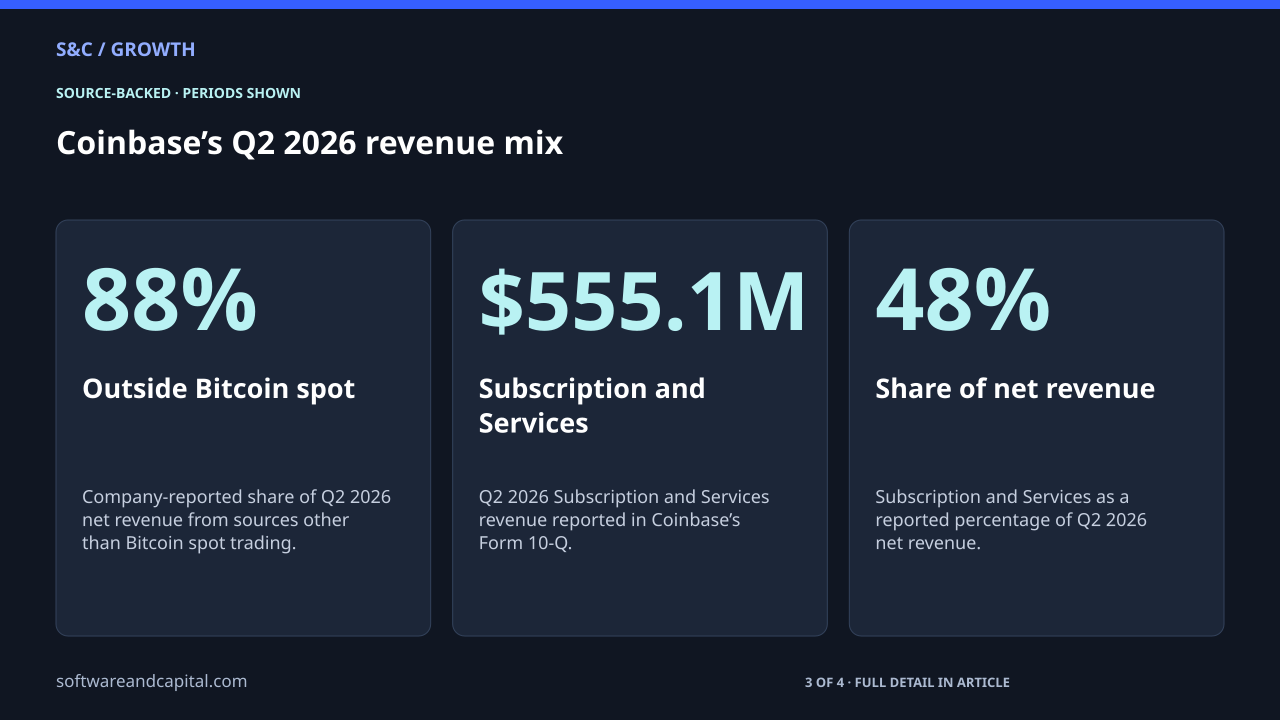
Coinbase’s Q2 2026 revenue mix
Company-reported share of Q2 2026 net revenue from sources other than Bitcoin spot trading.
Q2 2026 Subscription and Services revenue reported in Coinbase’s Form 10-Q.
Subscription and Services as a reported percentage of Q2 2026 net revenue.
The 88% number needs careful reading. “Outside Bitcoin spot trading” includes other transaction revenue as well as stablecoin, staking, interest and other services. It does not mean 88% of Coinbase is recurring revenue, or that 88% of the business has escaped crypto-market cycles.1, 2
Subscription and Services is now almost half of net revenue
Coinbase reported $555.1 million of Subscription and Services revenue in Q2, equal to 48% of net revenue. That category was just $6 million in Q2 2020, according to the company. The shift matters because the business can now earn money from assets and activity that do not require a customer to place a spot trade at that moment.1, 2
| Q2 2026 component | Revenue | What drives it |
|---|---|---|
| Stablecoin revenue | $292.1M | Economics tied primarily to USDC-related activity and balances under Coinbase’s arrangements. |
| Blockchain rewards | $83.3M | Rewards earned from participating in supported blockchain protocols. |
| Interest and finance fee income | $66.1M | Interest and finance-related income from eligible products and balances. |
| Other Subscription and Services | $113.5M | Other service revenue reported in the category. |
Outside Bitcoin does not mean outside trading
Transaction revenue was still $599.2 million in Q2, slightly more than Subscription and Services. Coinbase also emphasizes products such as derivatives and prediction markets as part of its “Everything Exchange” strategy. A broader asset mix can reduce dependence on Bitcoin spot fees without removing dependence on trading activity itself.1, 2
That distinction is useful when reading any platform business. A company can diversify what customers do before it diversifies the underlying economic cycle. Coinbase may collect revenue through more products, but many of those products still become more valuable when crypto prices, balances or trading participation rise.
Stablecoins are becoming a major business line
Stablecoin revenue was $292.1 million in Q2, the largest disclosed component of Subscription and Services. Coinbase also reported an all-time-high $20 billion average USDC balance held in Coinbase products. Those figures show that simply holding and moving dollar-linked crypto assets can create meaningful economics alongside exchange fees.1, 2
That does not make the stablecoin business risk-free or fully predictable. Stablecoin revenue depends on balances, interest-rate economics, commercial arrangements and user activity. It is different from a trading commission, but it is not the same thing as a fixed software subscription.2
Diversification makes the business broader, not non-cyclical
Four things to watch in Coinbase’s next results
- Whether Subscription and Services stays near half of net revenue when crypto trading conditions change.
- How stablecoin balances and stablecoin revenue move when interest rates or USDC usage change.
- Whether newer products such as derivatives and prediction markets add revenue without simply shifting trading volume between products.
- Whether operating costs rise as Coinbase supports a wider set of regulated financial products and markets.
Coinbase is no longer well described as a place that charges people to buy Bitcoin. The company has built several revenue engines around crypto balances, protocols and a wider set of markets. That is real diversification. The next question is whether those engines make Coinbase materially more resilient when the crypto cycle turns against trading activity.
Sources and methodology
Sources checked September 23, 2026. Dates and periods for individual figures are stated beside them.
- Coinbase: Q2 2026 earnings highlights ↗Accessed 2026-09-23
- Coinbase: Q2 2026 Form 10-Q ↗Accessed 2026-09-23
Scope and assumptions
The 88% figure is a company-defined measure for revenue outside Bitcoin spot trading and still includes other trading activity.
Subscription and Services is an accounting category, not a guarantee that all revenue in it is contractually recurring or insulated from crypto-market conditions.
Stablecoin revenue depends on balances, rates, user activity and commercial arrangements, so current quarterly economics should not be extrapolated mechanically.
Continue reading
76% of Shopify’s Revenue Came from Merchant Solutions in 2025 →
$2.2B From Online Conversations: How Reddit Makes Money →
$159B Valuation: Stripe’s Payday Without an IPO →
Deel’s Stablecoin Wallet Is in 80+ Countries. Is Payroll Becoming Crypto Infrastructure? →