Uber’s robotaxi strategy looks less like building one giant autonomous-driving company and more like assembling a marketplace. In March 2026 it announced a Rivian deal that could eventually cover up to 50,000 autonomous R2 vehicles. In August, it expanded a separate Pony.ai partnership for more than 2,000 robotaxis across Europe.1, 2
Uber is trying to make its app the demand and transaction layer for robotaxis built and operated by partners. Its Rivian deal calls for 10,000 initial autonomous R2 vehicles with an option for 40,000 more, while Pony.ai plans more than 2,000 robotaxis across Europe. Most of that scale is still planned rather than deployed.1, 2, 3
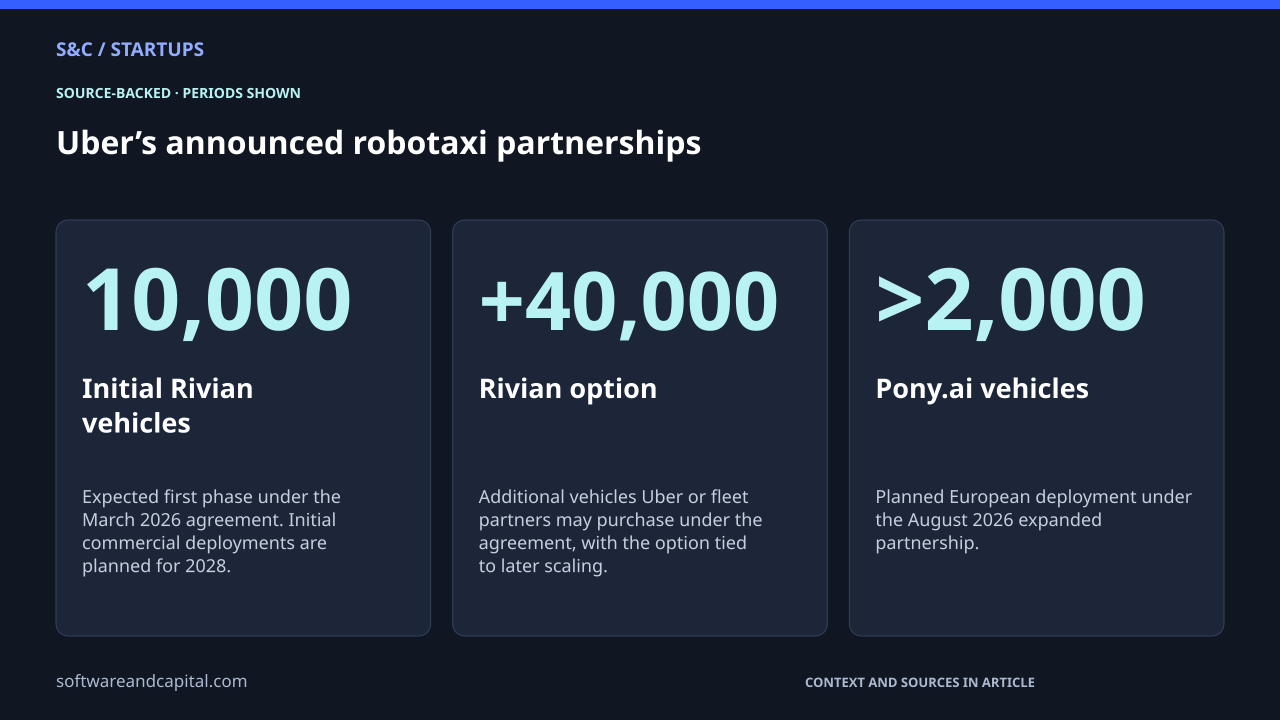
Uber’s announced robotaxi partnerships
Those numbers need their verbs attached. The Rivian vehicles are expected and optional, not a fleet already operating today. The Pony.ai agreement is also a planned expansion. The current proof point is smaller: riders in Zagreb can already book autonomous rides through Uber, with Pony.ai providing the driving system and Verne owning and operating the fleet.1, 2, 3
Uber is trying to own the customer layer, not every technical layer
The Zagreb launch makes the division of labor unusually clear. Pony.ai supplies autonomous-driving technology. Verne is the fleet owner and service operator. Uber integrates the service into its ride-hailing network and handles the rider experience in the app.3
| Layer | Example owner | Business role |
|---|---|---|
| Autonomous-driving system | Pony.ai or Rivian | Build and validate the technology that drives the vehicle. |
| Vehicle or fleet ownership | Rivian, Uber or fleet partners, and local operators | Provide the physical cars and capital tied to them. |
| Day-to-day fleet operations | Local operators such as Verne | Manage vehicles and the operating service in the market. |
| Customer demand and booking | Uber | Match riders to available vehicles, handle the app experience and payments. |
That structure lets Uber participate in autonomous mobility without betting that one internal driving stack must beat every specialist. The trade-off is dependence. If a partner misses technical milestones, deployment dates or regulatory approvals, Uber cannot simply solve the problem by changing the app.
The Rivian deal also puts Uber’s own capital into the stack
Uber said it may invest up to $1.25 billion in Rivian through 2031, subject to autonomous-performance milestones. The same announcement says Uber or its fleet partners are expected to purchase the first 10,000 vehicles. That means the strategy is asset-light only in a relative sense. Uber can avoid building every component while still committing meaningful capital to make supply exist.1
This is the mirror image of the question in our Waymo capital analysis. Waymo is building a tightly integrated driving and fleet system. Uber is asking whether a platform with enormous rider demand can connect several autonomous suppliers and operators instead.
A marketplace can make fragmented autonomy easier to buy
A rider generally does not want to manage relationships with separate vehicle makers, driving-software companies and fleet operators. Uber can hide that complexity behind one booking interface. In return, autonomous partners gain access to an existing demand network rather than having to build a consumer marketplace city by city.2, 3
The approach resembles other platform businesses: the platform is most valuable when it can aggregate supply that would otherwise be fragmented. Robotaxis add a difficult twist because the supply is regulated, capital-intensive and safety-critical. A weak supplier cannot be fixed with a better recommendation algorithm.
The 50,000 figure is a ceiling on a plan, not today’s fleet
What to watch before calling the strategy scaled
- How many announced vehicles actually enter paid service, and on what schedule.
- Whether multiple autonomy partners can meet Uber’s service and safety requirements across different cities.
- Who owns the vehicles and absorbs capital, maintenance and utilization risk in each market.
- Whether riders treat autonomous supply as interchangeable with human-driven rides or prefer particular operators.
Uber’s advantage is not that it has already built a 50,000-car robotaxi fleet. It is that it may not need to build one company that does everything. If the partnerships work, Uber can make autonomous vehicles from several suppliers look like one transportation network to the rider.
Sources and methodology
Sources checked September 22, 2026. Dates and periods for individual figures are stated beside them.
- Uber and Rivian: autonomous robotaxi partnership ↗Accessed 2026-09-22
- Uber and Pony.ai: more than 2,000 robotaxis planned in Europe ↗Accessed 2026-09-22
- Uber: autonomous rides launch in Zagreb ↗Accessed 2026-09-22
Scope and assumptions
The Rivian and Pony.ai vehicle counts are forward-looking partnership plans. They are not presented as currently deployed Uber robotaxis.
The article does not estimate robotaxi profitability, safety performance or market share because the cited announcements do not support those conclusions.
AI-assisted research and editing. Our editorial standards.
Continue reading
$16B for Driverless Rides: Why Robotaxis Need So Much Capital →
Amazon Has 1 Million Robots. What Happens to the Warehouse Job? →