Robotaxis are often framed as another way to avoid the bus or train. Waymo is now paying riders to do the opposite. Its new Bay Area program gives riders Waymo Cash when an autonomous ride connects closely enough with a public-transit trip.1
Waymo’s Bay Area transit rewards program gives riders $2.85 in Waymo Cash when a Waymo trip and eligible public-transit trip occur within two hours using a linked Visa card. Waymo says more than half of riders in its mature service areas use public transit. The strategy positions robotaxis as a first- and last-mile complement to transit.1, 2
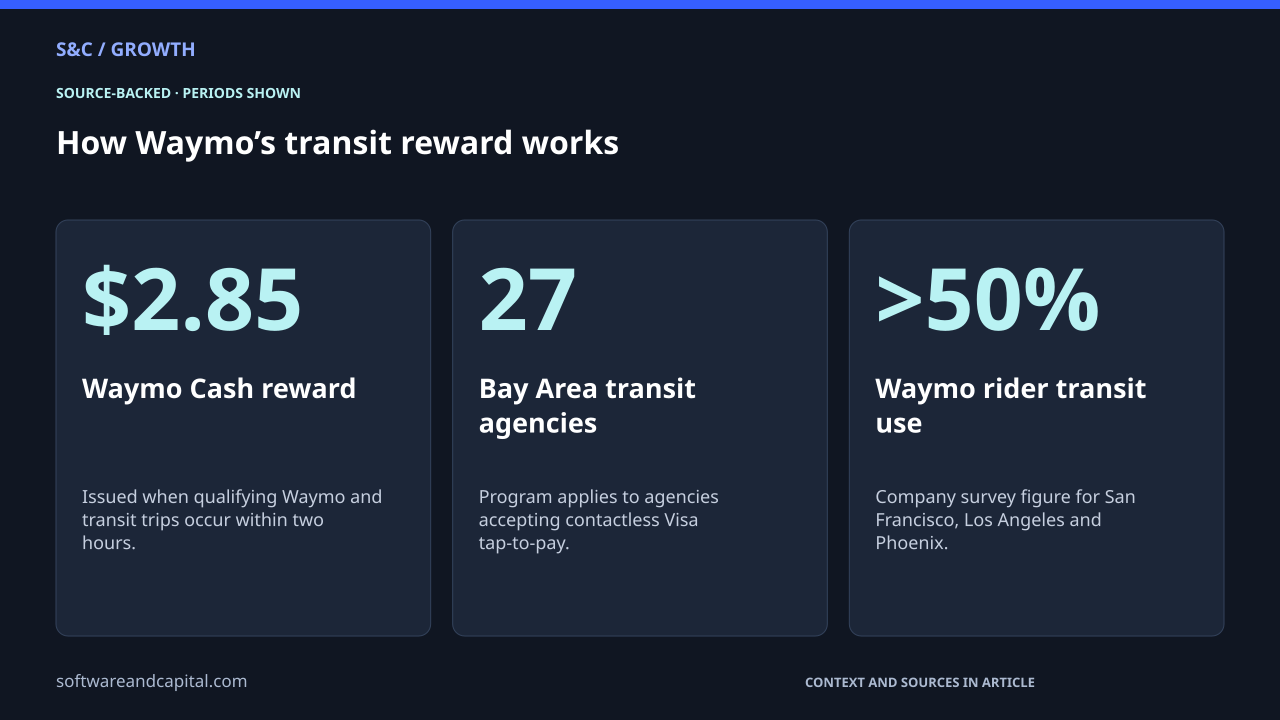
How Waymo’s transit reward works
Waymo is subsidizing the connection, not the whole commute
A rider links a Visa card in the Waymo app. If that card is used for a Waymo trip and eligible public transit within two hours, Waymo says it will automatically issue $2.85 in Waymo Cash, equal to a San Francisco bus fare.1
Waymo is also leasing 40 dedicated Caltrain station parking spaces for staged vehicles. The operational detail reveals the strategy: make the handoff between an autonomous car and a high-capacity transit line easier.1
The first and last mile is a different market from the whole trip
A train can move many people efficiently along a fixed corridor. It cannot pick each rider up at home. A robotaxi can fill that flexible edge of the network without needing to carry the rider for the entire journey.
Waymo says many of its riders already use transit
Waymo says recent surveys show more than half of riders in San Francisco, Los Angeles and Phoenix use public transit. That is a company survey result, not proof that Waymo caused those riders to use transit or that the reward program will increase ridership.1
The company is making the same complementarity argument as it expands internationally. In Singapore, Waymo explicitly describes autonomous ride-hailing as a way to complement the city’s public-transport network rather than replace it.2
The reward is also a growth experiment
Waymo Cash keeps the incentive inside Waymo rather than paying the rider in ordinary cash. If the program makes station connections easier, it can create trips Waymo might not otherwise capture while positioning the service as part of a larger mobility network.
What would show whether the strategy is working
- How many riders actually earn and redeem transit rewards.
- Whether station-linked Waymo trips increase after public rollout.
- Whether the program expands beyond the Bay Area and into other transit systems.
- Whether transit agencies see measurable changes in first- and last-mile access.
The interesting competition may not be robotaxi versus train. It may be robotaxi versus the car trip to the station, the parking space or the inconvenient final mile. Paying riders to connect the networks makes that strategy unusually visible.
Sources and methodology
Sources checked September 25, 2026. Dates and periods for individual figures are stated beside them.
- Waymo: Introducing transit rewards ↗Accessed 2026-09-25
- Waymo: Singapore expansion ↗Accessed 2026-09-25
Scope and assumptions
The more-than-50% transit-use figure comes from Waymo surveys.
The program is rolling out gradually and does not yet establish that robotaxis increase public-transit ridership.
Continue reading
$16B for Driverless Rides: Why Robotaxis Need So Much Capital →
Waymo Has Driven 270M Autonomous Miles. How Should You Read Its Safety Claim? →