Zoom became synonymous with the sales call during the remote-work boom. Its newer strategy is to make that conversation feed a much larger software system. The company is combining buyer signals before the meeting, conversation intelligence during the deal, outreach after the call and a forecast for management into what it calls a ‘revenue OS.’
Zoom’s ‘revenue OS’ combines buyer intelligence from Common Room with conversation data from Zoom Revenue Accelerator, outbound sequencing through Engage and pipeline forecasting through Forecast. Zoom’s phrase is marketing language, not an established software category. The strategic idea is clearer: use the customer conversation as proprietary context that can inform what sellers do before, during and after a deal.1, 2
| Layer | Product role | Data entering the loop |
|---|---|---|
| Buyer intelligence | Common Room by Zoom | CRM, product, marketing and external buying signals |
| Conversation intelligence | Zoom Revenue Accelerator | Meetings, calls and deal conversations |
| Outreach | Engage | Sequences and follow-up actions |
| Forecasting | Forecast | Pipeline signals, commitments and deal movement |
The conversation is the part Zoom naturally owns
A CRM knows the account record. A marketing system knows campaign activity. Zoom knows what the buyer actually said in the meeting. The revenue-OS strategy is an attempt to make that conversation context useful beyond transcription or coaching by connecting it to prospecting, follow-up and forecasting.1
Common Room adds the signal before the call
Zoom closed its acquisition of Common Room in July. Common Room combines first-party information from CRM, product and marketing systems with buying signals and person-level enrichment. Zoom’s rationale was explicit: add upstream buyer intelligence to the conversation data already captured by Revenue Accelerator.2
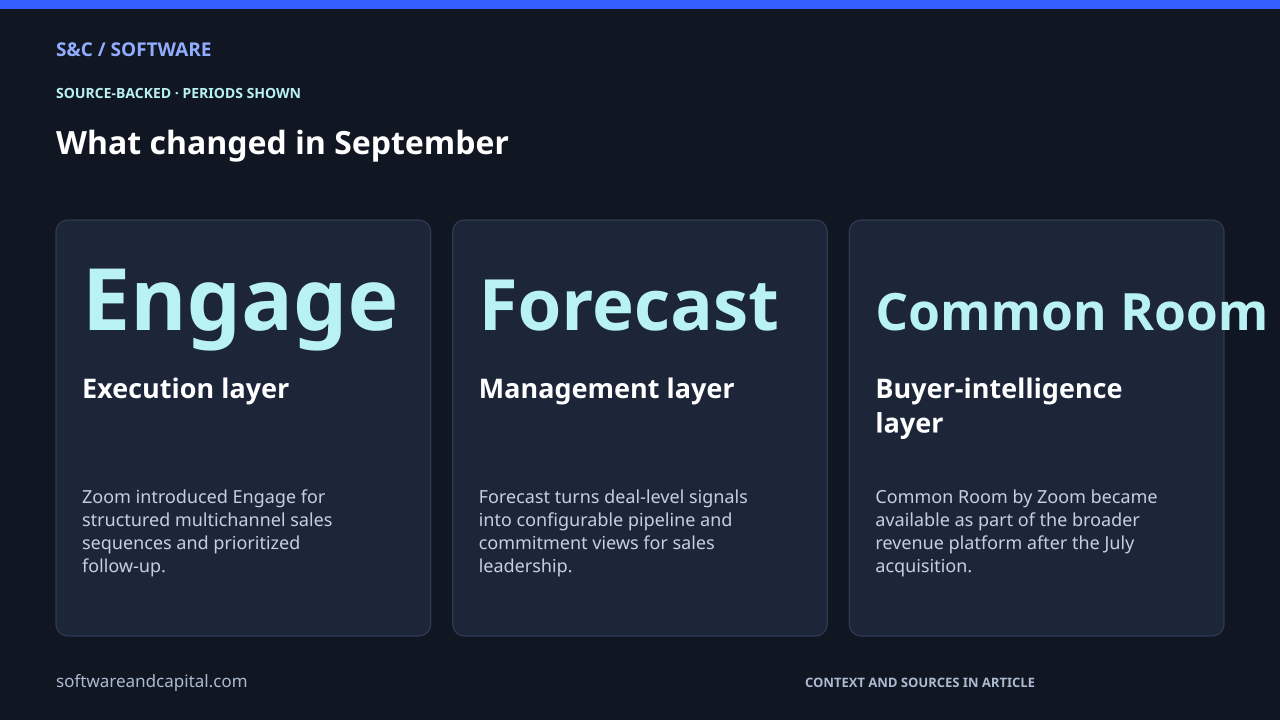
What changed in September
Zoom introduced Engage for structured multichannel sales sequences and prioritized follow-up.
Forecast turns deal-level signals into configurable pipeline and commitment views for sales leadership.
This does not replace the CRM
Zoom’s own materials describe writing updates back to CRM systems and combining CRM data with conversation history. That makes the strategy more complementary than substitutive today. The CRM remains a system of record, while Zoom is trying to become the system that interprets customer signals and recommends or executes the next revenue action.1, 2
‘Revenue OS’ is a strategy label, not a settled category
The phrase packages several existing software markets under one label: conversation intelligence, buyer intent, sales engagement and forecasting. Readers should therefore judge the strategy by integration and workflow outcomes rather than treating ‘revenue OS’ as a new market with agreed boundaries.
What would prove the platform thesis
- More customer signals becoming usable without manual stitching between point solutions.
- Forecast changes that can be traced to actual conversation and buyer-intent evidence.
- Sales actions flowing back to the CRM without creating a second conflicting system of record.
- Customers consolidating tools because the combined workflow is better, not merely because it is bundled.
Zoom is making the same broad move seen across modern software: use AI to turn an existing data advantage into a wider workflow. The open question is whether owning the customer conversation gives Zoom enough context to become a daily sales platform rather than a meeting product with adjacent features.
Sources and methodology
Sources checked September 26, 2026. Dates and periods for individual figures are stated beside them.
- Zoom: AI-powered revenue OS launch ↗Accessed 2026-09-26
- Zoom: acquisition of Common Room ↗Accessed 2026-09-26
- Zoom Support: Using Forecast for Revenue Accelerator ↗Accessed 2026-09-26
Scope and assumptions
Zoom’s product and customer-performance claims are vendor-reported.
The strategy currently complements CRM systems and should not be described as replacing the CRM.
Common Room, Engage and Forecast can have separate packaging and licensing requirements.