The AI infrastructure boom is usually told through GPUs, cloud providers and giant data-center developers. Accelevation sits lower in the stack. It manufactures and integrates power, cooling and modular systems that data centers need before racks of servers can do anything useful. Its IPO filing shows how quickly that supplier layer is scaling.1
Accelevation reported $437.5 million of revenue in the first half of 2026, up 175.8% from the same period a year earlier. The company says substantially all revenue comes from data-center customers and identifies AI-driven demand as a major growth factor. Its proposed IPO makes the physical supply chain behind AI infrastructure unusually visible.1, 2
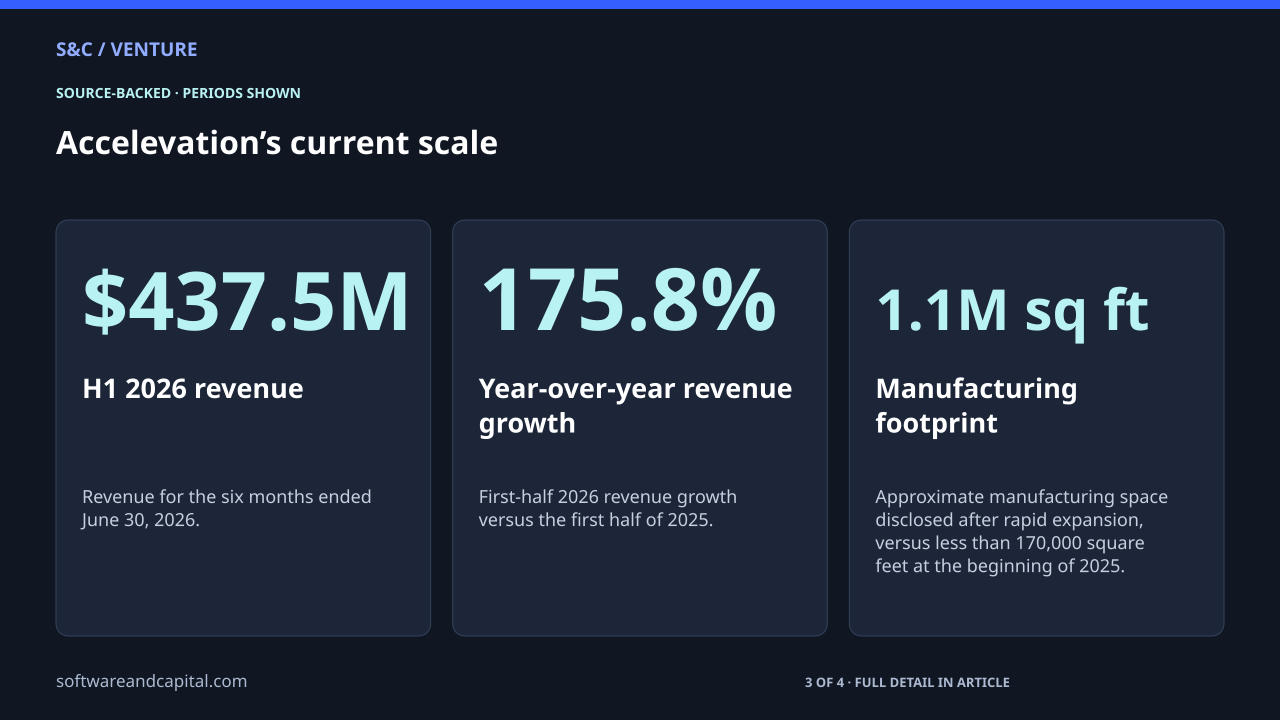
Accelevation’s current scale
The product is physical infrastructure, not compute
Accelevation sells customized and standard systems used to distribute power, manage thermal loads and accelerate data-center construction. That makes it a picks-and-shovels story in the literal sense: the company does not train AI models, but it supplies parts of the facility stack required to run them.1
| Layer | Examples | Accelevation’s role |
|---|---|---|
| Compute | GPUs and servers | Customer demand driver, not Accelevation’s product |
| Power distribution | Panels, busways and related systems | Designs, manufactures and integrates equipment |
| Cooling and modular infrastructure | Thermal and prefabricated systems | Supplies physical capacity for dense deployments |
| Data-center owner/operator | Hyperscale and colocation customers | Buys the infrastructure |
Growth came with much more factory capacity
The filing says manufacturing space expanded to roughly 1.1 million square feet from less than 170,000 square feet at the beginning of 2025. That physical expansion is a reminder that this is not cloud software economics. Fast growth requires factories, working capital, project execution and supply-chain capacity.1
The filing attributes demand partly to AI
Accelevation says substantially all of its revenue is tied to the data-center industry and identifies cloud computing, AI and broader digital workloads as drivers of new capacity investment. That is management’s demand explanation, not evidence that every dollar of revenue is an AI dollar.1
The IPO is also a liquidity event for existing owners
The roadshow covers 30 million shares at an expected $20 to $24 range. Accelevation itself is offering about 8.6 million shares, while existing stockholders are offering about 21.4 million. As with Figma’s IPO cash split, the headline deal size is not the same as cash entering the operating company.2
What to watch beyond the 176% growth headline
- How quickly the expanded manufacturing footprint is utilized.
- Customer concentration and dependence on large projects.
- Gross margin as customized infrastructure volume scales.
- How much of the proposed IPO goes to the company versus selling stockholders.
The story complements CoreWeave’s capital-intensity article and S&C’s AI electricity constraint analysis. The AI buildout is not only a software and semiconductor cycle. It is also an industrial supply-chain cycle.
Sources and methodology
Sources checked September 26, 2026. Dates and periods for individual figures are stated beside them.
- Accelevation: Amendment No. 2 to Form S-1 ↗Accessed 2026-09-26
- Accelevation: Launch of proposed IPO roadshow ↗Accessed 2026-09-26
Scope and assumptions
The IPO was proposed and had not completed as of the article’s as-of date.
Accelevation attributes demand partly to AI, but its customers also support cloud and other digital workloads.
Rapid historical growth does not establish future growth or investment returns.
Continue reading
CoreWeave Grew From $229M to $5.1B—and Still Lost $1.2B →