Corporate cards used to be mostly a payment product with expense software bolted on somewhere else. American Express is moving those layers together. Its new Amex Corporate program combines cards, spend controls, expense-management software and a mobile app, with additional AI agents planned for routine expense tasks.1, 2
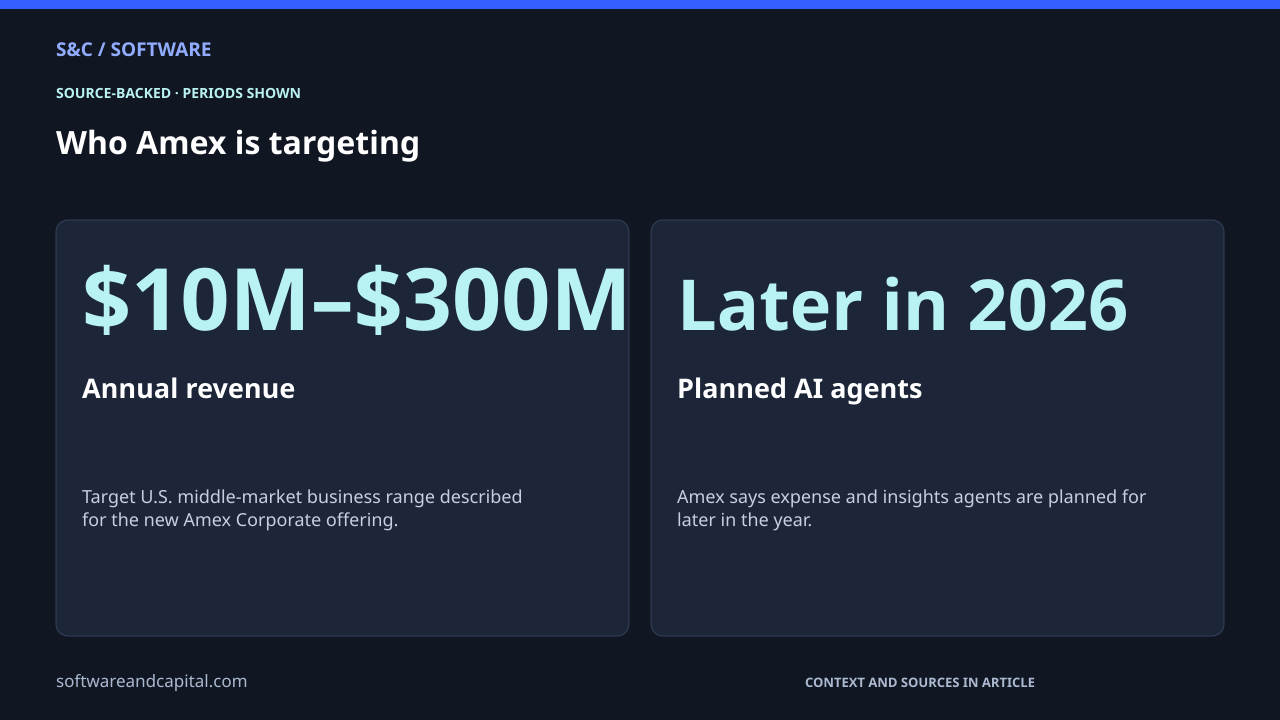
American Express launched a new Amex Corporate offering that combines Corporate Cashback Cards, integrated expense-management software and a mobile expense app. It targets U.S. businesses with roughly $10 million to $300 million in annual revenue. Amex says additional AI agents for expense follow-up and spend insights are planned, so those agent features should be treated as roadmap rather than fully deployed capability.1, 2
Who Amex is targeting
The corporate card is becoming the front end of a spend system
The integrated product brings card controls, transaction data and expense workflows into one system. The mobile app is designed to generate expense submissions as purchases happen, reducing the gap between payment and reporting.1, 2
| Traditional setup | Integrated Amex approach | Business effect |
|---|---|---|
| Card transaction | Card + program controls | Policy can sit closer to the payment |
| Separate receipt workflow | Expense app creates submissions | Less manual reconciliation |
| Finance reporting after the fact | Integrated transaction and expense data | Faster visibility into spend |
| Manual follow-up | Planned AI expense agent | Routine missing-detail follow-up can be automated |
Software is how an incumbent answers fintech competition
Newer spend-management companies have treated the card as one component of a broader software product. Amex already has payment distribution, merchant acceptance and corporate relationships. Adding software lets it compete on workflow rather than rewards and credit alone.1
Planned agents should stay labeled as planned
American Express says future agents will contact employees for missing expense details and answer finance-team questions about company spend. Those capabilities are part of the roadmap, not evidence of a fully deployed autonomous finance system today.2
What would show the strategy is working
- Adoption of the expense software among existing Amex corporate-card customers.
- Reduction in manual expense processing and reconciliation time.
- Retention or expansion gains from bundling cards and software.
- Whether planned AI agents move beyond assistance into approved transactional actions.
The interesting competitive shift is that payment networks are becoming software companies around the transaction. Amex does not need to stop being a card network to respond to fintech. It can use the card relationship as the distribution channel for a larger operating product.
Sources and methodology
Sources checked October 1, 2026. Dates and periods for individual figures are stated beside them.
- American Express: next-generation Amex Corporate ↗Accessed 2026-10-01
- PYMNTS: Amex equips corporate card program with new spend controls ↗Accessed 2026-10-01
Scope and assumptions
Some AI-agent capabilities are planned for later in 2026 rather than fully deployed.
The launch announcement does not provide customer adoption or ROI data for the new integrated software.
Continue reading
When Banking Lives Inside Business Software, Who Owns the Customer? →
Chime Is Paying $590M to Buy Its Longtime Bank Partner →
Mastercard Wants One Connection Between Merchants and Every Shopping Agent →