Chime has spent years owning the app while relying on partner banks for the regulated banking layer underneath it. Now it wants to own one of those partners. The company has agreed to acquire Stride Bank, a national bank that has supported Chime accounts for more than seven years, for $590 million in cash.1, 3
Chime agreed to buy longtime partner Stride Bank for $590 million in cash. If regulators approve the deal, Stride would become Chime Bank, N.A. Chime says ownership should improve speed, control, lending economics and funding costs. The transaction is expected to close in the first half of 2027 and has not closed yet.1, 3
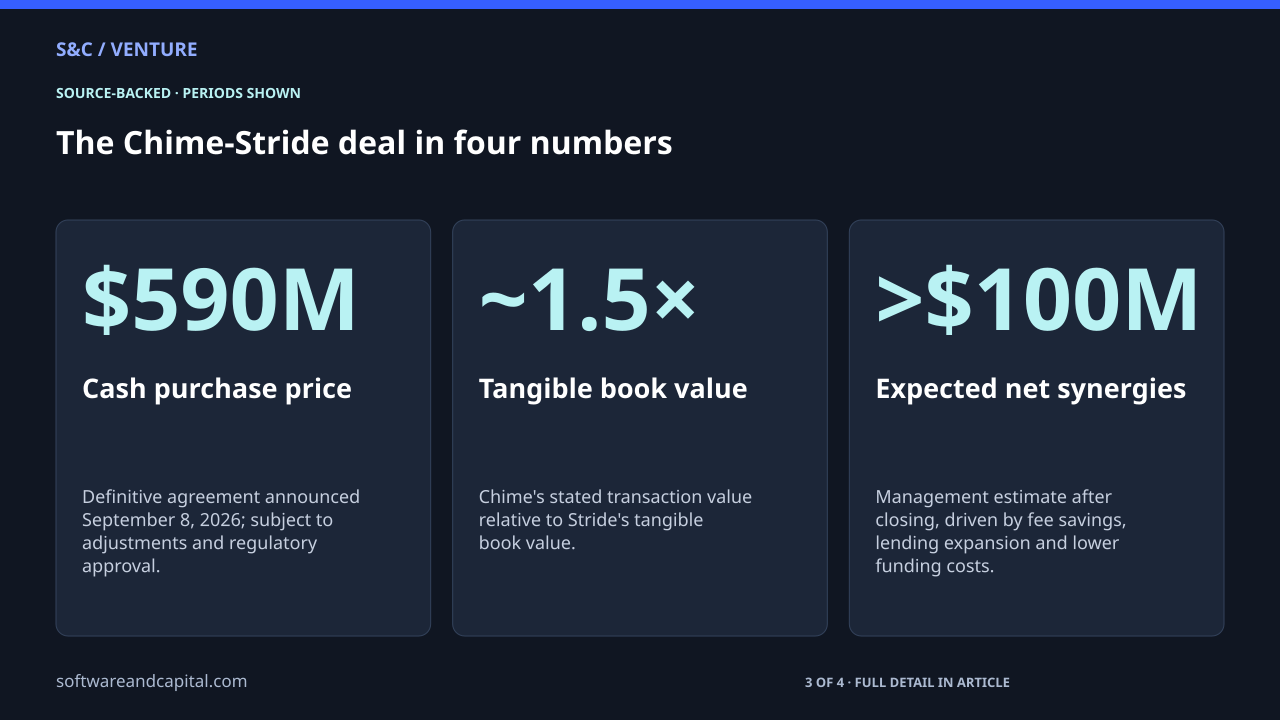
The Chime-Stride deal in four numbers
Definitive agreement announced September 8, 2026; subject to adjustments and regulatory approval.
Management estimate after closing, driven by fee savings, lending expansion and lower funding costs.
Chime is buying a partner, not starting a bank from scratch
Chime says the acquisition is a faster and more proven route to full-stack ownership than pursuing a new bank charter. That matters because Stride is not an unfamiliar target. Chime says Stride has been one of its banking partners for more than seven years and already supports many Chime member accounts.1, 3
| Layer | Today | If the deal closes |
|---|---|---|
| Member experience | Chime builds the app, products and member experience. | Chime continues to own the app and member experience. |
| Regulated bank infrastructure | Partner banks, including Stride, provide regulated banking infrastructure. | Stride becomes Chime Bank, N.A., a wholly owned subsidiary. |
| Economic relationship | Chime pays sponsor-bank and related partner costs. | Chime expects savings from owning rather than partnering. |
| Timing | Existing accounts continue under current arrangements. | Closing is targeted for H1 2027, subject to approvals. |
Owning the bank changes the economics Chime can control
Chime says more than $100 million of expected net synergies would come from sponsor-bank fee savings, expanding lending products and a lower cost of funds. Those are management estimates, not realized savings. The strategic logic is still visible: owning the regulated institution can remove a partner layer from parts of the business.1
The company also says it intends to keep the model payments-led and asset-light and to keep bank assets below $10 billion for the foreseeable future. That is an important qualifier. Buying a bank does not automatically mean Chime is trying to become a traditional balance-sheet-heavy lender.1
The deal does not make Chime a bank today
Chime's help center tells members that nothing changes now. If the acquisition closes, Chime says it will become a bank holding company and Stride will be the bank subsidiary. The transaction still needs approvals from the Office of the Comptroller of the Currency and the Federal Reserve, plus other customary conditions.3, 1, 2
What the acquisition could change
- More control over the banking infrastructure behind Chime products.
- A different cost structure where sponsor-bank fees and funding costs currently sit.
- A faster route to launching products that depend on the bank layer.
- More direct regulatory and balance-sheet responsibilities inside the Chime group.
This is the acquisition version of the question S&C explored in Revolut's U.S. charter application. One company is applying to build a bank. Chime is buying an institution it already knows. Both routes are attempts to own more of the regulated infrastructure beneath a fintech product.
The $590 million headline therefore matters less as an ordinary M&A price than as a change in architecture. Chime built a large consumer-finance relationship on top of partner banks. The proposed Stride deal is a bet that owning more of that stack is now worth the capital, regulation and operational responsibility that come with it.
Sources and methodology
Sources checked September 28, 2026. Dates and periods for individual figures are stated beside them.
- Chime: Stride acquisition announcement filed as SEC Exhibit 99.1 ↗Accessed 2026-09-28
- Chime: September 8, 2026 Form 8-K ↗Accessed 2026-09-28
- Chime Help Center: what the Stride agreement means for members ↗Accessed 2026-09-28
Scope and assumptions
The acquisition is signed but not closed. Closing timing, synergies and future operating benefits are management expectations.
Chime uses more than one banking partner today, so Stride should be described as a longtime partner rather than the only bank behind Chime.
This is a business-structure analysis, not a recommendation about Chime securities or any banking product.
Continue reading
Why Revolut Wants to Become a Bank in America →