Three cap-table vendors draw their free line in almost the same place. Carta, Fidelity Private Shares and Qapita all offer a no-cost early-stage plan around 25 stakeholders and roughly $1 million raised. The similarity is useful because it shows where basic ownership administration ends and more complicated equity work begins.1, 2, 3
Carta, Fidelity Private Shares and Qapita all advertise free cap-table plans around the same early-stage boundary: about 25 stakeholders and roughly $1 million raised. Their paid layers add services such as valuations, financial reporting, integrations and expanded administration. The packaging suggests that basic ownership records are the entry point and complexity is the monetization surface.1, 2, 3
| Platform | Free plan | Published eligibility | Examples included |
|---|---|---|---|
| Carta | Launch | Up to 25 stakeholders and $1M raised | Cap table management, securities issuance, equity reporting, SAFE modeling and fundraising tools |
| Fidelity Private Shares | Launch | Up to 25 stakeholders and less than $1M raised | Cap table management, data room, board consents, scenario modeling and standard reporting |
| Qapita | Spark | Up to 25 stakeholders and less than $1M raised | Cap table management, equity plan management, funding-round modeling and a data room |
The free cap table is the entry product
At the beginning, the core job is relatively bounded: record ownership, issue securities, model an early financing and keep the documents organized. Giving that layer away can remove the reason for a new company to start in a spreadsheet. The vendor then has a chance to remain in place as the ownership record becomes harder to manage.1, 2, 3
Complexity creates the paid surface
| Platform | Higher-complexity examples |
|---|---|
| Carta | Priced-round tools, 409A valuations, GAAP financial reporting under ASC 718 and additional products |
| Fidelity Private Shares | 409A valuations, ASC 718 reporting, HRIS and payroll integrations, plus higher-touch onboarding |
| Qapita | 409A valuation, board consents, Form 3921, financial reporting, custom administration and integration options |
The products differ, but the direction is consistent. A startup can begin with the record itself. More advanced work appears as the company hires, raises, values employee equity, prepares accounting reports and needs more support. The buyer is no longer paying only to know who owns shares. It is paying to operate around that ownership.1, 2, 3
The stakeholder threshold is a pricing unit
Carta says its paid packages are priced using the package, the number of stakeholders and optional add-ons. Fidelity and Qapita also structure plans around company stage and expanding requirements. That is different from software sold only by employee seat. The cap table becomes more valuable and more labor-intensive as the number of people and securities attached to it grows.1, 2, 3
This is where S&C’s software-pricing guide is useful. A pricing unit is a clue about what makes the vendor’s cost or customer value expand. For equity software, stakeholder count, financing stage and additional compliance work can all become part of that expansion.
Free does not mean the three products are interchangeable
The shared threshold should not be mistaken for a performance ranking. Each platform includes a different mix of workflows, service levels and add-ons. The public pages also do not reveal conversion rates from free to paid, customer acquisition cost or gross margins. Those numbers would be needed to prove a specific land-and-expand model financially.1, 2, 3
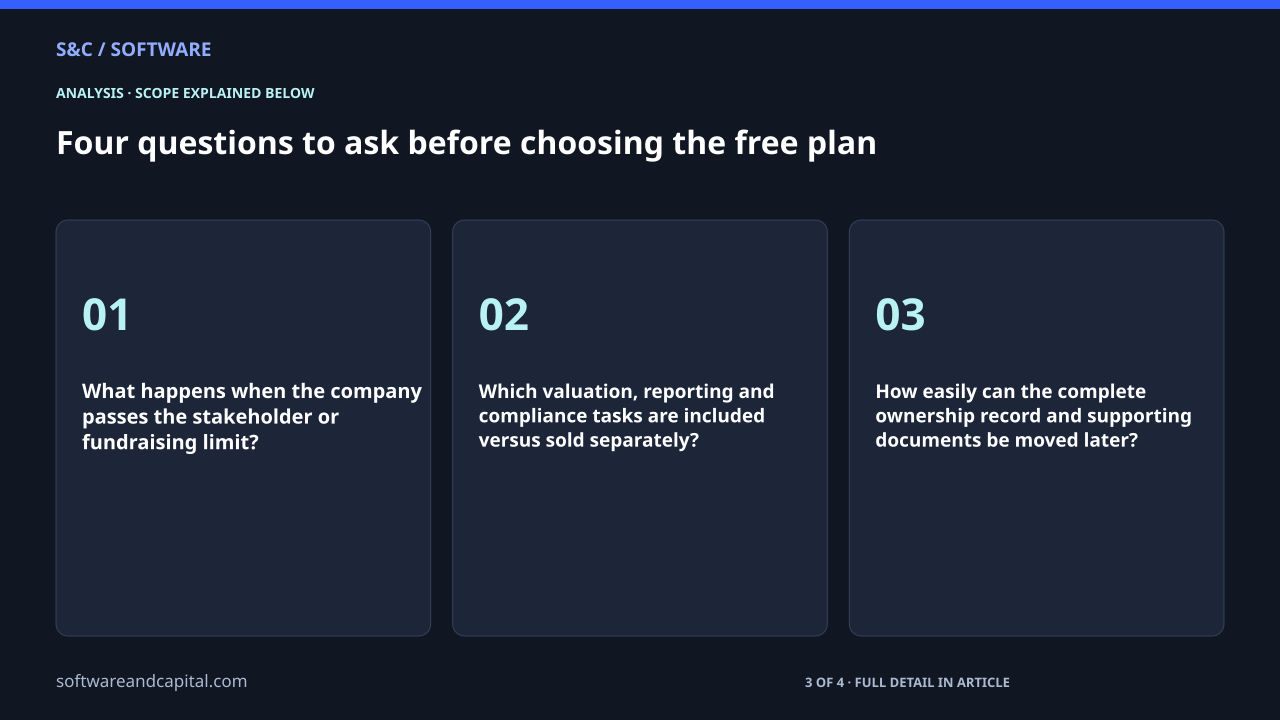
Four questions to ask before choosing the free plan
- What happens when the company passes the stakeholder or fundraising limit?
- Which valuation, reporting and compliance tasks are included versus sold separately?
- How easily can the complete ownership record and supporting documents be moved later?
- Which integrations and professional-service workflows will matter after the next financing?
The Pulley shutdown makes the portability question concrete. The free plan may be the easiest moment to choose a system, but it is also the moment when future switching costs are smallest. As financing history accumulates, the cap table becomes less like a lightweight app and more like company infrastructure.
That is the more interesting business model behind free cap-table software. The vendors are not only competing to store a simple ownership list. They are trying to become the system that remains in place when the ownership list turns into valuation work, financial reporting, fundraising operations and governance.
Sources and methodology
Sources checked September 27, 2026. Dates and periods for individual figures are stated beside them.
- Carta: equity-management plans and pricing ↗Accessed 2026-09-27
- Fidelity Private Shares: equity-management pricing ↗Accessed 2026-09-27
- Qapita: equity-management pricing ↗Accessed 2026-09-27
Scope and assumptions
The comparison reflects public U.S.-oriented pricing pages checked on September 27, 2026 and can change as vendors revise packaging.
Eligibility wording differs slightly across vendors, so the shared 25-stakeholder and roughly $1 million boundary is described as a pattern rather than an identical contract term.
Public pricing pages do not reveal conversion, retention, acquisition cost or margins, so the article does not claim to prove a vendor’s internal growth model.
Continue reading
1,000 Jobs, 3,000 Tasks: Why Software Bills Surprise You →
Pulley Raised $50M Across Its Series A and B. Now It’s Shutting Down →
Five $100K SAFEs at a $5M Cap Sell 10% of a Startup—Not 2% →