Cap-table software is easy to treat like bookkeeping until the software company itself is going away. Pulley says it will stop operating on December 8, 2026 and has entered an exclusive partnership with Carta to help eligible customers migrate. Prospective Pulley customers are being directed to Carta too.1
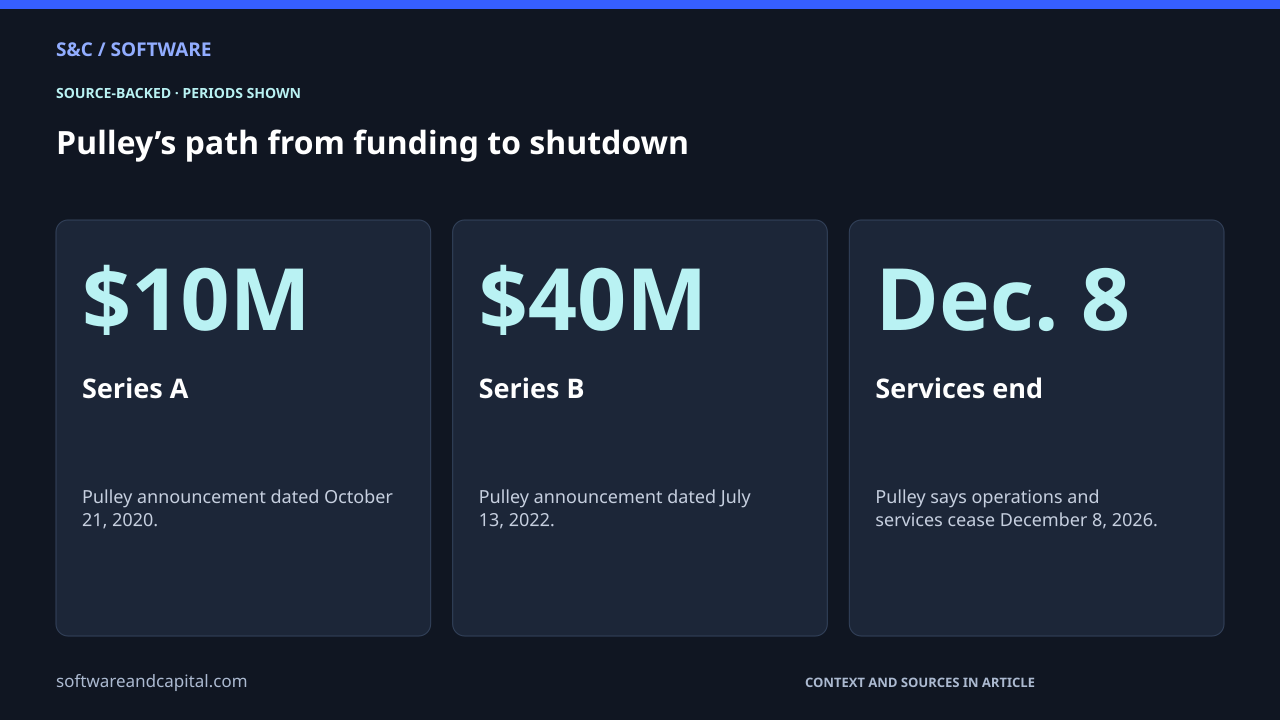
Pulley says it will cease operations on December 8, 2026 and has an exclusive partnership with Carta for customer migration. Pulley announced $10 million in Series A funding in 2020 and $40 million in Series B funding in 2022. The shutdown makes continuity and migration part of the cap-table buying decision.1, 2, 3
Pulley’s path from funding to shutdown
A six-year arc in four dates
- October 21, 2020
Pulley announces a $10M Series A
The company said Stripe led the round, with Caffeinated Capital, General Catalyst, 8VC and other investors participating.2
- July 13, 2022
Pulley announces a $40M Series B
Founders Fund led the round, with existing investors including Stripe and Elad Gil participating.3
- September 15, 2026
Pulley announces its shutdown
Carta’s September 2026 comparison guide records Pulley’s shutdown announcement and its assisted-migration arrangement with Carta.4
- December 8, 2026
Pulley says services will cease
Pulley’s current notice gives December 8 as the final day for operations and services.1
This is not an ordinary software switch
A cap table records who owns a company and how securities such as shares, options and SAFEs fit together. Moving that record means more than exporting a contact list. Carta’s migration guidance says a switch can require the current cap table, core equity and financing documents, stakeholder contact information and a legal review after the data is imported.5
| Record | Why it matters |
|---|---|
| Current cap table | The starting ownership record has to be reconstructed on the new system. |
| Equity and financing documents | The legal records support the securities and financing history represented in the cap table. |
| Stakeholder contacts | Employees, investors and other holders need to be connected to the migrated records. |
| Legal review | Carta recommends coordinating with counsel to spot-check imported data after migration. |
The customer handoff matters as much as the shutdown
Pulley is not simply telling customers to download their files and find another vendor. Its notice says eligible customers may receive a limited-time offer and assisted migration to Carta. It also sends prospective customers directly to Carta. That makes the shutdown a distribution event for the incumbent as well as an exit for the challenger.1
That does not prove the category has only one viable winner. It does show why continuity can become part of the product. The more deeply an ownership system is connected to financing records, option grants, valuations and legal workflows, the more disruptive another migration can become.1, 4
$50 million of funding explains the scale of the attempt
Pulley publicly announced a $10 million Series A in 2020 and a $40 million Series B in 2022. Those two rounds alone total $50 million. The number shows that Pulley was not a tiny experiment. It does not explain why the company is shutting down, and Pulley’s public shutdown notice does not give a reason.2, 3, 1
What the shutdown actually tells a software buyer1, 4
- Vendor continuity belongs in the buying decision when the software holds a company’s ownership record.
- A migration plan matters before a shutdown forces the question.
- A free or inexpensive starting product can become much more consequential as financing and compliance history accumulate.
S&C’s SaaS portability guide makes the general version of this point: an export is useful only if it can become a working replacement. Cap tables raise the stakes because the data represents ownership. The next question is why several equity platforms make that system free at the beginning, then charge as the company becomes more complicated.
Pulley’s shutdown is therefore more than a startup postmortem. It is a reminder that software can become infrastructure long before a company feels like an enterprise customer. Once a system records who owns what, the durability of the vendor and the portability of the record become part of the product.
Sources and methodology
Sources checked September 27, 2026. Dates and periods for individual figures are stated beside them.
- Pulley: shutdown and Carta migration notice ↗Accessed 2026-09-27
- Pulley: $10 million Series A announcement ↗Accessed 2026-09-27
- Pulley: $40 million Series B announcement ↗Accessed 2026-09-27
- Carta: 2026 cap-table software guide and Pulley shutdown update ↗Accessed 2026-09-27
- Carta: How to switch cap table providers ↗Accessed 2026-09-27
Scope and assumptions
Pulley’s public shutdown notice does not state why the company is closing, so the article does not assign a cause.
The $50 million figure is the sum of Pulley’s disclosed Series A and Series B announcements, not a claim about lifetime capital raised or money remaining at shutdown.
Carta is both Pulley’s migration partner and a competitor, so its migration guidance is useful operational evidence but not neutral market-share research.
Continue reading
Your SaaS Export Is Not an Escape Plan →
AI Took Over 60% of Carta’s Q1 Funding. What About Everyone Else? →
Why Cap-Table Software Is Free Until Your Startup Gets Complicated →