Stablecoins are usually discussed as a crypto-market product. Deel is testing a more ordinary role: getting workers paid. Its wallet lets eligible contractors keep earnings in a dollar-denominated digital balance inside the same platform that already handles employer payments, payroll workflows and compliance.1, 2
Deel’s stablecoin wallet has expanded to more than 80 countries. Stripe powers the underlying issuance, wallet and settlement infrastructure, while Deel still handles employer collection, payroll and compliance. The stablecoin changes how eligible contractors can hold and move earnings, not the legal payroll system around those payments.1, 2
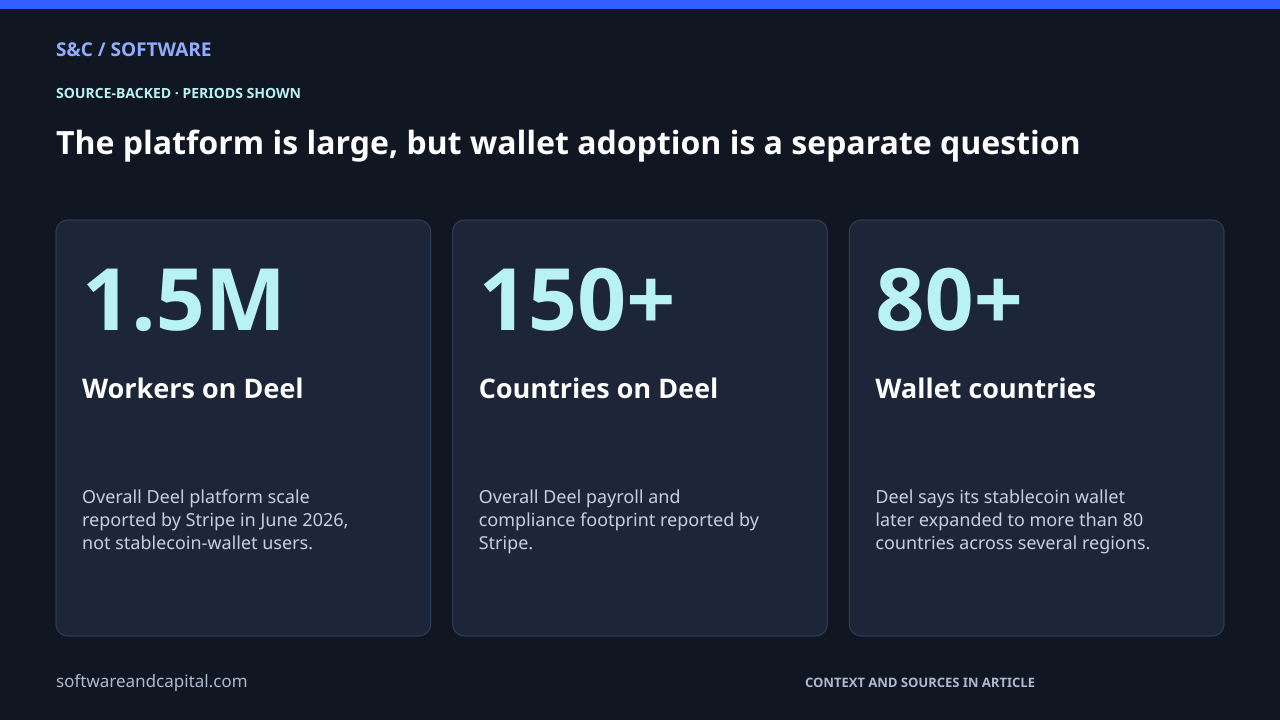
The platform is large, but wallet adoption is a separate question
That distinction matters. The 1.5 million workers and 150-plus countries describe Deel’s full platform, not the number of people using the stablecoin wallet. The wallet’s current reach is smaller, though Deel says it has moved well beyond its original Argentina launch.1, 2
The stablecoin sits inside the payroll stack
| Layer | What happens | Who handles it |
|---|---|---|
| Employer payment | A business funds payroll or contractor invoices. | Deel and Stripe payment infrastructure. |
| Payroll and compliance | Worker classification, contracts and payroll rules still apply. | Deel’s existing payroll and compliance system. |
| Dollar-backed balance | Eligible contractor earnings can be converted into DLUSD. | Bridge, a Stripe company, issues the dollar-denominated balance. |
| Wallet and settlement | The balance is held in an embedded wallet and moved on blockchain rails. | Privy wallet infrastructure and Tempo settlement. |
| Spending or withdrawal | Eligible contractors can hold, spend or withdraw supported balances. | Deel product controls and supported payout rails. |
The useful point is that payroll and stablecoin settlement are not the same thing. Employers still need a system that knows who is being paid, under which contract, in which jurisdiction and under which rules. The stablecoin layer changes what can happen after money reaches the worker’s balance.1
Why a dollar-backed balance can matter cross-border
Stripe says the product was designed partly for contractors who prefer to hold value in U.S. dollars rather than convert immediately into local currency. Deel’s current documentation also shows the wallet alongside external USDC and USDT withdrawal options. That makes stablecoins less about speculative trading and more about payment choice and settlement.1, 2
The appeal will vary by country. Exchange-rate volatility, local banking access, tax treatment, wallet regulation and contractor preferences are not universal. A dollar-linked balance can be useful in one market and unnecessary in another.1
This does not make payroll decentralized
The experience is still built around centralized providers. Deel operates the worker relationship, Stripe supplies payment infrastructure, Bridge issues the balance and Privy supplies the embedded wallet. The blockchain component can make settlement programmable and portable without removing the companies that manage identity, compliance and user access.1, 2
That makes this a useful companion to our Coinbase revenue analysis. Coinbase shows how stablecoins are becoming a meaningful business line inside crypto infrastructure. Deel shows what one non-trading use case can look like when those rails move into everyday work payments.
What would show stablecoin payroll is becoming infrastructure
- The number of workers actively choosing the wallet rather than only having access to it.
- Repeat usage across several pay cycles and regions.
- Lower settlement cost or faster access compared with conventional payout methods.
- Broader employer adoption without weakening payroll, tax or compliance controls.
Stablecoins do not need to replace payroll software to matter. They only need to become a useful settlement option inside it. Deel’s expansion to more than 80 countries suggests that experiment is moving beyond a single-market launch. The next evidence to watch is adoption, not platform reach.
Sources and methodology
Sources checked September 23, 2026. Dates and periods for individual figures are stated beside them.
- Stripe: Deel chooses Stripe to create a stablecoin wallet ↗Accessed 2026-09-23
- Deel: Stablecoin payments for contractors in Mexico ↗Accessed 2026-09-23
Scope and assumptions
Deel’s 1.5 million workers and 150-plus countries describe the overall platform, not active stablecoin-wallet users.
The 80-plus-country wallet footprint is company-reported and does not reveal usage, balances or transaction volume.
The usefulness of dollar-backed balances varies by local currency, regulation, tax treatment and worker preference.
Continue reading
88% of Coinbase Net Revenue Now Comes From Outside Bitcoin Spot Trading →