Private equity is designed to lock money up for years. CVC has just raised $10 billion for a business built around the opposite need: investors and fund managers that want liquidity before the original fund naturally winds down. The buyer is not purchasing a public stock. It is buying interests in private funds or assets that already exist.1, 3
CVC closed a $10 billion secondaries fund that buys existing private-equity interests rather than only committing to new funds. In an LP-led deal, an investor sells a fund stake. In a GP-led deal, assets can move into a continuation vehicle. The market gives investors and fund managers another route to liquidity inside an otherwise illiquid asset class.1, 2
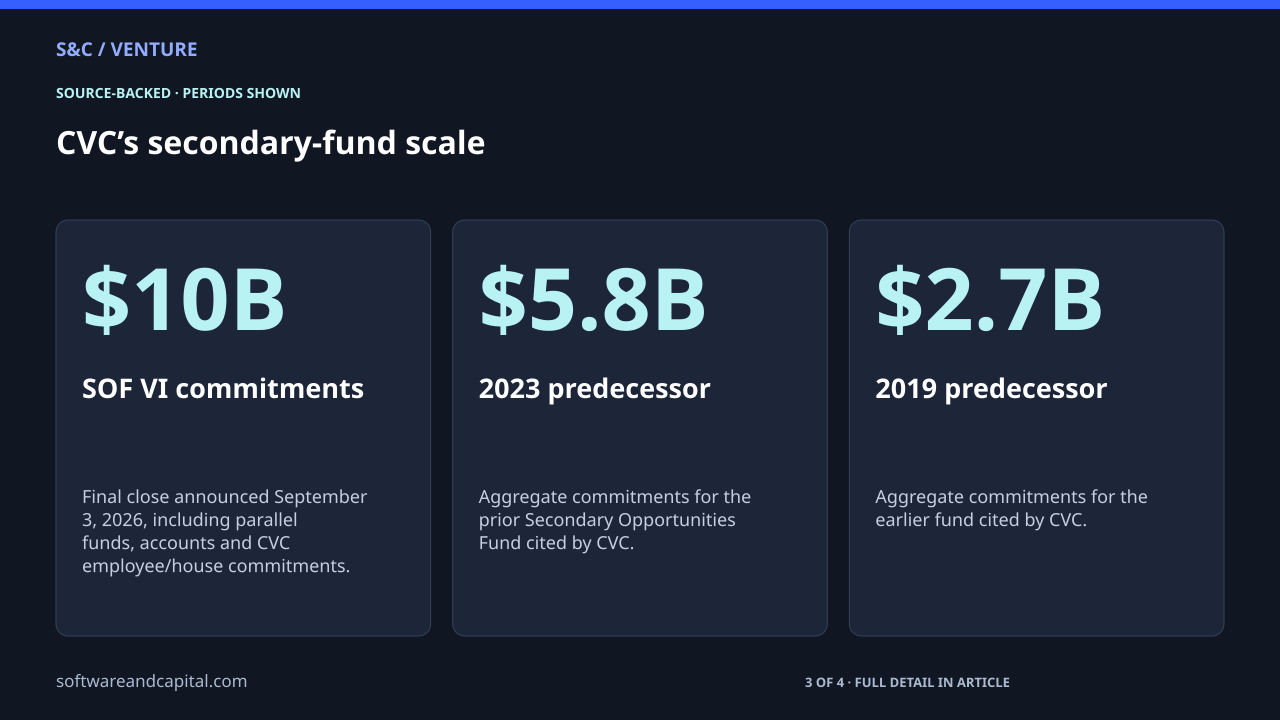
CVC’s secondary-fund scale
An LP-led secondary is an investor selling a fund stake
A limited partner, or LP, may own an interest in a private-equity fund but want cash before the fund finishes selling its companies. In an LP-led secondary, a buyer acquires that existing fund interest. CVC says sellers may use the market to manage liquidity, rebalance portfolios or change exposure.3
A GP-led secondary starts with the fund manager
General partners, or GPs, can also create a transaction around assets they already manage. CVC describes GP-led deals as transactions in which a buyer acquires assets through structures such as continuation vehicles, allowing selected companies more time outside the original fund's timetable.3
| Transaction | Who initiates it | What changes hands | Why it happens |
|---|---|---|---|
| LP-led | An existing fund investor | A fund interest or portfolio of fund interests | The investor wants liquidity, rebalancing or a change in exposure. |
| GP-led | The fund manager | One or more existing portfolio assets, often into a continuation structure | The manager wants more time or a new ownership structure for selected assets. |
The $10 billion is committed capital, not a portfolio already bought
CVC's $10 billion figure is aggregate capital commitments to SOF VI. It is not $10 billion of assets already purchased, and it is not a return figure. The fund still has to deploy that capital into transactions over its investment period.1
That distinction matters because fund headlines can make private-market money sound more liquid than it is. Investors commit capital first. The manager calls and deploys that capital as suitable transactions emerge. The eventual investment outcome depends on prices paid, portfolio performance, fees and timing.1, 2
Secondaries make an illiquid market less absolute
CVC says its secondaries platform has screened about $1 trillion of transactions and acquired more than 1,800 fund interests across more than 200 transactions. Those company-reported figures are useful because they show a market that has become institutional rather than occasional, even though the underlying assets remain private.2
Three things a secondaries headline should keep separate
- Fund commitments: capital investors have promised to the secondary fund.
- Deployment: capital the fund has actually invested into secondary transactions.
- Liquidity proceeds: cash a selling LP, GP or other holder receives from a specific transaction.
S&C's Stripe tender-offer explainer covers liquidity in one private company. Secondaries solve a different problem: liquidity inside the funds that own private companies. The common thread is that private ownership does not mean there is only one moment when a holder can sell.
The $10 billion fund is interesting because it shows how large that middle market has become. Private equity may still be illiquid compared with public stocks, but there is now a substantial business built around creating exits before the original fund reaches its natural end.
Sources and methodology
Sources checked September 28, 2026. Dates and periods for individual figures are stated beside them.
- CVC: Secondary Opportunities Fund VI closes at $10 billion ↗Accessed 2026-09-28
- CVC: Secondaries strategy ↗Accessed 2026-09-28
- CVC: How private-equity secondaries work ↗Accessed 2026-09-28
Scope and assumptions
CVC is both the fund manager and the source for the fundraise and market-description claims, so manager views on attractiveness or expected returns are not treated as independent evidence.
The $10B figure is committed capital, not capital already deployed or investment performance.
Transaction pricing, leverage, fees and outcomes vary across secondaries and are not inferred from the fund size.
Continue reading
$159B Valuation: Stripe’s Payday Without an IPO →
Priority Commerce Is Going Private in a $1.6B CEO-Led Deal. How Does a Management Buyout Work? →