The robotics boom is usually shown through a finished machine walking, carrying boxes or folding laundry. D-Robotics is making a different bet. It wants to supply the compute chips, developer kits and software that many robot makers use underneath their own products, which makes its $400 million Series C a picks-and-shovels story rather than a bet on one humanoid.1, 3
D-Robotics raised $400 million to expand the chips and software that robot makers build on. The company says cumulative Sunrise chip shipments have passed 8 million units and its S600 chip reached more than 20 embodied-AI customers within six months. Those figures are company-reported, but they show a robotics strategy aimed at infrastructure rather than one finished robot.1, 3
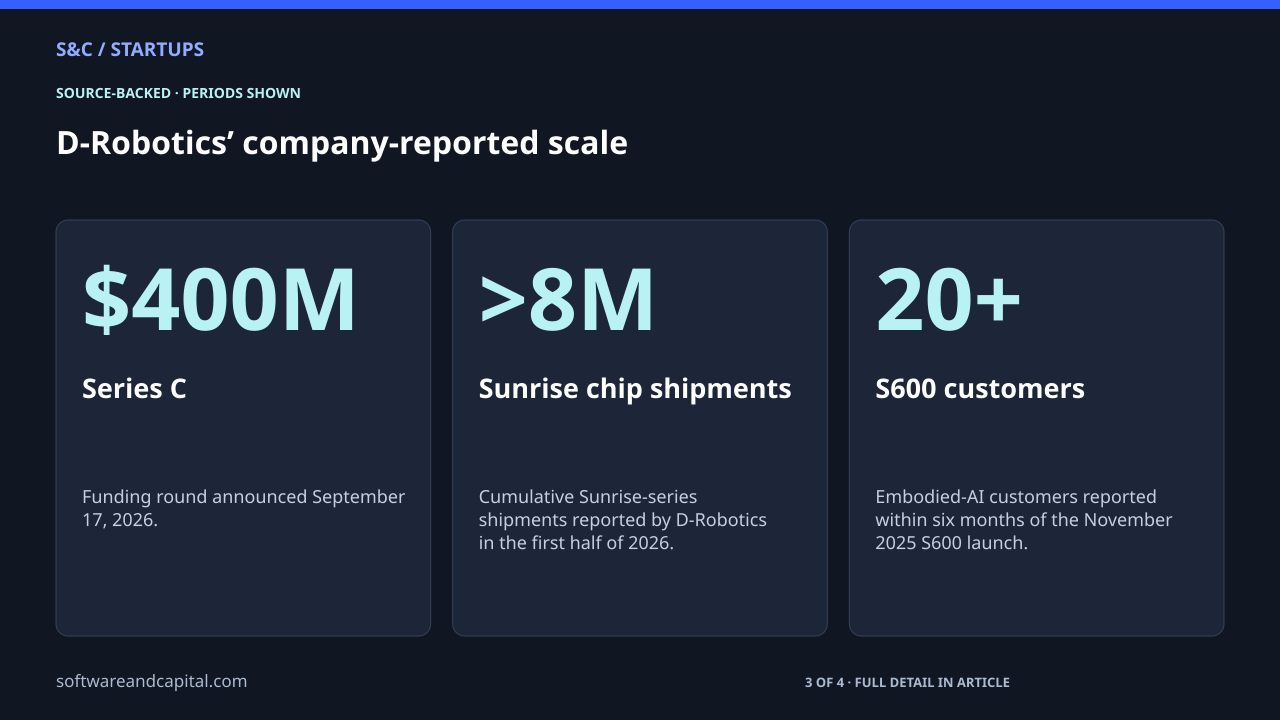
D-Robotics’ company-reported scale
The product sits below the robot brand
D-Robotics describes its platform as infrastructure spanning intelligent computing chips, RDK developer kits, operating systems and application software. That means a robot maker can build on a shared compute and development layer instead of designing every part of the stack from scratch.1, 3
| Layer | D-Robotics role | Example downstream use |
|---|---|---|
| Compute | Sunrise chips provide on-device AI processing. | Humanoid, quadruped, companion and logistics robots. |
| Developer hardware | RDK kits give teams a ready development platform. | Prototype and product development. |
| Software | Operating-system and application layers connect hardware to robot behavior. | Perception, control and application development. |
| Ecosystem support | Programs connect teams with supply-chain, go-to-market and fundraising support. | Startups and robot product teams moving toward production. |
Infrastructure can spread across several robot categories
A finished robot company has to win in a particular product category. An infrastructure supplier can participate across many categories if its hardware and software become common building blocks. D-Robotics says its platform is used in humanoids, quadrupeds, home-service robots, companion devices and autonomous mobile robots.3
That diversification does not guarantee a better business. It changes the dependency. Instead of needing one robot design to dominate, D-Robotics needs robot makers to keep choosing its chips and software as their products move from prototype to volume production.1
The 8 million shipment number needs context
D-Robotics says cumulative Sunrise-series shipments exceeded 8 million units in the first half of 2026. That figure does not mean 8 million humanoid robots. The Sunrise family spans multiple computing tiers and use cases. The number is evidence of shipped compute products, not a direct count of one robot category or a disclosed revenue total.1, 3
The financing is aimed at broadening the stack
The company says the Series C will expand the Sunrise chip portfolio across computing levels and develop a software platform spanning the robot-development chain. In other words, the new capital is being used to widen the infrastructure layer rather than fund one flagship robot.1
What to watch as robotics infrastructure scales
- Whether customers move from development kits into repeat production volumes.
- Whether one software layer can serve meaningfully different robot forms.
- How much of the business is recurring software versus hardware shipments.
- Whether chip adoption translates into durable revenue and margins.
S&C has looked at robot intelligence through Skild AI's business model and robot motion through Qualcomm's PickNik acquisition. D-Robotics is another layer: the compute and developer infrastructure many robot products may share.
That makes the $400 million round interesting even without a famous consumer robot attached. If robotics becomes a large product category, some of the most durable businesses may sit one layer down, selling the components and software that many manufacturers need before the machine ever reaches a customer.
Sources and methodology
Sources checked September 28, 2026. Dates and periods for individual figures are stated beside them.
- D-Robotics: $400 million Series C announcement ↗Accessed 2026-09-28
- PR Newswire: D-Robotics Series C release ↗Accessed 2026-09-28
- PR Newswire: D-Robotics infrastructure portfolio at IFA 2026 ↗Accessed 2026-09-28
Scope and assumptions
The 8M chip shipments, 20+ S600 customers and developer-ecosystem figures are company-reported and are not independently audited in the cited sources.
The financing announcement does not disclose valuation, audited revenue or unit economics.
PR Newswire reproduces D-Robotics-originated information and is used for product context rather than independent validation.
Continue reading
Skild Says It Reached $100M ARR 10 Months After Its First Robot Deployment →
Show a Robot One Video. Skild Says It Can Learn the Task Without Retraining →
Qualcomm Is Buying the Open-Source Software That Helps Robots Move →