Warehouses can already buy robots that move carts, lift pallets or handle pieces. The harder problem appears when those machines come from different vendors and have to share work with people. Destro AI has raised $8 million to build the coordination layer above that mixed floor.1, 2
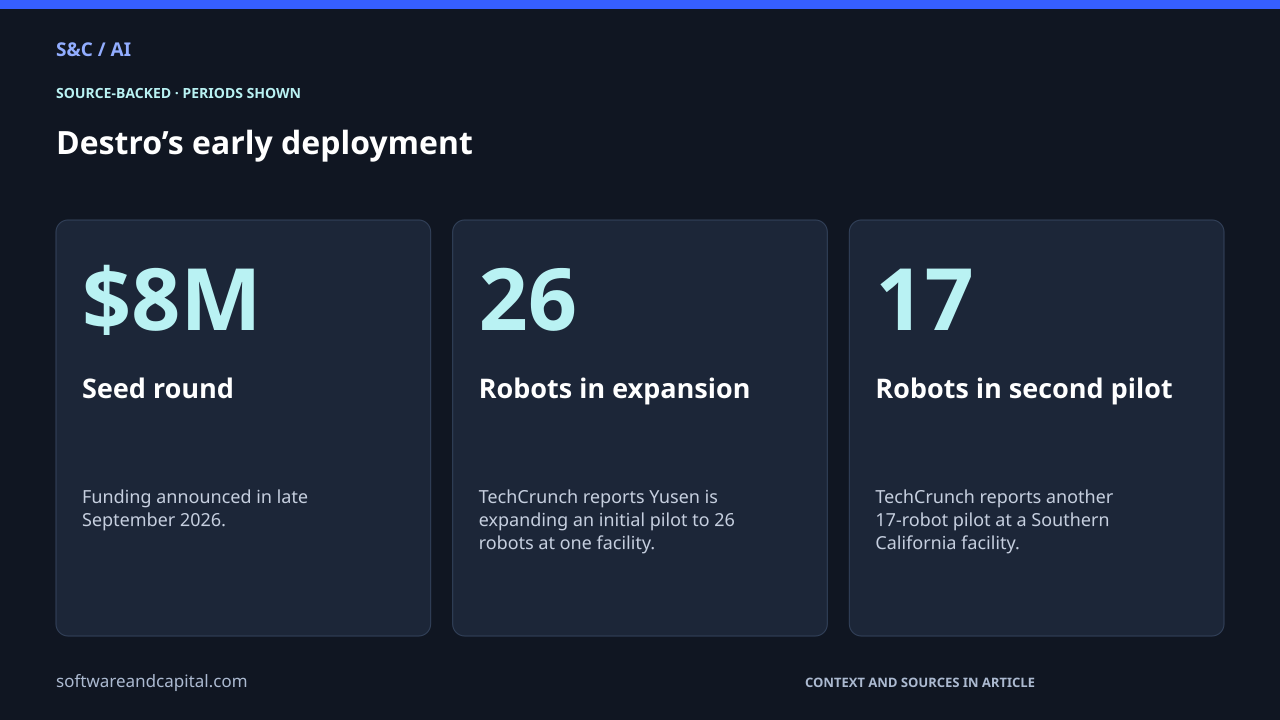
Destro AI raised an $8 million seed round for software that coordinates warehouse workflows across robots, human workers and enterprise systems. Its MothershipOS assigns tasks across mixed fleets, while VisionOS runs on robots for perception and manipulation. TechCrunch reports Yusen is expanding an initial pilot. The company is early-stage, so deployment and profitability claims remain company or customer statements.1, 2
Destro’s early deployment
The orchestration layer decides who should do what
Destro describes MothershipOS as a system that ingests warehouse state and assigns tasks across robots and people. A separate VisionOS layer runs on robots for perception and manipulation. The architecture separates fleet-level decisions from the capabilities of any one machine.1, 2
| Resource | What it can do | What the orchestration layer decides |
|---|---|---|
| Cart-moving robot | Move loaded carts | Which cart, destination and timing |
| Manipulator | Pick or handle goods | When manipulation is needed |
| Human worker | Unload, inspect or handle exceptions | Which task needs human judgment |
| Warehouse system | Tracks inventory and orders | Which workflow has priority |
Hardware variety makes a neutral layer more valuable
A warehouse operator may buy different robots for different jobs. If each vendor brings its own isolated fleet manager, the operator can end up coordinating the coordinators. A robot-agnostic layer is valuable only if it can reliably arbitrate across those systems.2
The Yusen example is stronger than a generic demo
TechCrunch reports that Yusen Logistics is expanding a pilot and starting a second deployment. That provides evidence of real workflow use. It still does not establish broad product-market fit or the founder’s stated path to cash-flow positivity.2
What to watch as the category grows
- How many robot vendors can be coordinated in one production site.
- Whether orchestration reduces labor or throughput bottlenecks measurably.
- How the system handles failures and human exceptions.
- Whether robot vendors keep orchestration open or pull the control layer into their own stacks.
The warehouse-robotics market may not be won by a single universal robot. It may instead need a traffic-control layer that turns many specialized machines and human workers into one coordinated operation.
Sources and methodology
Sources checked October 1, 2026. Dates and periods for individual figures are stated beside them.
- Destro AI $8M seed announcement via Business Wire syndication ↗Accessed 2026-10-01
- TechCrunch: Destro AI warehouse orchestration ↗Accessed 2026-10-01
Scope and assumptions
Destro is early-stage and the disclosed deployment base is still small.
Profitability targets and performance claims are company or customer statements rather than audited outcomes.
Continue reading
Amazon Has 1 Million Robots. What Happens to the Warehouse Job? →
D-Robotics Raised $400M to Sell the Picks and Shovels for Robots →
Show a Robot One Video. Skild Says It Can Learn the Task Without Retraining →