Most acquisition headlines end with the target disappearing into the buyer. Domo’s transaction did something stranger. Progress bought substantially all of the operating business, while the listed corporation survived, changed its name to Huckleberry.ai and kept cash plus tax attributes that were excluded from the asset sale.
Progress paid $400 million for substantially all of Domo’s operating assets and employees. The listed company survived as Huckleberry.ai, which says it starts with about $221 million in cash, no debt and more than $900 million of net operating loss carryforwards. The asset price, remaining cash and tax losses are different things and should not be added together as a valuation.1, 2
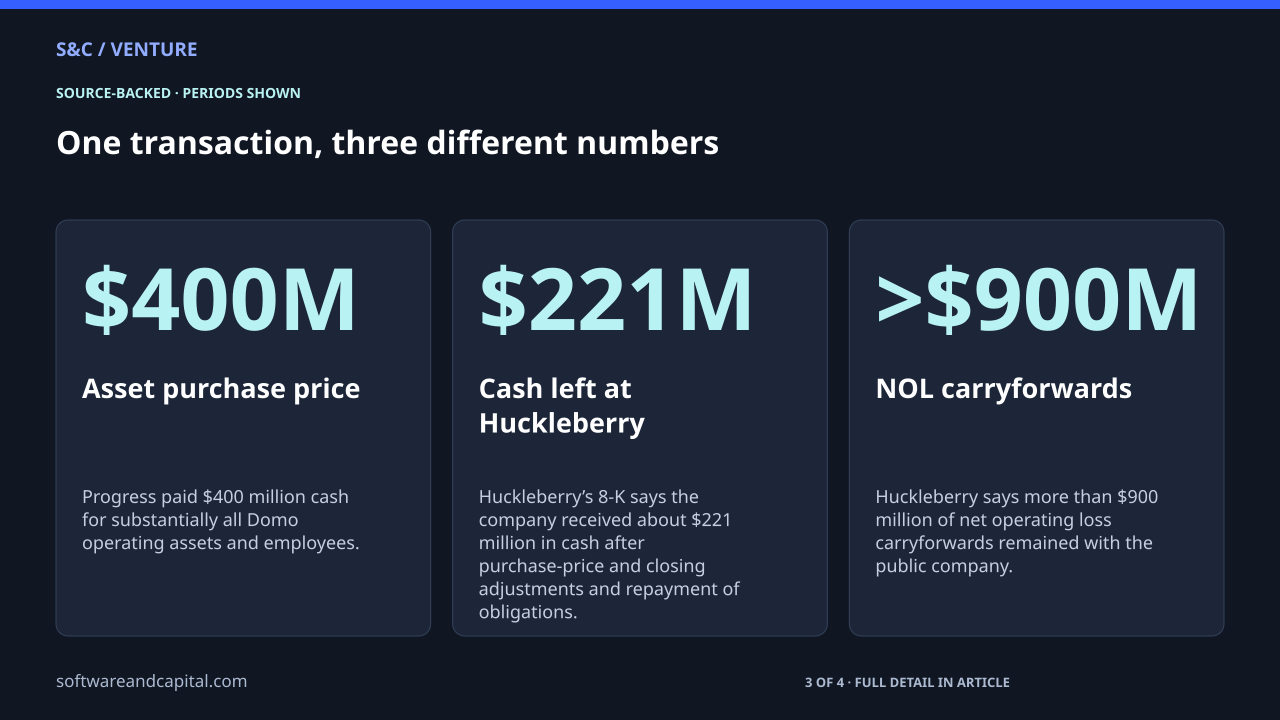
One transaction, three different numbers
Progress paid $400 million cash for substantially all Domo operating assets and employees.
Huckleberry’s 8-K says the company received about $221 million in cash after purchase-price and closing adjustments and repayment of obligations.
Huckleberry says more than $900 million of net operating loss carryforwards remained with the public company.
Huckleberry’s closing announcement describes the approximately $221 million cash balance as about $4.46 per share.
Progress bought the operating business, not the corporate shell
The filing says Progress acquired substantially all assets and employees used to run Domo’s software business and assumed certain liabilities. Huckleberry retained the listed corporate entity and its net operating loss carryforwards. That is an asset sale, not the same structure as buying every share of Domo.1, 2
| Item | Progress | Huckleberry |
|---|---|---|
| AI and data platform | Acquired | No longer the operating platform |
| Substantially all employees | Moved with the transaction | Small public-company structure remains |
| Purchase consideration | Paid $400M cash | Received proceeds subject to adjustments |
| Cash after closing adjustments | Not the headline asset price | About $221M |
| NOL carryforwards | Excluded | More than $900M retained |
$400 million and $221 million answer different questions
The $400 million is what Progress paid for the acquired assets. Huckleberry’s approximately $221 million is what remained in cash after adjustments, debt repayment, warrant repurchases and other closing items described by the company. Treating the two as directly additive would double-count parts of the same transaction economics.1, 2
Tax losses are an asset with conditions, not cash
A net operating loss carryforward can potentially reduce taxable income in future periods if the company generates qualifying profits and can use the losses under tax rules. It is not a bank balance, and the full headline amount should not be treated as a guaranteed tax saving or immediate company value.
The listed entity is now looking for its next business
Huckleberry says it is evaluating new opportunities after the Domo operating business moved to Progress. That creates a public company with cash, tax attributes and management, but without the software operation that previously defined it. What it becomes next is a separate question from what Progress bought.2
Three numbers not to combine casually
- The $400 million asset purchase price paid by Progress.
- The approximately $221 million cash balance left at Huckleberry after closing adjustments and obligations.
- The more than $900 million of NOL carryforwards, which are tax attributes rather than cash.
The Figma IPO cash-split guide makes a similar reading point: a transaction headline can contain several pools of money with different destinations. Domo/Huckleberry is the asset-sale version of that lesson.
Sources and methodology
Sources checked September 26, 2026. Dates and periods for individual figures are stated beside them.
- Progress Software: Form 8-K on completed Domo asset purchase ↗Accessed 2026-09-26
- Huckleberry.ai: Form 8-K on completed Domo asset sale ↗Accessed 2026-09-26
Scope and assumptions
Net operating loss carryforwards are not cash and their future tax value depends on profitability and applicable tax rules.
The approximately $221 million cash figure is after specified closing adjustments and obligations, not simply $400 million minus one line item.
The article does not assign a valuation to Huckleberry or recommend its shares.
Continue reading
5 Numbers That Explain Where Figma’s IPO Money Went →
$159B Valuation: Stripe’s Payday Without an IPO →
Qualcomm Is Buying the Open-Source Software That Helps Robots Move →